

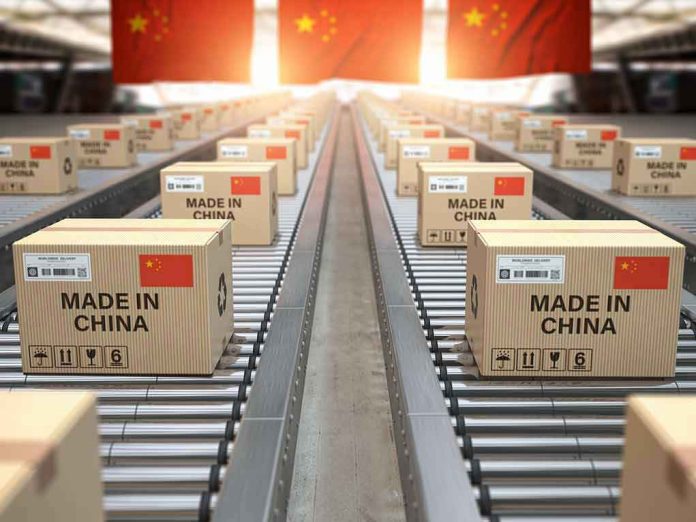
China’s solar giants did not retreat from a U.S. forced-labor crackdown—they rewired their global supply chains to dodge its tripwires while keeping the cheap inputs flowing.
Story Snapshot
- The Uyghur Forced Labor Prevention Act flips the burden of proof onto importers and targets Xinjiang-linked solar inputs. [3][5]
- China dominates key solar materials, especially polysilicon tied to forced-labor risk. [3]
- U.S. enforcement snarled billions in shipments, prompting rapid supply-chain redesigns. [3][4]
- Advocates warn that many “clean” chains still hide tainted upstream inputs and bifurcated product lines. [3][7]
How A Human-Rights Law Crashed Into China’s Solar Machine
Congress did something rare when it passed the Uyghur Forced Labor Prevention Act: it drew a bright moral line through a critical global industry. The law tells U.S. Customs officers to presume that anything made in China’s Xinjiang region, or with inputs from Xinjiang, uses forced labor and cannot legally enter the United States unless importers prove otherwise. [3][5] That flips the traditional model; companies now must show their hands instead of waiting for government to catch them.
The timing could not have been more explosive for solar. The U.S. Department of Labor reports that polysilicon, the gray, sand-derived feedstock that ultimately becomes a gleaming solar module, is a high-risk sector for forced labor, with nearly half of global polysilicon production concentrated in Xinjiang alone. [3] That same polysilicon makes up roughly ninety-five percent of the world’s solar panels. [3] When Washington put a legal bullseye on Xinjiang, it effectively put one on the heart of the global solar supply chain.
Why Xinjiang Still Haunts “Green” Energy Dreams
The moral problem in Xinjiang is not subtle. U.S. government material and independent researchers describe mass arbitrary detention of more than one million Uyghurs and other Muslim minorities, along with “job training” programs that funnel detainees into factories and mines under coercive conditions. [1][3] The Department of Labor bluntly states that there is extensive evidence of labor abuse across much of the solar supply chain, not just at one glamorous brand-name factory at the end of the line. [3]
That upstream reality means a rooftop panel sitting on an American church or school can encode a story that starts in a guarded compound thousands of miles away. Chinese companies have poured capital into Xinjiang because labor is cheap, energy is subsidized, and local authorities eagerly support industrial growth. [1][3] When Western buyers talk about “low-cost clean energy,” they often mean, without saying it out loud, “built on somebody else’s unfree labor and coal-fired power.” That tension sits at the center of the current fight.
What U.S. Enforcement Actually Did On The Ground
When the law took effect, the reality at ports was immediate: containers got stuck. Trade lawyers describe how, within the first year of enforcement, Customs and Border Protection examined more than four thousand shipments, valued at over 1.3 billion dollars, under the Uyghur law. [4] Solar was a prime target. Importers suddenly faced detentions, delayed projects, and the prospect of paying liquidated damages if they could not prove their products were clean. [3][4] That kind of pain forces boardroom conversations.
Original equipment manufacturers responded the way large corporations usually do under new liability regimes: they pushed risk down the chain and demanded documentation. Bradley’s analysis notes that U.S. buyers started insisting on contract terms covering border delays and import-related costs, then turned to their suppliers with demands for traceability, affidavits, and alternative sourcing. [4] That scramble did not emerge from a moral epiphany; it emerged from the prospect of losing money and market share if shipments got seized at the dock.
How Chinese Firms “Redesigned” Their Solar Supply Chains
Policy analysts at the Center for Strategic and International Studies predicted this pattern years ago: when governments block tainted goods from a specific market, companies often reroute them to other destinations instead of shutting down abusive production. [1] Their assessment of the solar sector warns that import restrictions and corporate responses could shift Xinjiang components into Chinese domestic use or unconstrained foreign markets, while “clean” product lines get built for higher-scrutiny countries like the United States. [1]
Human-rights researcher Laura Murphy describes exactly that emerging model: some firms bifurcate their supply chains into supposedly clean and tainted channels, with U.S.-bound modules documented as Xinjiang-free while other customers quietly receive cheaper product rooted in the same system of coercive labor transfers. [7] The Department of Labor’s finding of widespread abuse across the chain supports her concern that many companies only trace from the polysilicon stage forward, ignoring earlier steps like metallurgical-grade silicon that may still be deeply tied to Xinjiang. [3][7]
Compliance, Evasion, And The Conservative Common-Sense Test
Chinese industry representatives insist that these restructurings reflect lawful compliance, not evasion. On paper, that is plausible: if a company truly replaces Xinjiang inputs with materials from non-coercive regions, there is nothing wrong with that adaptation. The sticking point is proof. The current public record rarely includes facility-level audits, laboratory testing of material origin, or transparent supplier maps that an ordinary citizen could scrutinize. [3][4] Instead, the world sees pledges, certificates, and carefully lawyered statements.
China controls 80% of solar manufacturing. The EU response? Subsidize European solar firms that can't compete on cost. The libertarian response: if a hostile power controls a strategic industry, you don't subsidize failure — you deregulate success and let markets build…
— Alex Günsberg (@alex_gunsberg) May 15, 2026
Conservative common sense says: trust, but verify. A regime that built an internment-and-forced-labor system is not entitled to the benefit of the doubt. When the same Chinese producers dominate global solar manufacturing and keep enjoying cost advantages, while U.S. enforcement keeps seizing shipments and advocates keep flagging opaque upstream links, Americans are justified in suspecting that too much of this “compliance” is cosmetic. [3][4][7] Values that prize human dignity, rule of law, and fair competition demand more than paperwork.
What Comes Next For American Consumers And Policymakers
American consumers face an uncomfortable but unavoidable question: are cheap imported panels worth the moral and strategic price? The United States can choose to enforce its law strictly, even if that raises near-term project costs and slows some climate targets, while investing in domestic and allied manufacturing that does not depend on coerced labor. [3][4][5] Or Washington can look the other way, accept glossy compliance narratives, and let the market chase the lowest visible price.
A serious approach would strengthen verification tools, from forensic testing of polysilicon to deeper customs scrutiny of upstream inputs, while rewarding companies that genuinely sever links to forced labor instead of just shifting paperwork. [3][4][7] That path aligns with both conservative values and basic decency: no family flipping on their living-room lights should have to wonder if the panel on their roof was made by a prisoner who never had a choice.
Sources:
[1] Web – A Dark Spot for the Solar Energy Industry: Forced Labor in Xinjiang
[3] Web – ILAB Solar Storyboard – U.S. Department of Labor
[4] Web – The Uyghur Forced Labor Prevention Act (UFLPA): A Year into …
[5] Web – [PDF] A Never-Ending U.S.-China Solar Trade War? The Uyghur Forced …
[7] Web – Why Solar Companies Can’t Ignore the Forced Labor Enforcement …