

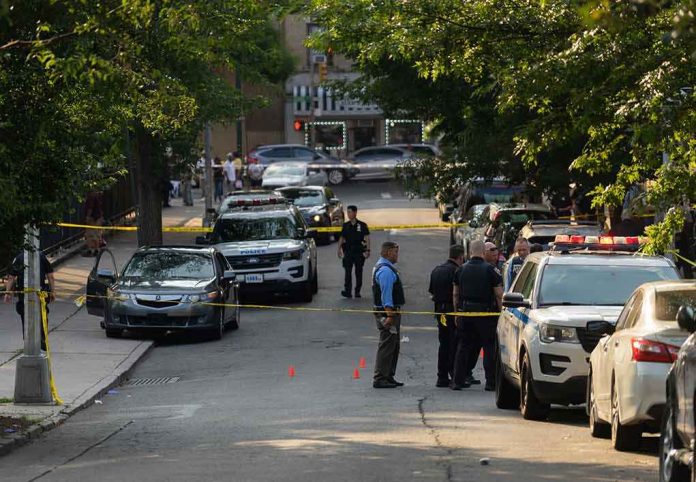
A young husband and father of four is dead and the man accused of beating him had just walked out of jail after a previous violent assault, once again exposing how soft-on-crime decisions leave innocent families to pay the ultimate price.
Story Snapshot
- A recently released Georgia inmate allegedly carried out another brutal beating only days after getting out, echoing broader failures in how violent offenders are handled.
- Police say the same man had “viciously” attacked his own elderly father over housing, yet he was back on the street instead of behind bars.[4]
- National data show many released offenders are rearrested for violent crimes, raising serious questions about release policies and public safety.
- Families of victims nationwide are increasingly demanding answers from a justice system that appears more focused on offenders’ “second chances” than on protecting law‑abiding citizens.[2][3]
Questionable Release Decisions With Deadly Consequences
Police in Georgia recently detailed how a man who had just been released from prison turned on his own elderly father in a housing dispute, “viciously” beating him in the head and face and leaving him bruised and bleeding.[4] Local reporting emphasized that the suspect was a recently released prisoner, raising the obvious question of why a man capable of such violence was back in a residential setting instead of under secure supervision.[4] For many families, that question is no longer abstract policy talk; it is a matter of life and death.
Across the country, grieving families are confronting the same pattern: dangerous offenders are released or left inadequately supervised, then go on to commit new, sometimes fatal, assaults. In Kentucky, the parents of six‑year‑old Logan Tipton recently learned that the man who broke into their home and stabbed their sleeping son to death had been allowed to walk free after serving less than half of a 20‑year sentence, because of good behavior credits and a legal finding of insanity on the murder charge.[2][3] Their devastation is compounded by the knowledge that the system chose to give their child’s killer another chance.[2][3]
Victims’ Families Left to Fight a System That Failed Them
The Tipton family’s outrage captures what many conservative Americans feel when they see violent criminals prioritized over public safety.[2][3] They watched the courts find the attacker not guilty of murder by reason of insanity, downgrade the outcome to assault, and then release him early for good behavior, all while their son is permanently gone.[2][3] In Florida, the family of Janard Geffrard is demanding answers after he was allegedly beaten to death in a jail cell by a cellmate, raising questions about how known violent inmates are housed and monitored even once they are locked up. Each case underscores a system that too often treats victimized families as an afterthought.
Other families have turned their grief into public scrutiny after deadly beatings inside government facilities. Relatives of Robert Brooks, who died after a violent beating in a New York correctional facility that was captured on video, have pushed investigations into how officers and administrators allowed the situation to escalate to a fatal level.[3] Their fight illustrates another failure point: even when violent offenders are in custody, government agencies do not always act competently or humanely, and ordinary citizens pay the price.[3] Whether the violence happens on the street or behind prison walls, it is enabled by a bureaucracy that rarely faces real accountability.
What the Data Say About Recidivism and “Second Chances”
Federal research from the Bureau of Justice Statistics shows that rearrest after release is not rare but routine. In a study of prisoners released in 30 states, more than a quarter of all released prisoners were arrested for a violent offense within five years, and the rates were even higher for certain categories. That data does not prove that any specific release decision automatically caused a later killing, but it does confirm what many conservatives already suspect: repeated leniency for violent offenders is not a cost‑free experiment, and law‑abiding families are the ones absorbing the risk.
As debates continue over “criminal justice reform,” early release, and mental health defenses, these numbers should be front and center. When courts and corrections officials choose to release someone with a proven record of serious violence, they are not making a neutral, technical decision, they are making a bet with other people’s lives. The pattern documented in Georgia, Kentucky, Florida, and New York suggests that bet is going bad far too often.[2][3][4] For conservatives who value the rule of law, family security, and a government that protects its citizens before it protects offenders, the message is clear: policies must change so that violent crime is punished firmly, and dangerous individuals stay off the streets before another young husband or child pays with their life.
Sources:
[2] YouTube – Son of man who was beaten by corrections officers at N.Y. prison …
[3] Web – Father charged with murder in alleged fatal beating of man who …
[4] YouTube – Bodycam footage shows NY officers beating prisoner before death