

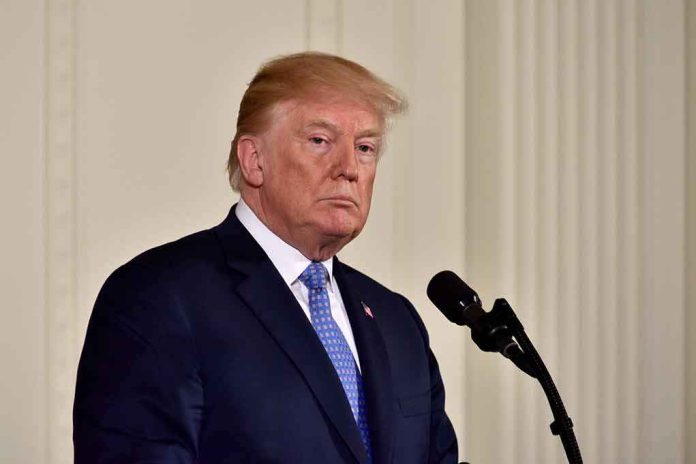
Presidents don’t choose the setting so much as they choose the moment; at Mar-a-Lago’s jungle-themed Halloween party, President Trump chose both—turning a social spectacle into an on-the-record, freewheeling press availability that blended pageantry with policy and political message.
At a Glance
- Trump used a Halloween party at Mar-a-Lago to hold an impromptu press Q&A, taking questions on Haiti, Ukraine, Iran, domestic politics, and more.
- Multiple outlets documented the scene in real time, with video clips and pool reporting anchoring what he said and how he said it.
- The exchange fits a long tradition of informal presidential “gaggles” that trade stagecraft for spontaneity and message testing.
- These settings allow a president to drive headlines while signaling to multiple audiences—supporters in the room, voters at home, and foreign leaders watching.
A Halloween party as a presidential press venue
The Mar-a-Lago ballroom was dressed for a party, not a policy rollout—costumes, music, donors, and members—but the cameras and notepads were there all the same. President Trump, in his standard navy suit and red tie, told reporters he had “come as Donald Trump,” a wink at the evening’s theme that also telegraphed a familiar approach: keep the trappings, keep the control, and keep talking. Reporters asked about politics and foreign hot spots; he answered at length, sometimes combatively, sometimes jocularly, and often with deliberate message signals. National outlets captured the moment in contemporaneous reports and video segments, confirming both the venue and the exchange with press at the October 31 event in Palm Beach.
Visuals and live hits reinforced the picture beyond quotes on a page. Cable clips showed the knot of cameras, Secret Service suits, and party guests edging into the frame while Trump fielded a rotating set of questions—precisely the hybrid of social setting and political theater that has marked many of his unscripted exchanges. Fox News carried live coverage of his attendance at the party, and CNN aired video excerpts of his back-and-forth with reporters, situating the remarks in the broader political storylines of the night.
What he addressed: policy flashpoints and domestic politics
Foreign policy dominated much of the questioning—Ukraine, Iran, Yemen’s Houthi militants—alongside 2026 campaign subplots. In clips and pooled notes from the scene, Trump toggled between criticism of adversaries and rivals, praise for allies, and claims of leverage or progress. He discussed Ukraine in the context of ending the war and intelligence sharing; on Iran, he paired warnings with broad assertions of U.S. control and consequences. He also dipped into domestic political feuds, including Michigan races and campaign strategy, using the moment to amplify contrasts that his team clearly believed would travel beyond the ballroom.
The performative edge—sharp put-downs for antagonistic questions, boasts about influence, and pointed judgments about foreign leaders—wasn’t incidental. These impromptu sessions function as both content and signal: to supporters, a demonstration of fight; to newsrooms, copy and clips; to foreign counterparts, a reminder that declarations can come at any hour, from any stage. That multiplicity is why these moments matter; they’re not just for the highlight reel.
Why this setting fits a long tradition of presidential “gaggles”
Informal on-the-record exchanges—what Washington shorthand calls “gaggles”—long predate television-era press conferences. They are opportunistic by design: quick bursts of Q&A where the president or a senior aide sets tone, tests lines, and makes news without the choreography of a formal briefing. Historically, gaggles have been shorter, looser, and sometimes off-camera, but they have always served the same purpose: feed the information bloodstream while controlling proximity and pace.
That history is useful context for a Q&A amid Halloween décor. Franklin Roosevelt’s office bull sessions evolved into Kennedy’s televised press conferences; between those poles sits a century of improvisation in how presidents talk to the press. Contemporary administrations, including Trump’s, have alternated between full-dress briefings and selective access or impromptu availabilities, often using peripheral venues—runways, rope lines, or, yes, private clubs—to put the principal in front of questions on their own terms.
How presidents leverage informal access
Informal exchanges prize velocity over varnish. They allow a president to respond to developing events, to plant a strategic narrative ahead of a formal move, or to crowd out an unhelpful storyline with a more quotable one. The trade-offs are obvious: less precision, more memorable sound bites; fewer footnotes, more spectacle. For a communications team, that can be an asset. An arresting visual—the leader flanked by costumed revelers and security—guarantees airtime and shareable video. The Halloween backdrop at Mar-a-Lago delivered that in spades, and the resulting coverage emphasized both the content of Trump’s answers and the unorthodox stage on which he gave them.
These moments also reflect a structural reality: the modern presidency communicates across multiple channels at once. A gaggle is not just for the White House press corps; it is for friendly outlets that will stream it, for adversarial ones that will interrogate it, and for a digital audience that will clip and circulate it. The Halloween Q&A checked those boxes, with mainstream and partisan media alike publishing snippets and framing the exchange through their editorial lenses, while still corroborating the basic facts of time, place, and participation.
Mechanics of message: what travels, what sticks
Three features typically determine which lines from an informal Q&A endure beyond the news cycle: specificity, conflict, and novelty. Specific numbers or named actors tend to anchor follow-on reporting; a sharp exchange with a reporter will generate headlines; and a previously unvoiced position or pledge will prompt policy parsing. The Mar-a-Lago exchange exhibited all three at moments, which is why disparate outlets clipped different segments and led with different emphases. But as with prior gaggles, the strategic constant was clear: use the accessibility of the format to steer conversation toward the White House’s preferred contrasts—on foreign crises, on political opponents, and on leadership style.
For readers, the takeaway is not that the venue trivializes the content—presidents have made consequential news in airplane aisles and driveway scrums—but that the venue telegraphs intent. A party-floor Q&A signals comfort with the ad hoc and a willingness to let unscripted moments carry a message. That choice is itself a form of communication, one previous presidents have used in different idioms and one this president continues to favor.
**Trump slips another unfiltered JBA gaggle into the feed right before midterms, camera rolling as he boards or deplanes.**
### 1. The Frame
**What people think this is about:** Routine presidential travel footage or a quick press availability at Joint Base Andrews on October…— GrumpyNews, emotionally clean news. (@GrumpyNews_) October 29, 2026
The bottom line
On October 31 in Palm Beach, President Trump turned a club ballroom into a podium, taking questions on geopolitics and campaigns amid a jungle of Halloween kitsch. The scene was distinctive; the tactic was not. Informal, on-the-record exchanges are a staple of presidential communication—useful for speed, spectacle, and message discipline. This one functioned exactly that way, and the documentation—pooled reporting, contemporaneous video, and live coverage—establishes both what happened and why it mattered beyond the costumes.
Sources:
youtube.com, cnn.com, tommyxtopher.substack.com, news4jax.com, economictimes.indiatimes.com, govfacts.org, socialsci.libretexts.org, dw.com, newyorker.com