

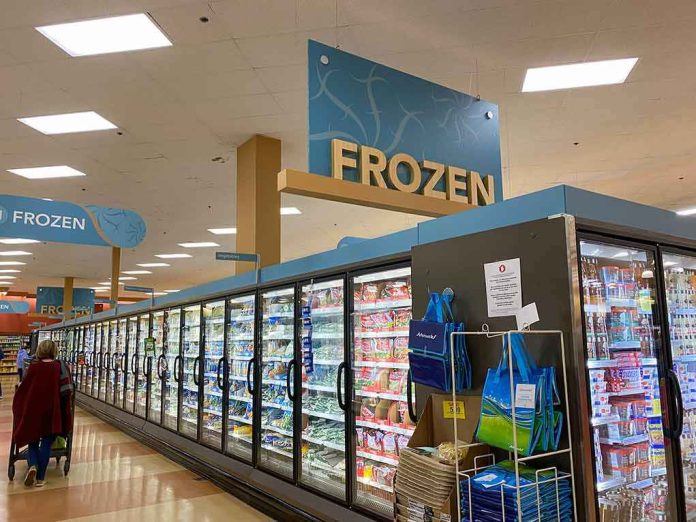
When refrigerated food warms up across multiple facilities at once, that is a system problem, not a string of coincidences — and in connected cold chains, “system” increasingly means software, networks, and the operational technology that bridges them to compressors, valves, and heat.
At a Glance
- The Pentagon has treated a cluster of overnight freezer failures at U.S. military commissaries as a suspected cyber incident, based on the pattern and timing of malfunctions.
- A closely analogous attack in France showed that networked refrigeration controllers can be remotely manipulated to trigger defrost cycles and drive temperatures to roughly 50°C/122°F, spoiling food and even causing fires.
- Known weaknesses in commercial refrigeration control gear — especially legacy firmware and exposed remote-access paths — create a credible pathway for malicious commands.
- The hallmark of these events is coordinated behavior across sites; mechanical faults rarely fail in sync before dawn, but software can.
What happened at U.S. bases, and why investigators see a pattern
Beginning in August, multiple U.S. military commissaries reported freezers that had slipped into defrost mode overnight, warming sufficiently to ruin perishables. Officials counted incidents across at least several states and described the malfunctions as clustered rather than isolated — the sort of simultaneity that pushes incident responders to consider a common cause. On that basis, the Department of Defense began treating the cluster as a suspected cyberattack and escalated coordination with relevant commands and partners who had just faced a strikingly similar problem in Europe. One brief caveat is appropriate: investigators characterized the case as suspected, not confirmed, while they worked to determine the precise cause.
The operational signature matters. Defrost cycles are legitimate control functions — necessary to keep evaporator coils from icing over — but when invoked continuously or at the wrong time, they predictably warm a box designed to be cold. A single unit cycling oddly suggests a thermostat, relay, or compressor issue. A dozen units across different bases warming in the same window points to something capable of orchestrating behavior: shared software, centralized configuration, or external manipulation.
The French case that proved the method is viable
Days before U.S. officials drew a line around their own freezer events, France documented precisely how network-facing cold-chain controls can be turned against themselves. Supermarket groups there saw connected refrigeration systems switched into prolonged defrost and heating states; temperatures in affected cases reached about 50°C (122°F), resulting in widespread food spoilage and reported fires in some locations. French authorities described compromises of Danfoss store controllers and related gear at scale, across hundreds of stores and multiple banners, with remote manipulation as the proximate cause.
These are not speculative demonstrations in a lab. They are production systems doing exactly what their control logic instructed — except the instructions were malicious. In essence, the attack path exploited the very features that make modern cold chains efficient: centralized control, remote telemetry, and software-defined setpoints. The French events established two vital facts for any investigator looking at similar symptoms elsewhere: first, that attackers can reach and operate these systems from afar; second, that the physical consequences are severe, immediate, and costly.
How connected refrigeration gets attacked
Modern supermarket and commissary refrigeration relies on supervisory controllers that aggregate sensors and actuators: case temperatures, suction pressure, expansion valves, defrost heaters, compressor staging, and alarms. These controllers often expose web interfaces, vendor remote-support channels, or links into building-automation networks. If those pathways are reachable from the internet, from a third-party vendor network, or through poorly segmented corporate IT, they become targets.
In the French incidents, reporting pointed to families of store controllers running outdated firmware and to previously discussed weaknesses in this class of equipment — not always zero-day exploits, but the predictable attack surface of legacy OT: default or weak credentials, unencrypted services, insufficient network isolation, and slow patch cycles. Once inside, an intruder does not need to “hack physics.” They toggle modes. They stretch a defrost from minutes to hours. They raise a setpoint or disable a low-temperature limit. The machine does the rest, faithfully.
Why simultaneity is the red flag
Freezers fail all the time, individually. Compressors seize. Fans ice up. A defrost timer sticks. What mechanical components do not do is coordinate their failure to the same hour across a continent. Software can. Configuration can. A malicious script dispatching the same command to multiple controllers certainly can. That is why the U.S. pattern — overnight defrost behavior seen at multiple commissaries across different services — reads as consistent with a coordinated control event, and why defense officials treated it accordingly while they traced the root cause.
This is not to romanticize sophistication. The French attack did not require exotic implants; it required reachable systems and insufficient guardrails. The hardest part was not writing code; it was finding organizations that had left critical operational interfaces one pivot away from the public internet — a recurring story in OT incidents far beyond refrigeration.
Operational impact: beyond spoiled food
Food loss is the obvious cost; it is not the only one. In France, overheating units were tied to fire risk in some stores, a reminder that defrost heaters and compressors draw real power and generate real heat when misused. In a military context, the knock-on effects include commissary supply disruptions, emergency restocking logistics, and morale costs for families who rely on base stores. Repeated events can prompt more conservative posture decisions — from on-site resilience measures to broader guidance on supply sufficiency — because a cold chain is a chain; if one link can be toggled from afar, planners assume others can too.
There is also a data dimension. These controllers often log events: mode changes, alarms, user actions. If attackers tamper with or erase those logs — or if logs never left the device for centralized storage — after-action clarity suffers. That is a solvable problem. Forward logs off-device in real time, maintain strict time synchronization, and treat controller audit trails as evidence, not mere diagnostics.
🇺🇸 The Pentagon is treating freezer failures at U.S. military base stores in August as a suspected cyberattack, Reuters reports, and investigators are in touch with France, where a similar hack hit hundreds of supermarkets this month.
Four officials told Reuters the late-August… pic.twitter.com/a0WUZzdc1Y
— 🔥🗞The Informant (@theinformant_x) October 29, 2026
Defense-in-depth for the cold chain
The remedy stack is mature, even if its adoption is uneven. Start with network isolation: supervisory controllers and case controllers should sit on segmented OT networks with deny-by-default rulesets and no direct internet exposure. Terminate remote access through hardened gateways, enforce multifactor authentication, and eliminate vendor backdoors and default credentials. Patch what can be patched; for what cannot — and there is plenty in legacy OT — wrap it with compensating controls: application-layer allow-lists for commands, strict role-based access, and monitored jump hosts.
At the device level, use configuration baselines with cryptographic integrity checks; alarm not just on temperature excursions, but on policy deviations: unexpected defrost durations, disabled setpoint limits, or out-of-hours mode changes. Finally, rehearse the physical fallback. Mechanical interlocks and thermal safety cutouts are not quaint; they are the last line of defense when software goes rogue. France’s experience showed that hours-long defrost cycles are not theoretical; design so that no single mode can push a system into an unsafe thermal envelope without an independent trip.
Why this matters going forward
Connected refrigeration is critical infrastructure in everything but name: food safety, public health, retail economics, and, for the military, readiness. The French attack demonstrated practical tradecraft and consequences at scale; the U.S. commissary incidents presented a pattern that warrants — and received — a cyber lens. Treating these as suspected cyber events is not alarmism; it is alignment with the physics and the architecture of how modern cold chains actually operate. The lesson is durable: where software centralizes control, security must centralize discipline.
Sources:
dw.com, abcnews.com, cnet.com, instagram.com