

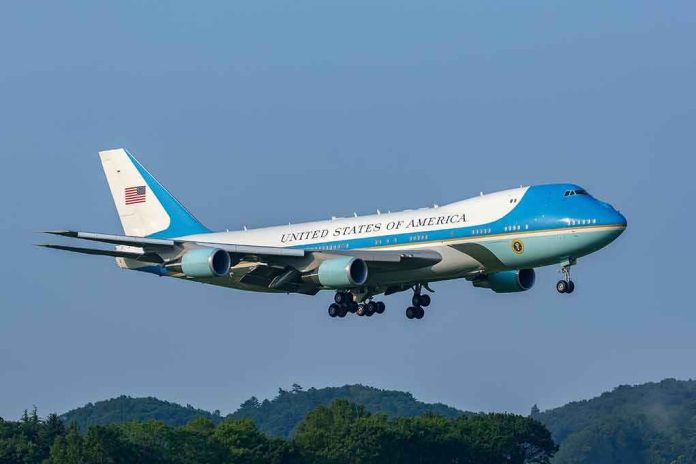
Presidential pageantry and airspace governance collided over Washington when the presidential 747 made two low passes near the White House during Halloween festivities—an operation that was coordinated and incident-free yet still startled a city conditioned to treat unexpected low-flying aircraft as potential threats.
At a Glance
- The flyover was staged as part of the White House Halloween celebration and was coordinated in advance with aviation authorities.
- Operations at Reagan National briefly paused for the maneuver; no aviation incidents were reported.
- AlertDC issued a same-day advisory, but the narrow warning window left many residents and officials surprised and uneasy.
- Calling the aircraft “Air Force One” in public-facing materials blurred a technical distinction that matters in a security-sensitive city.
What actually happened: a ceremonial pass, coordinated and brief
During the White House’s Halloween event—an annual, public-facing evening on the South Lawn with the president, first lady, and children—the presidential 747 executed two low passes visible from the Executive Mansion. The White House framed the moment as a celebratory element of the festivities; contemporaneous reporting confirms the holiday context and the timing with the trick-or-treat event itself. Air traffic authorities were not caught flat-footed. The Federal Aviation Administration said the maneuver was coordinated in advance and required a brief ground stop at Ronald Reagan Washington National Airport, a routine traffic-management step when unusual operations occur in the capital’s tightly managed airspace. The flyover ended without any reported aviation incident or emergency response.
There was at least some formal public notification. AlertDC, the District’s opt-in public alerting system, issued a 5:24 p.m. message advising of a U.S. military flyover over the National Mall. In that sense, the operation checked the coordination boxes that matter to regulators and controllers: pre-briefing, deconfliction with scheduled traffic, and a bounded time window. From an air-operations standpoint, it was a deliberate, preplanned aerial event—no more spontaneous than a stadium flyover before kickoff.
Why Washington reacted: coordination is not the same as communication
Residents experienced the passes differently. The D.C. Council said people downtown, at the Pentagon, and at Reagan National received only about 15 minutes’ notice; many were startled, including councilmembers themselves. The Washington Post likewise reported that the unexpected display alarmed some residents—an unsurprising reaction in a city whose airspace has been hyper-regulated since 2001, and where unusual engine noise, trajectory, or altitude immediately cues risk perception. The distinction is crucial. Institutional coordination between the FAA, the military, and the Secret Service can occur days or weeks in advance; effective risk communication to the public must happen early enough, and widely enough, to prevent surprise. Those are different jobs with different success metrics, and this episode shows how a plan can satisfy the first while falling short on the second.
The notification gap created downstream friction. Airport users confronted a short, unexplained pause; commuters and pedestrians heard and saw a low-flying, large aircraft without the context planners had. In the capital, where proximity to protected facilities, defense headquarters, and a permanently active special flight rules area makes low-altitude anomalies salient, a narrow warning window is practically an invitation to confusion—even when the underlying operation is fully authorized.
The “Air Force One” label: harmless shorthand or a confidence problem?
Public-facing materials and social posts called the aircraft “Air Force One,” which is common vernacular for the presidential 747s. Technically, however, “Air Force One” is a radio call sign used when the president is aboard; it is not the airplane’s name. The Air Force’s own fact sheet spells out the distinction: any Air Force aircraft carrying the president uses the “Air Force One” call sign; otherwise, the VC‑25A/B uses a standard tail number and mission identifier. During the Halloween passes, President Trump was on the South Lawn, not on the aircraft, so the flight was not operating under the Air Force One call sign, even if the airframe was one of the presidential jets.
Why that technicality matters: precision builds trust in sensitive environments. In Washington, where citizens have learned to parse sirens, rotor noise, and air corridors, a mismatch between branding and aviation fact reads as casual with the details. For aviation professionals, it is a non-issue; for the public, it is an avoidable irritant that can color perceptions of transparency and seriousness.
How these displays are usually authorized—and why that matters here
Public flyovers are not conjured by a wave from the reviewing stand. They are processed events. The National Guard’s public-affairs guidance describes a standardized request pathway—submission of a DD Form 2535, site owner certification, and FAA approval—normally 30 to 90 days ahead for non-operational flyovers. While the White House, Secret Service, and Air Force have their own channels for presidential movements and special events, the point stands: these activities are planned, staffed, risk-assessed, and slotted into air traffic flows. Washington’s airspace is among the most constrained in the world, with layered restrictions and entities—from the Secret Service to the National Capital Region Coordination Center—watching every anomaly. When an FAA spokesperson says a flyover was coordinated and a ground stop put in place, that indicates a process ran as designed on the aviation side.
Where the process is more brittle is public information. Alerting is often optimized for operational sufficiency—“controllers and pilots know; that’s enough”—rather than for public reassurance. A better practice in the capital is multi-channel, earlier notice targeted to the zones most affected: airports, the Pentagon corridor, downtown districts where the soundscape changes are sharpest. That is especially true when the aircraft is both large and low, and the altitude visually contradicts the normal mental model residents hold for the capital’s air routes.
NOW: After a day of rallying and an hour of handing out candy to families at the White House, President Trump just WALKED BACK INSIDE with First Lady Melania
He made these kids' whole year, and Air Force One even performed a flyover 🇺🇸 pic.twitter.com/BPG0N3DkTl
— sidney Powel (@SidneypowellAGA) October 30, 2026
Balancing spectacle and stewardship going forward
Civic rituals and presidential theater have their place. The Halloween passes accomplished what they were designed to do on the South Lawn: delight the kids, create images, and project capability. The operation also underscored the responsibilities that come with staging spectacle in the nation’s most scrutinized airspace. Three adjustments would reduce friction without sacrificing showmanship. First, treat public notice as part of safety, not an afterthought: publish an advisory early in the day, clarify approximate timing windows, and brief airport users and large employers in the affected corridors. Second, use precise nomenclature in public communication—call the aircraft what it is and explain what it is not. Third, publish a post-event synopsis from the FAA or the White House Military Office summarizing coordination steps and constraints; a single page of facts does more to build confidence than celebratory clips ever will.
Bottom line
The Halloween flyover was a coordinated, incident-free ceremonial operation that played as intended on the South Lawn and as a surprise on the streets. In Washington’s security-conscious airspace, that divergence is predictable, not paradoxical. The fix is not to cancel spectacle; it is to align airside discipline with landside communication. Do that consistently, and even a low, loud presidential 747 can be theater without turbulence.
Sources:
mediaite.com, eastwingmagazine.com, pbs.org, wjla.com, af.mil