

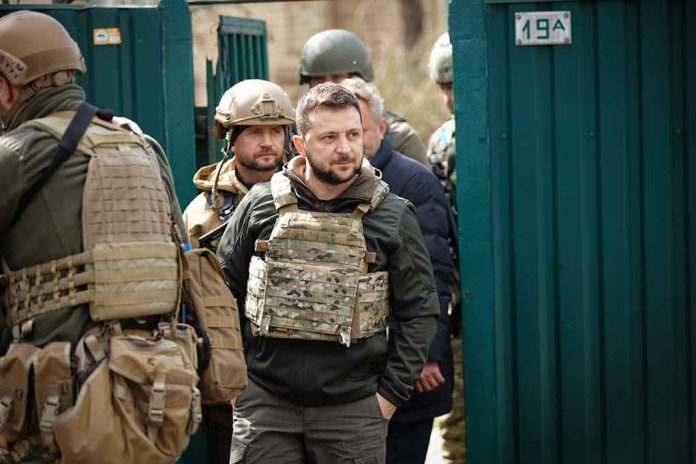
Wartime Ukraine is running the same gauntlet many states have faced: separating legitimate national-security measures against a hostile foreign influence from impermissible burdens on religious freedom. The debate is not “are Christians persecuted?” in the abstract; it is whether Kyiv’s restrictions target conduct tied to Russian state influence or sweep too broadly across a religious community.
The Short Version
- Zelensky has rejected claims that Ukraine persecutes Christians, asserting broad religious freedom and challenging U.S. commentators’ depictions.
- He distinguishes alleged Ukrainian “persecution” from documented Russian attacks on clergy and religious sites during the war.
- UN reporting and rights monitors acknowledge concerns: violence around Orthodox property disputes and a 2024–25 legal framework that can restrict groups with Moscow ties.
- Allegations publicized by Tucker Carlson and UOC-linked advocates are specific and alarming but remain largely assertion-driven absent case-by-case adjudication.
What Zelensky actually said, and why it matters
Ukraine’s president has offered a categorical, on-record denial that Kyiv is persecuting Christians. In a late-2026 interview, he described religious life as “very free,” and he challenged the authority of American commentators to depict conditions they have not witnessed firsthand. The denial serves two purposes: to rebut a politically potent American narrative, and to frame Ukraine’s measures as aimed at national security rather than belief. That framing is central because the war has made religion a vector of influence: clergy and parishes command trust, buildings offer sanctuary and signal territorial presence, and hierarchies link out to Moscow. In Zelensky’s telling, the threat is not faith; it is the use of ecclesiastical structures to advance an enemy’s campaign.
Zelensky contrasts this with Russia’s conduct: he has said Russian forces have killed roughly 120 clergy and damaged or destroyed more than 800 religious sites since the full-scale invasion; Ukrainian and international outlets have catalogued extensive damage to churches and monasteries in active combat zones. The thrust is straightforward: don’t confuse the offender and the responder. The war’s religious toll—on people and buildings—is real, and Moscow is the source of much of that harm. That claim aligns with independent wartime documentation of widespread damage to cultural and religious infrastructure.
How Ukraine’s legal approach evolved in wartime
The hard legal problem is narrower and more technical than the broad rhetoric suggests. In 2024, Ukraine advanced legislation revising the state’s authority over religious associations with links to the Russian Orthodox Church. The law’s purpose, in the government’s account, is to protect constitutional order during an existential war; its mechanism is to allow measures—up to dissolution—against religious organizations deemed affiliated with a foreign religious center tied to Russia’s influence apparatus. Kyiv stresses that the law is not aimed at a faith as such and does not create a “state church.”
Human-rights monitors, however, flagged risks embedded in that structure. UN experts warned that conditioning legal status on contested “canonical” ties could restrict worship and religious practice—core elements of freedom of thought, conscience, and religion. The concern is not theoretical: in polarized local communities, disputes over parish alignment have sparked confrontations, and rights monitors recorded both violence and inadequate law-enforcement responses to such incidents since 2022. The result is an uneasy equilibrium: a statutory tool designed for national security operating amid local conflicts where belief, identity, language, and geopolitics converge.
The Carlson-Novynskyi allegations: specific, vivid, and still evidence-light
Prominent American media voices, led by Tucker Carlson, have described a darker picture: church seizures by armed men, forced removals of priests, beatings of believers, raids on convents, and an “effective ban” on the Ukrainian Orthodox Church’s primacy. Vadym Novynskyi, a sanctioned protodeacon and former MP, amplified the theme, alleging false criminal cases against bishops and violence against parishioners. These are not abstract charges; they paint an image of systemic religious oppression. But the publicly available record consists largely of on-air claims and advocacy materials rather than court-tested files, verifiable incident lists, or adjudicated outcomes that would allow independent readers to trace allegation to evidence, case by case.
The most combustible accusation—that security services tortured priests for speaking Russian—demands the highest standard of proof. To date, it appears as a public claim by a named advocate rather than an evidentiary package with medical documentation, sworn complaints, and prosecutorial or judicial findings. In a debate this charged, specificity is not a luxury; it is the only way to separate wartime rumor, propaganda, and individual misconduct from a state policy of persecution. Until detailed files surface, these allegations remain assertions that require scrutiny but cannot be treated as established fact.
What independent monitors do and do not say
International reporting offers a third lane between official denial and televised indictment. UN human-rights monitoring in 2022–2024 documented incidents of inter-Orthodox conflict around parish control, recorded threats and physical violence, and criticized inadequate police response in some cases. It also expressed concern that Ukraine’s 2024–25 legal amendments—invoking national security as grounds for restricting religious associations—could enable dissolution of organizations on the basis of affiliation, chilling worship and practice. These assessments stop well short of declaring generalized persecution of Christians; they do, however, undermine any claim that religious freedom is wholly “unaffected” by wartime policy.
American reporting has likewise drawn a distinction between belief and conduct: officials and observers have noted Ukraine’s constitutional protections for religion and the absence of a blanket ban on Christian worship, while acknowledging scrutiny of parts of the UOC seen as vectors for Russian influence. Even political figures critical of Moscow have conveyed that Ukrainian partners described no systematic persecution of believers; that coexistence of reassurance and caveat captures the reality of a legal order narrowed by war yet not collapsed into anti-Christian policy.
The analytic hinge: belief versus affiliation, and how to prove the line holds
At the center of this dispute is an accountability problem. A government can claim it is targeting espionage, collaboration, or incitement, not religion; critics can claim the net is cast over an entire denomination under the guise of security. The only way to resolve that standoff is with granular transparency. For Kyiv, that means publishing redacted indictments, warrants, judgments, and evidentiary summaries in clergy and parish cases; clarifying how “affiliation” is determined; and demonstrating that worship continues under alternative registrations when organizations are dissolved. For monitors, it means tracking outcomes: which cases end in conviction for conduct crimes, which are dismissed, and whether police investigate violence against UOC communities with the same vigor they apply to alleged collaboration. Without that ledger, both the categorical denial and the sweeping indictment will remain more rhetorical than evidentiary.
There is also a historical lesson that should discipline policy choices. Comparative research shows that broad restrictions on religious freedom tend to increase, not pacify, social conflict over time. In wartime, a state may accept short-term friction for security; still, measures that are both necessary and judicious are easier to defend abroad and more durable at home. Narrow tailoring—articulated thresholds for affiliation, regular judicial review, and meaningful avenues for congregations to continue worship—helps preserve that balance.
How to read the competing narratives—now and later
Three propositions can be held at once. First, Russia’s war has inflicted substantial harm on religious life in Ukraine, including the killings of clergy and the destruction of religious sites. Second, Ukraine is not running an anti-Christian state project: worship remains widespread, plural traditions operate, and the law does not create a confessional enemy. Third, Ukraine’s new legal architecture—particularly where it turns “affiliation” into a justiciable security risk—poses real risks for freedom of religion or belief unless implemented with evidentiary rigor and independent review. Zelensky’s denial withstands sweeping charges of generalized Christian persecution; it does not end the argument over whether every concrete state action is narrowly justified. That argument will be settled—if it is settled at all—by case files, not by television.
Sources:
christianpost.com, barrettmedia.com, state.gov, kyivindependent.com, mediaite.com, ecoi.net, nationalreview.com, edocs.buttecounty.ca.gov