

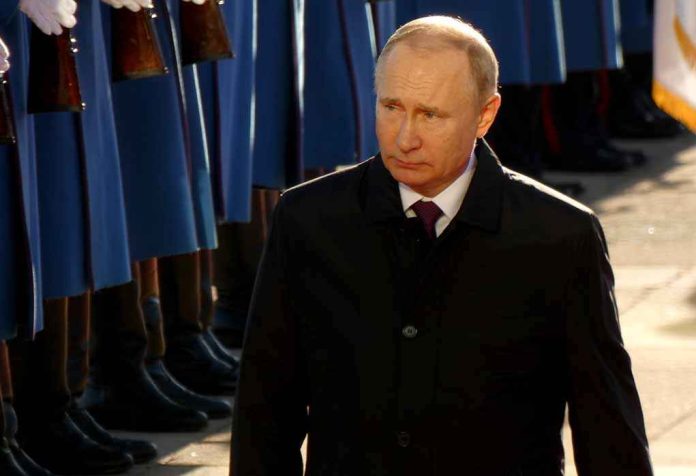
Personal diplomacy, when it produces a concrete result, is not an abstraction but a chain of decisions, calls, and calculations that end with a citizen walking free; Stephen Hubbard’s return from Russian custody fits that pattern, and the public record makes clear that President Trump personally pressed Vladimir Putin for the release and that Moscow granted it.
The Short Version
- Stephen Hubbard, a 74-year-old U.S. citizen, was released by Russia after more than four years in custody and returned to the United States.
- President Trump publicly said he asked Vladimir Putin by phone to free Hubbard; the Kremlin confirmed the release was at Trump’s request, citing Hubbard’s health.
- Trump characterized the outcome as involving no prisoner swap; separate reporting raised questions about whether sanctions policy factored into diplomacy.
- Hubbard later appeared at the White House, underscoring that the outcome was not merely promised but delivered.
What Happened: A U.S. Detainee Came Home, With Leaders on Both Sides Explaining Why
The core facts are straightforward. Multiple major outlets reported that Russia released Stephen Hubbard, a U.S. citizen in his seventies who had been held for years on allegations he fought as a mercenary in Ukraine; those stories also documented his travel back to the United States. President Trump said publicly that he called Vladimir Putin and asked for Hubbard’s release and that Russia complied. Dmitry Peskov, Putin’s spokesman, corroborated that sequence, stating that Putin freed Hubbard at Trump’s request and considered Hubbard’s poor health in doing so. Those statements align with the outcome observable to all: Hubbard left Russian custody and came home.
Because detainee cases often get muddied by rumor, public confirmation from both principals matters. In this case, there is consistency on the causality—Trump asked; Putin agreed—and on the result, which U.S. media tracked in real time and which later culminated in Hubbard’s presence at the White House, a visible marker that the administration regarded the episode as a successful intervention.
How It Was Framed: No Swap Versus Broader Leverage
Trump described the outcome as a “no swap”—no exchange of prisoners or direct quid pro quo. That formulation is specific: it addresses the absence of a one-for-one trade. Some coverage, however, pointed to sanctions decisions elsewhere in policy that touched on Russia around the same time frame and connected those to the diplomatic context. The distinction matters. “No swap” refers to the narrow mechanism of release, whereas sanctions moves speak to the broader architecture of leverage and signaling that can surround any high-stakes ask of Moscow. Both frames can be true at once: no prisoner exchange occurred, and sanctions policy may have been part of the environment in which negotiators operated.
Experienced practitioners recognize that detainee negotiations almost never occur in a vacuum. Even when the public-facing message is minimalist—no concessions, no trade—the other side is still counting costs and benefits across a larger ledger: reputational optics, humanitarian claims, domestic narratives, and potential policy linkages. That is not a criticism of the outcome; it is a description of how statecraft functions, especially with counterparties skilled at extracting advantage where they can.
The Charges and the Claim of Innocence
Russia’s basis for holding Hubbard rested on allegations that he participated as a mercenary in the Ukraine war. Trump publicly called Hubbard “innocent,” and Hubbard’s legal representatives denied the mercenary charge. These assertions directly rebut Russia’s narrative but do not resolve the case on the merits; what they do accomplish is to show alignment between the administration’s view and the defense’s account. In practice, many U.S. detainee cases feature exactly this pattern: a foreign government’s security-law framing met by a combination of legal defense and political advocacy aimed at bringing the American home first, with arguments about underlying guilt or innocence often left to history.
For the families and for the U.S. government, the immediate humanitarian imperative usually dominates. The older the detainee and the more tenuous the reported health, the more urgent the calculus becomes; Peskov’s explicit reference to health considerations in this case underscores how that factor can provide Moscow a face-saving rationale for release while meeting Washington’s central ask.
Mechanism and Timing: Why a Single Call Can Matter
Presidents often say a call made the difference; sometimes that is rhetorical shorthand. Here, the public statements line up in a way that suggests the intervention was both direct and decisive. Trump said he asked; Putin’s office said he granted the request. That does not mean months of groundwork did not precede the outcome—envoys, backchannel intermediaries, and lawyers typically shape the runway—but it does mean the final clearance likely depended on top-level political will. In highly personalized systems, and Russia is one, that is often what closes the transaction.
One practical marker of seriousness is the speed with which logistics follow the political decision. Reporting documented Hubbard’s movement back to the United States and, within days, his appearance at the White House alongside the president. That timeline is consistent with a greenlight issued at the apex and executed swiftly by subordinate ministries once the principals signaled agreement.
The Broader Landscape: Wrongful Detention Is Now a Recurring Policy Arena
Hubbard’s case is not an outlier; it is part of a durable policy problem in which authoritarian or adversarial states detain Americans to create bargaining chips, shape narratives, or signal resolve. The United States tracks these cases and has built a policy toolkit that spans sanctions, designations, and structured negotiations. Nonprofit monitoring shows both a rise in detentions and a recent cluster of successful returns—25 releases in 2022–2023—reflecting sustained diplomatic engagement. Russia, alongside China, Iran, and Venezuela, accounts for a large share of such cases, a base-rate reality that sets expectations for future incidents and underscores the value of tested playbooks.
This environment rewards two capabilities: operational patience—assembling facts, managing families’ expectations, and keeping channels open—and tactical audacity when the chance arises to cut a deal or, as in this instance, close with a leader-to-leader appeal. The policy challenge for any administration is to bring Americans home while minimizing the incentive structure that encourages future seizures. That tension rarely disappears; it is managed, not solved.
What Endures From the Hubbard Case
Three lessons have durable value. First, outcomes count most. Hubbard’s return and his subsequent presence in the Oval Office provide the clearest measure of success; they are not spin, they are facts on the ground. Second, the language used to characterize an outcome—no swap, humanitarian grounds—frames public understanding but sits atop a more complex reality of leverage and policy context. Precision about terms prevents category errors that plague public debate. Third, personalized diplomacy with Moscow still works under certain conditions: when the ask is bounded, when the humanitarian rationale is credible, and when the counterpart can claim credit domestically.
None of that diminishes the role of teams whose quiet work sets the table. But it does explain why, in this case, simultaneous statements from President Trump and the Kremlin are not mere optics; they are evidence of how the decision was made. If the aim is to bring Americans home without triggering a cascade of costly trades, this is what a relatively clean success looks like—an individualized request, a health-based justification, and a rapid exit that left Hubbard thanking the president in person days later.
Sources:
youtube.com, cbsnews.com, nbcnews.com, thehill.com, english.nv.ua, nypost.com, bbc.com, detroitnews.com, tommyxtopher.substack.com, cnn.com, state.gov, asisonline.org