

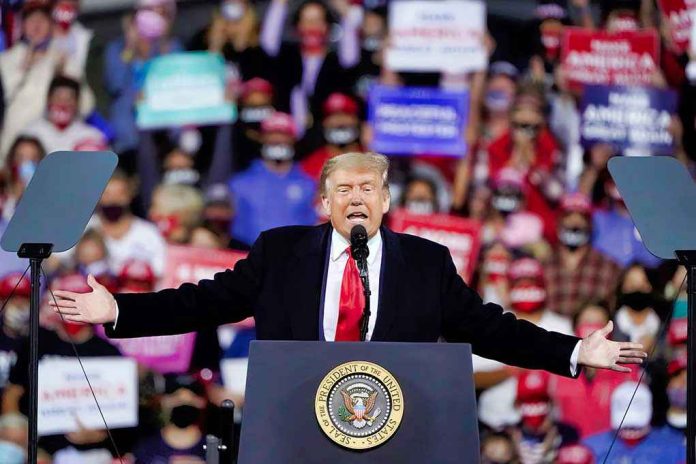
Trump used a Faith and Freedom Coalition stage to promise stronger protection for religious liberty and less Washington control over daily life.
Quick Take
- Trump said he would defend the right of Evangelicals and all Americans to live by their faith.
- He said his team would cut regulations, roll back government overreach, and return power to ordinary people.
- He claimed his administration protected conscience rights for doctors, nurses, teachers, and the Little Sisters of the Poor.
- He also said he would fight anti-Christian bias with a new federal task force.
Trump Frames Faith as a Freedom Issue
At the Faith and Freedom Coalition’s Road to Majority conference, Trump tied religious liberty to a larger fight against Washington power. He said he would support Evangelicals and all Americans who want to live by the teachings of their faith. He also said his administration was eliminating job-killing regulations and reversing government overreach. In his telling, those moves were part of a broader push to give power back to everyday Americans.[2]
The speech leaned on a familiar message for conservative voters: faith, free speech, and limited government belong together. Trump said pastors and other religious leaders should not fear punishment for speaking from the pulpit. He also said his administration had acted to protect religious liberty through an executive action that covered groups such as the Little Sisters of the Poor. Those claims matched the themes he used in earlier speeches to the same audience.[1]
What Trump Said About Conscience Rights and Religious Speech
Trump told the crowd that his administration protected the conscience rights of doctors, nurses, teachers, and religious groups. He also said he stopped the Internal Revenue Service from using the Johnson Amendment to interfere with pastors’ speech. Those points were central to his pitch that government had no place pressuring believers to stay silent. For many conservatives, that message lands because it speaks to a real fear of bureaucrats punishing faith-based views.[2]
Trump’s 2019 remarks made the same case in broader terms. He said clergy could speak again without losing tax status, and he said his government was defending the sanctity of life. He also said his administration had taken action to protect free speech on college campuses and faith-based adoption. The through-line was clear: he presented himself as a president who used federal power to protect, not pressure, religious Americans.[1]
Claims About Anti-Christian Bias Draw Scrutiny
Trump also announced a new federal task force on fighting anti-Christian bias. He said the mission would be to investigate illegal discrimination, harassment, and persecution against Christians in America. In the 2024 speech, he said the problem had reached a level “nobody can believe.” The provided research shows that this claim was treated as a major talking point, but it also shows that critics questioned whether the evidence matched the scale of the warning.[4][3]
President Trump leaving the White House for the Washington Hilton where he will talk to the Faith & Freedom Coalition and his speech, he said, in part “concerns the recent Election of Communists in our Country” pic.twitter.com/114r1SDtHn
— AlexGangitano (@AlexGangitano) June 26, 2026
That gap matters because the available research does not show a clear official record proving the kind of widespread persecution Trump described. The package notes that public data and later criticism did not back up the strongest version of the claim. Still, Trump used the stage to argue that believers were under pressure in schools, the military, government, workplaces, hospitals, and the public square. That is a message that fits conservative concerns about state power and cultural hostility toward faith.[4]
The Bigger Political Message
Trump also used the event to frame his record as proof that conservative governance still matters. He pointed to steps against federal funding for fetal tissue research and to other anti-abortion policies as signs that he had moved in the direction his supporters wanted. He also linked religious liberty to the Constitution, saying his administration would protect Americans’ rights as written. For his audience, that connects faith freedom with a larger defense of life, speech, and self-government.[3][2]
The broader picture is simple. Trump came before a friendly crowd and cast himself as the defender of believers against hostile elites, heavy-handed regulators, and cultural attacks on traditional values. Some of his claims were strong and specific, while others rested more on rhetoric than on hard public proof. Even so, the speech gave his supporters what they wanted most: a clear promise that faith would not be pushed aside by the federal government.[1][4]
Sources:
[1] YouTube – Live: Trump delivers speech at Faith and Freedom Coalition’s ‘Road to …
[2] Web – Remarks by President Trump at the Faith and Freedom Coalition’s …
[3] Web – Trump Faith & Freedom Conference Speech Transcript – Rev
[4] Web – WATCH: Trump tells Faith and Freedom Coalition conference … – PBS