

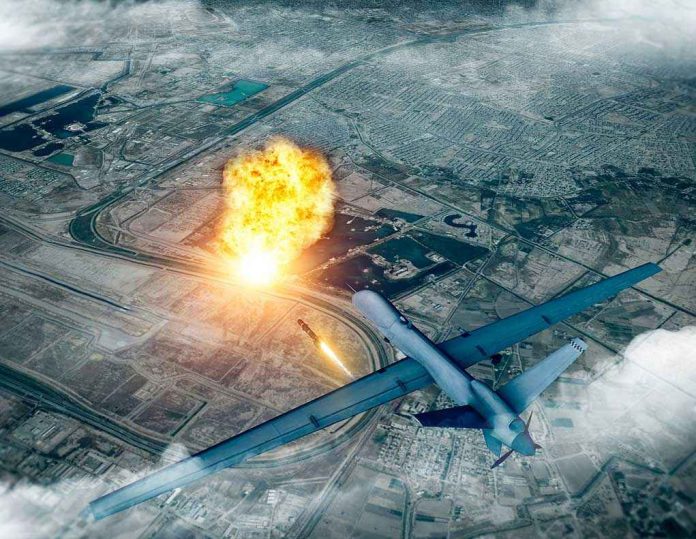
The real significance of the Moscow refinery strikes is not that they proved Russia can be attacked; it is that they forced the war’s most protected city to absorb visible, repeatable damage at a site that sits close enough to the Kremlin to make abstraction impossible. That does not mean Moscow’s defenses collapsed. It does mean Ukraine has pushed deep-strike warfare into a phase where reach, persistence, and symbolism reinforce one another.
Key Points
- The Moscow refinery strikes were large enough, visible enough, and repeated enough to matter as more than spectacle.
- The Kapotnya refinery was hit despite heavy interception claims, showing that some drones penetrated Moscow’s defensive umbrella.
- The attacks caused airport disruptions, fire, smoke, and reported injuries, which made the war feel local to Moscow residents.
- The strategic effect is real but limited: the evidence supports vulnerability and disruption more strongly than a claim of systemic Russian collapse.
Why the Kapotnya Strike Mattered
The attack on the Moscow Oil Refinery at Kapotnya mattered because it combined three things that deep-strike campaigns live or die on: proximity, repetition, and proof of penetration. Reuters and CNN both described the June strike as among the largest on Moscow since the full-scale war began, while NBC reported that thick black smoke spread over the capital and that a drone struck the refinery itself rather than merely being intercepted at a distance.[1][3][4] That distinction is the essence of the story. A drone that reaches the target area, ignites a fire, and disrupts civilian life is not a symbolic overflight; it is an operational breach with political meaning.
The refinery’s location sharpened that meaning further. NBC placed Kapotnya roughly ten miles from the Kremlin, and Reuters put it about 15 kilometers away.[1][4] In strategic terms, that is not the edge of the theater; it is the state core. The symbolic value of striking a fuel facility so close to the center of Russian power is obvious, but symbolism alone would not carry the argument. What makes the event durable is that the strike appears to have landed on infrastructure that matters, in a district that Moscow is supposed to protect better than any other place in the country.
What the Reporting Shows About Damage and Disruption
The strongest reporting does not prove the full extent of structural damage, and that limitation matters. The available coverage shows fire, smoke, and visible impact, but not a complete forensic accounting of how much production was lost or how long particular units stayed offline.[1][3][4] That is the line between a dramatic strike and a strategically decisive one. The evidence is enough to establish direct damage to a critical fuel facility; it is not enough to quantify the outage with precision. A disciplined reading should preserve that distinction rather than blur it for rhetorical effect.
Even so, the disruption was unmistakable. Reuters reported damage to a high-rise residential building, an industrial facility, and private houses in the Moscow region, along with injuries.[1] CNN and NBC both reported temporary interruptions at major Moscow airports.[1][3] Those are not military effects in the narrow sense, but they are war effects all the same. Air travel suspensions, emergency response activity, and the visual shock of a refinery fire near the capital all tell the same story: the conflict had crossed from distant borderland attrition into the routines of metropolitan life.
How Ukraine Is Using Long-Range Drones
Ukraine’s deep-strike drone campaign is not designed to win by a single spectacular blow. Its logic is cumulative. Al Jazeera reported that Kyiv has invested heavily in long-range drones to strike deep inside Russia, with the explicit aim of making Russians in Moscow and other cities “feel the consequences of war at home.”[4] That phrase is not incidental rhetoric; it captures the strategic method. Ukraine is trying to export uncertainty, force defensive expenditure, and turn Russia’s rear areas into contested space. In modern war, that is a form of coercion even when the immediate physical damage is modest.
The pattern around Moscow suggests persistence rather than one-off signaling. Reuters said the refinery had been hit earlier in the same week, and the research package notes reporting that it was struck multiple times within days.[4][7] Repeated attacks matter because they change defender behavior. A single breach can be written off as an anomaly. A second, then a third, indicates a campaign that is probing for seams, stressing response systems, and demonstrating that even the most defended sites are not immune. That is how deterrence erodes in practice: not all at once, but through repeated proof that “protected” is a relative term.
The Strategic Debate: Vulnerability, Not Collapse
The honest reading of the evidence is that Moscow is vulnerable, not that Russian air defense has failed in any absolute sense. Reuters reported Russian claims that about 180 drones were shot down around Moscow, and the broader coverage consistently shows a large interception effort alongside a smaller number of successful hits.[3][4] That is why claims of a total security breakdown overstate the case. The defensively useful fact for the Kremlin is that many drones are being destroyed. The damaging fact is that some still get through, and when they do, they can hit vital infrastructure near the Kremlin.
That is also why casualty reporting deserves caution. The research package shows inconsistency, with some accounts stressing no injuries and others reporting 16 or 17.[1][3][4] In a contested information environment, exact casualty counts are often the first numbers to wobble. More important is the pattern: civil disruption occurred, damage was visible, and authorities had to manage the event as a public emergency. The Kremlin can plausibly argue that its defenses limited the harm. It cannot plausibly argue that the strike was inconsequential.
The deeper strategic question is whether these attacks meaningfully degrade Russia’s war effort. The available sources support a limited but real answer. Reuters linked Ukrainian strikes on refineries to gasoline shortages and possible fuel imports by sea, while NBC noted effects on energy supply in occupied Crimea.[1][4] That is suggestive evidence of broader strain, not proof of decisive military degradation. The impact may be more economic and psychological than battlefield-transformational. Still, in a war driven by industrial capacity, fuel logistics, and public endurance, economic friction is not secondary; it is one of the main arenas of conflict.
#Ukraine appears to be taking the fight deep into #Russian territory…A massive drone attack forced the temporary shutdown of all four #Moscow airports. @kartikeya_1975 @SwaranSinghJNU #OnPoint
https://t.co/AlOdU9Hzkf— News9 (@News9Tweets) June 22, 2026
Why Moscow’s Air Defenses Do Not End the Story
Russian officials have every incentive to emphasize interception numbers, and they did. That message is useful domestically because it frames the event as managed risk rather than breached sovereignty. It is also partially true. Yet interception statistics cannot erase the fact that the refinery was hit. The important analytical mistake is to treat “most were shot down” as equivalent to “nothing got through.” In drone warfare, the attacker often needs only a few penetrations to produce disproportionate political and economic effect, especially when the target is a refinery, airport-adjacent facility, or residential district near the capital.
This is why the event resonated far beyond Moscow’s southern suburbs. The war’s geography has been altered. What once looked like a distant campaign of raids on border regions now reaches into the Russian state’s administrative and symbolic center. That does not mean Ukraine can bomb Russia into surrender. It does mean Russia must now defend the rear as carefully as it defends the front, and that is a costly inversion. The Kremlin can absorb embarrassment; it cannot wish away the burden of permanent rear-area defense.
Long-range drone warfare also works through perception. The clearest public footage, as the research package notes, often comes from residents’ social media and reposted clips, which are vivid but less authoritative than forensic assessments.[2][5][8][9] That matters because visual proof can overstate certainty while still reflecting a real event. The smoke is real even when the full damage inventory is not. In this case, the images and the reporting align closely enough to support the central conclusion: Ukraine has brought the war to a place the Kremlin wanted to keep psychologically inviolable.
What Comes Next in the Moscow Deep-Strike Campaign
The larger consequence is not a single refinery fire but the normalization of vulnerability. Once a capital city has been penetrated repeatedly, the question shifts from whether it can happen to how often, at what cost, and with what cumulative effect. Reuters and NBC describe repeated strikes on the same refinery within days, and that recurrence is the more telling fact.[1][4] Repetition turns shock into an operating condition. It forces Russia either to spend more on defenses, accept more disruption, or both.
For Ukraine, that is the logic of long-range pressure. The goal is not necessarily to destroy every target outright. It is to force Russia to defend a vast and expensive interior, to expose the fragility of energy infrastructure, and to remind Russian elites and civilians alike that distance no longer guarantees safety. The Kapotnya strikes show that this logic is already working at least in part. Moscow may still intercept most drones, but it now has to live with the fact that the ones that slip through can light up the skyline near the Kremlin.
Sources:
[1] Web – Target Moscow: The Ukraine War Has Come Right to Putin’s Doorstep
[2] Web – Moscow refinery attack: Ukrainian drones hit Kapotnya in biggest …
[3] Web – Ukrainian forces struck the Moscow Oil Refinery in the Russian …
[4] Web – Ukraine launches largest attack on Moscow since start of full-scale …
[5] Web – Ukraine hits Moscow refinery in major drone attack on Russian capital
[7] Web – An oil refinery in Moscow was among the sites struck by Ukrainian …
[8] Web – Ukrainian drones hit Moscow’s largest oil refinery for the third time …
[9] Web – A Ukrainian drone strike on a Moscow oil refinery produced a flood …