

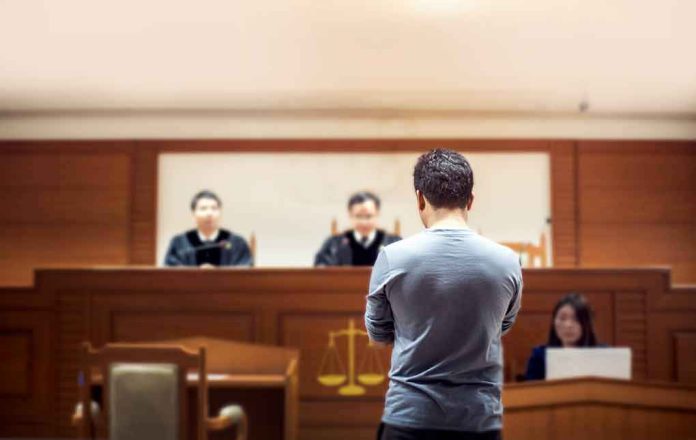
The fight over what counts as “unlawful voting” does not turn on a cast ballot; in Minnesota, the legal tripwire is crossed the moment someone intentionally misrepresents who they are while applying for a ballot — a felony even if no vote is ultimately recorded.
The Short Version
- Minnesota law makes it a felony to intentionally misrepresent identity while applying for a ballot; success in voting is not required.
- Prosecutors allege James O’Keefe and Cam Higby used real voters’ names at multiple polling places without permission during the Aug. 11 primary.
- Election workers reportedly flagged the conduct; prosecutors say the men began the application process but stopped before signing the oath or receiving ballots.
- The defense frames the episode as investigative journalism that deliberately avoided signing or voting, arguing no “application” occurred.
What Minnesota’s unlawful-voting statute actually criminalizes
Minnesota Statutes § 204C.14 is written to protect the integrity of the act of voting and the steps that immediately precede it. Subdivision 1(a) forbids an individual from intentionally misrepresenting identity while applying for a ballot, and it classifies a violation as a felony. That wording matters: the legislature chose to criminalize misrepresentation at the application stage in addition to depositing a ballot or voting by machine. In other words, the crime is complete upon the intentional false identification in the application context; the state does not need to prove that a ballot was issued or cast to prosecute under this provision.
Practically, “applying for a ballot” encompasses the brief, structured exchange at the table where election judges verify eligibility—name, address, and, where relevant, voucher—before presenting the oath and issuing a signature line or a ballot receipt. Minnesota’s design aims to deter impersonation or identity manipulation at the threshold, not merely punish it after a completed vote. That preventive orientation is why the statute’s scope and timing are central in any case alleging false identification at the check-in stage.
The case theory prosecutors say they can prove
In public statements accompanying the charges, Hennepin County Attorney Mary Moriarty alleged that O’Keefe and Higby entered polling places during the Aug. 11 primary and identified themselves using the names of real registered voters without those voters’ knowledge or permission. The reported charging narrative says the encounters occurred at multiple locations, involved approaching election judges, and advanced into vouching-related conversation before the men stopped short of signing the oath. The state’s legal theory hinges on the statutory line described above: intentional identity misrepresentation during the act of applying, not the issuance of a ballot per se.
Contemporaneous witnesses strengthen that theory. According to coverage of the prosecutor’s announcement, election workers flagged “strange behavior,” and the encounters were not confined to a single, ambiguous interaction; multiple precincts and judges reportedly observed or documented the conduct. If corroborated by judge statements, sign-in logs, and precinct incident notes, that mosaic can satisfy the state’s proof burden on both act (what was said and when) and intent (the purposeful use of someone else’s identity in an application context).
The counter-case: journalism, not voting — and the line they argue they did not cross
O’Keefe and Higby present their actions as a stress test of Minnesota’s “vouching” rules—a documentary probe into what poll workers would permit absent identification. They say they trained participants not to sign anything, not to touch ballots, and to disengage before any formal step that could be construed as voting. On that foundation, they deny having “applied” for a ballot and insist that no one impersonated a voter in a manner that satisfies the statute’s elements; stopping before the oath, in their view, kept the conduct on the journalism side of the line rather than the unlawful-voting side.
This defense zeroes in on statutory timing and definition: when does an application begin? If the men only asked hypotheticals or probed procedures, they argue, they did not initiate an application at all. If, however, they affirmatively used the names of actual voters in the exchange election judges treat as the opening of the application—name and address lookup—the prosecution’s reading gains traction. That is why the precise words used, the sequence of the check-in scripts, and how judges contemporaneously understood the interactions are evidentiary fulcrums for either side.
Where the law and facts will meet: “application,” intent, and corroboration
Three questions will likely decide any courtroom outcome. First, application onset: Minnesota’s polling-place workflow is standardized; election judges ask for name and address, check the roster, and move to oath and signature. If a judge initiates that process upon hearing a name claimed as one’s own, the state can argue the application began at the moment of misrepresentation—even if the oath was never signed. Second, mens rea (intent): prosecutors will need to show the identity claim was an intentional misrepresentation, not a hypothetical or a test framed clearly as such to the worker. Video, audio, and judge testimony can illuminate tone, word choice, and context. Third, corroboration: independent accounts from multiple polling places and the registered voters whose names were allegedly invoked can anchor an otherwise he-said/she-said dispute in contemporaneous records.
Defense counsel will press each hinge point. They will argue the interactions never left the realm of inquiry, that any mention of real names did not constitute a present-tense identity claim, and that the absence of a signed oath, voucher affidavit, or ballot receipt reflects a non-application. They will emphasize the rarity of successful in-person impersonation to frame the prosecution as overreach and to suggest that Minnesota’s guardrails—election judges who halted the process—functioned as designed, making criminal charges unnecessary to protect election integrity.
Cam Higby and James O’Keefe appeared in Minnesota court on Monday on felony charges for showing how easy it is to start the voting process there without any proof of who you are. They never cast a ballot and never signed an oath. They walked out after asking questions on camera.…
— Paul A. Szypula 🇺🇸 (@Bubblebathgirl) November 16, 2026
Why this controversy resonates beyond one case
In-person voter impersonation at the polls is, by most empirical looks, an uncommon subtype of election misconduct. A Wisconsin review over a decade found that only a handful of prosecutions involved impersonation, despite intense political focus on the topic. Scarcity does not trivialize the harm if it occurs; it does, however, explain why states draft statutes to deter at the earliest possible moment and why prosecutors emphasize the application stage. Statutes like Minnesota’s are built to avert harm ex ante, not just punish it ex post. That architecture makes journalistic “tests” that role-play the critical juncture inherently fraught.
At the same time, the First Amendment defense is not mere rhetoric; documenting public administration, including election procedures, is protected activity when it does not cross into conduct the law proscribes. The bright line, then, is factual and situational: whether the documentation required assuming another person’s identity in the formal act of applying for a ballot. Courts routinely distinguish speech about a system from participation in it under false pretenses; where that boundary sits in a polling place will be drawn by the record of words actually spoken at the check-in table and how Minnesota’s statutory terms are construed against that record.
How to read the next filings with a clear eye
Ignore the noise and look for five things in the docket: the exact statutory subsections charged and any jury-instruction definitions of “applying for a ballot”; a count-by-count chronology tying each alleged name to a time, precinct, and election judge; sworn statements from the registered voters regarding nonconsent; unedited audio/video establishing the defendants’ precise phrasing and the judges’ responses; and any contemporaneous incident reports or roster annotations. Those items will either substantiate the prosecution’s application-stage theory or bolster the defense claim that the interactions never crossed from inquiry into impersonation.
Whatever the verdict, the lesson endures. Election law treats the moments before a ballot is issued as the core of integrity, and it criminalizes deception at that threshold. Journalism that examines those rules is legitimate and often valuable; journalism that assumes a false identity inside the application process risks converting scrutiny into participation. In Minnesota, the difference is not academic—it is the statutory line.
Sources:
thegatewaypundit.com, apnews.com, mprnews.org, revisor.mn.gov, kstp.com, startribune.com, wisconsinwatch.org