

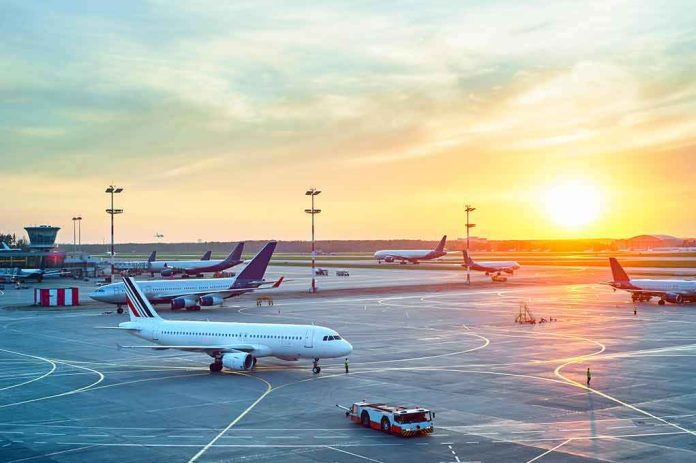
Two commercial jets at Miami International Airport came close enough together on the ground, at low speed, in good visibility, with air traffic control watching every movement on radar — and still made contact. That is the detail worth sitting with before anything else: modern taxiway collisions rarely happen because pilots cannot see each other. They happen in the narrow, procedural seams between clearances, readbacks, and geometry, which is exactly the terrain investigators will now have to map.
Key Points
- A Copa Airlines Boeing 737, carrying 172 people and taxiing toward its gate, had its wingtip strike the nose of a UPS Boeing 767 that was taxiing for departure to Bogotá.
- The Federal Aviation Administration and Miami-Dade Aviation officials place the contact at roughly 9:15 p.m. at the intersection of two taxiways.
- Two people were treated at the scene for minor injuries and did not require hospitalization.
- UPS confirmed one of its aircraft was involved and said its crew was safe; the cause of the contact has not been officially determined.
- The incident sits inside a well-documented, recurring category of airport-surface risk that the FAA tracks nationally every year.
What Happened on the Taxiway
The collision occurred on the ground, not in flight, at the intersection of two taxiways at Miami International Airport. According to the FAA’s account, “the wingtip of a Copa Airlines Boeing 737 struck the nose of a UPS Boeing 767 while the airplanes were taxiing”. Miami International Airport communications director Greg Chin placed the timing precisely, saying that “at approximately 9:15 p.m., an arriving aircraft and a departing aircraft made contact with each other at the intersection of two taxiways”. The Copa jet was moving toward its gate after arrival; the UPS freighter was taxiing outbound, cleared for a departure to Bogotá, Colombia.
UPS confirmed its aircraft’s involvement directly, stating: “We are aware of an incident involving one of our aircraft on the ground in Miami. Our crew is safe, and we are committed to working with authorities to determine what happened”. That statement does two things worth noting — it establishes the company’s own account of crew safety, and it signals that fault has not been assigned, even by the operator whose aircraft sustained nose damage. Copa’s jet was carrying 172 people at the time of contact, underscoring that this was a passenger-carrying collision risk, not merely a cargo-apron mishap.
Injuries, Response, and the Immediate Aftermath
Miami-Dade Aviation and Miami-Dade Fire Rescue reported that two people were treated at the scene for minor injuries and were not transported to a hospital. That is the figure that held up across the fullest set of contemporaneous reporting, even though an early airport statement had initially indicated no injuries before the fire-rescue account surfaced. Reporting on whether airport operations were disrupted or aircraft were redirected to alternate taxiways varied somewhat across outlets, which is typical in the first hours after any ground incident at a major hub — operational details get refined as airport authorities reconcile logs across departments.
Why Ground Collisions Happen — and Why Impact Point Isn’t the Whole Story
Identifying that a wingtip struck a nose tells investigators where two aircraft met, not why they occupied the same space at the same moment. That distinction matters because taxiway contact can originate from a clearance miscommunication, a missed hold-short instruction, a controller sequencing decision, a crew’s misjudgment of clearance from an adjacent aircraft, or some combination of these — and resolving which applies here requires controller transcripts, surface-movement radar data, and cockpit recordings that have not been made public. No cited account has assigned responsibility, and the FAA’s description of contact geometry establishes what touched first, not who had the right of way.
A Recurring Category, Not a Freak Event
Airport-surface conflicts of this kind belong to a class the FAA tracks formally as runway incursions — a category broader than collisions, encompassing any incorrect presence of an aircraft, vehicle, or pedestrian on a protected surface. In fiscal year 2023, the agency recorded roughly 1,760 such incursions across about 54.3 million takeoffs and landings nationwide, a rate near 32 per million operations. General aviation accounted for roughly 80 percent of that total, meaning the aggregate rate does not map cleanly onto a widebody-to-narrowbody encounter between two scheduled carriers. Separate Department of Transportation analysis of the same period attributed about 60 percent of incursions to pilot deviations and roughly 20 percent to air traffic controller action or inaction, with the remainder tied to vehicle or pedestrian deviations. Those proportions don’t resolve the Miami case, but they frame it: surface conflicts are a persistent, measurable system risk, not an anomaly confined to one night in November.
The FAA has spent the past decade layering technology onto that risk. Airport Surface Detection Equipment, Model X — known as ASDE-X — fuses radar, transponder multilateration, and ADS-B broadcast data to give controllers a continuous, identified picture of every aircraft and vehicle moving across an airport’s surface, and a related Taxiway Arrival Prediction capability has been deployed at 43 airports in the national airspace system to flag developing conflicts before they become contacts. The National Transportation Safety Board has pushed further, recommending for years that the FAA require direct in-cockpit alerting — a system that warns pilots themselves of probable collision risk, rather than relying solely on controllers to intervene from the tower. Miami International Airport, as one of the country’s busiest international gateways, operates within exactly this layered safety architecture; the open question for investigators is where, on this specific taxiway, at this specific minute, that architecture did not prevent contact.
What Comes Next
The FAA has acknowledged an investigation is underway, and incidents of this kind typically draw NTSB involvement given the passenger count aboard the Copa aircraft and the damage to both airframes. A full accounting — aircraft registrations, clearance records, surface-movement data, and a formal cause determination — has not yet been released, and responsibility has not been officially assigned. What is firmly established is the sequence of physical facts: two aircraft, a shared taxiway intersection, a wingtip-to-nose impact, two minor injuries, and no loss of life. That record stands on its own, independent of whatever the investigative docket eventually concludes about how it came to happen.
TWO PLANES COLLIDED AT MIAMI INTERNATIONAL AIRPORT.
THEY WEREN’T EVEN IN THE AIR. ✈️
A Copa Airlines passenger jet and a UPS cargo plane collided on the ground Saturday night near a taxiway intersection.
The Copa flight had arrived from Panama City with 172 people aboard.
The… pic.twitter.com/nHdivt7wf6
— Daniel C (@chowoohpolice) November 15, 2026
Sources:
facebook.com, cbsnews.com, edition.cnn.com, faa.gov