

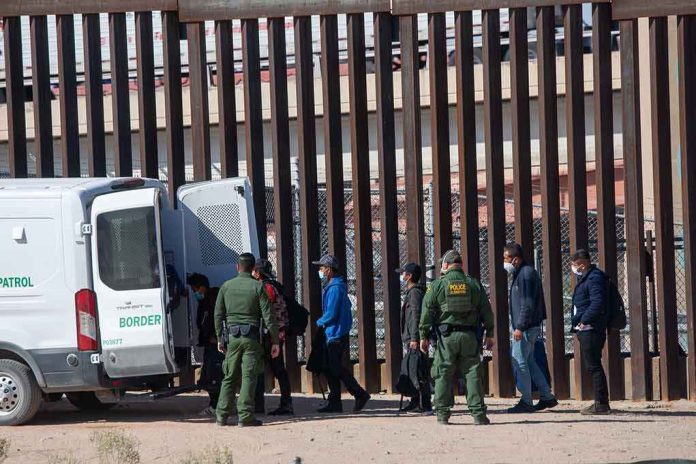
The fight over asylum at the southern border is not a skirmish about policy preferences; it is a clash over the outer limits of presidential power under the immigration laws Congress actually wrote, and whether authority to restrict entry can be transformed into authority to turn off statutory asylum once a person is here.
At a Glance
- The Supreme Court has agreed to decide whether President Trump can suspend access to asylum and related protections for migrants who cross the southern border illegally, a policy two lower courts have found unlawful.
- The administration grounds its power in 8 U.S.C. §§ 1182(f) and 1185(a), which authorize restrictions on “entry”; challengers argue those provisions cannot override asylum procedures Congress guaranteed in the INA.
- A D.C. Circuit panel and a federal district court concluded the directive exceeds executive authority because “entry” control does not permit curtailing asylum eligibility once a person is on U.S. soil.
- The Court’s ruling will define how far presidents can go to manage asylum by proclamation when Congress has not enacted comprehensive border legislation.
The legal question the Court took: entry control versus asylum rights
The Supreme Court agreed to hear the administration’s appeal testing whether the president may broadly suspend access to the asylum system for people who cross the southern border between ports of entry. The government’s legal theory relies on long-standing statutory grants that allow the president to “suspend the entry” of noncitizens or impose restrictions on their entry, principally 8 U.S.C. § 1182(f) and § 1185(a). Those provisions have been read expansively in past disputes about who may be allowed to enter at all; in Trump v. Hawaii, the Court upheld a proclamation restricting the entry of certain nationals as a lawful exercise of § 1182(f) authority. The present case, however, turns on a sharper edge: does power to restrict entry extend to cutting off asylum procedures that Congress codified for people who reach U.S. territory or otherwise are subject to our removal process?
Challengers say no, and two courts agreed. A federal district judge held the directive unlawful, and a divided D.C. Circuit panel affirmed, emphasizing the textual boundary: § 1182(f) authorizes suspending “entry,” not rewriting eligibility for asylum or foreclosing statutory screenings that attach once a person is apprehended inside the country. That framing is crucial because the Immigration and Nationality Act (INA) uses different mechanisms for border control and for adjudicating protection claims, and Congress spelled out procedures—credible fear screening, asylum eligibility, withholding of removal—that operate after entry or apprehension. The administration counters that in the face of operational crisis, Congress’s entry powers provisions function as a safety valve that permits categorical limits necessary to restore order at the border.
How we arrived here: executive improvisation in the asylum space
Across the last decade, successive administrations have tried to manage migration spikes by stretching existing statutory authorities rather than waiting for comprehensive legislation. The Trump years tested “Remain in Mexico,” third-country transit restrictions, and pandemic-era Title 42 expulsions; the Biden years leaned on humanitarian parole programs, appointment scheduling through CBP One, and a 2024 proclamation-and-rule package intended to meter arrivals and raise screening thresholds. Each approach triggered immediate litigation, and few produced durable settlement. The result is a jurisprudence with one robust pillar—broad presidential power to restrict entry under § 1182(f) in certain contexts—and an unsettled frontier where entry control meets asylum procedure.
Congress’s research arm has repeatedly underlined that overlap and tension. It has explained that while the president’s entry authority is sweeping, the INA also embeds protections—including asylum and withholding—that are not easily displaced by regulation or proclamation once a person is within the United States or otherwise subject to our removal system. That unresolved seam is precisely where this case sits. If the Supreme Court says “entry” power reaches into asylum processing, presidents will possess a potent tool to throttle access during surges. If it says no, only Congress can recalibrate the asylum gateway at the level of eligibility and procedure.
What the lower courts actually held
The litigation record matters. The district court concluded that the directive’s categorical bar on asylum and related protections for illegal border crossers conflicts with the INA’s text and structure, which guarantees the ability to apply for asylum subject to congressionally defined exceptions and procedures. On appeal, a D.C. Circuit panel agreed in substance: by its plain terms, § 1182(f) empowers the president to suspend entry, not to impose “additional limitations” on asylum eligibility or to negate statutory screenings that take effect after apprehension. While the directive remained operational under a stay pending Supreme Court review, the appellate reasoning underscored the central point: the executive cannot do by proclamation what Congress has addressed directly in the INA’s asylum and withholding provisions.
That reading aligns with a familiar separation-of-powers logic in immigration law. When Congress speaks in detail—especially about procedures and eligibility—the executive may implement and prioritize, but cannot displace the scheme with a categorical rule that runs counter to the statute’s design. The administration’s rejoinder is that Congress gave it a parallel, emergency-style pathway in § 1182(f) and § 1185(a) to impose temporary measures that function as exceptions to ordinary INA rules when national interests demand it. The Court must choose between those theories—or find a limiting principle that preserves entry control without authorizing functional repeal of asylum by proclamation.
Stakes for policy, process, and the separation of powers
The decision will ripple beyond this directive. First, it will clarify whether presidents can use entry-control statutes to reshape asylum access in response to flows—effectively giving the executive a metering lever—or whether only Congress can revise core asylum procedures and eligibility rules. Second, it will guide how agencies calibrate frontline processing: credible-fear screenings, expedited removal, and transfers to the immigration courts depend on whether access to the asylum system can be categorically narrowed by executive action. Third, it will influence litigation posture in the next surge. If the Court validates the administration’s approach, future presidents of either party will wield the same tool; if not, the pressure returns squarely to Congress to enact a durable framework.
Finally, the opinion will refine how Trump v. Hawaii is read outside its national-security and nationality-based context. That case affirmed sweeping discretion to restrict entry; this one tests whether that discretion can be used to alter rights and procedures that vest after presence is established. However the Court draws that line, it will set the template for the next decade of border management and litigation.
The U.S. Supreme Court will consider the legality of President Trump's asylum restrictions at the U.S.-Mexico border, challenging lower court rulings. https://t.co/dqdGX0VM8P pic.twitter.com/AOPVEyVexd
— Missouri Lawyers Media (@MoLawyersMedia) November 13, 2026
What to watch as the case proceeds
Watch for two anchors in the briefs and argument. The first is statutory text and structure: challengers will lean on the INA’s asylum provisions and the “entry-only” language of § 1182(f), reinforced by the D.C. Circuit’s plain-text reading. The second is functional necessity: the government will argue that §§ 1182(f) and 1185(a) are emergency valves that operate as exceptions to the INA’s general rules when migration dynamics overwhelm the system. Expect extensive sparring over whether “suspending entry” can be implemented through place-of-apprehension rules that, as a practical matter, foreclose asylum—and whether that is regulation of entry or impermissible alteration of asylum eligibility.
Sources:
inquisitr.com, cnn.com, whitehouse.gov