

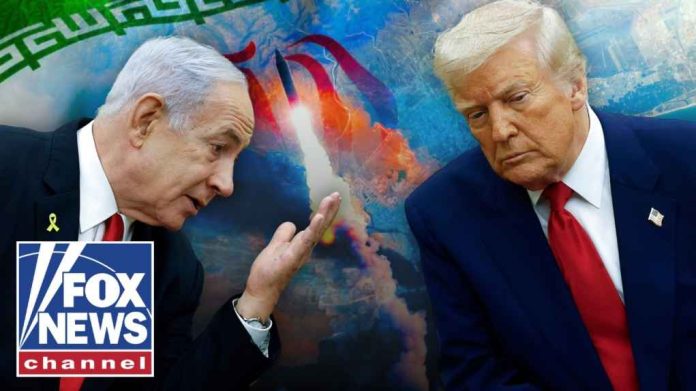
Trump’s five words—“He’ll do what I tell him”—turned a routine leader-to-leader check-in into a referendum on who actually calls the shots on war and peace with Iran.
Story Snapshot
- Trump publicly claimed Netanyahu would “do whatever I want him to do” on Iran strikes [3].
- Reports describe a tense Trump-Netanyahu call over whether to resume attacks or hold for diplomacy [4].
- CBS reporting says Trump conditioned support for Israeli strikes on Iran’s missile program if a deal failed [1].
- Netanyahu publicly credited Trump’s role while pitching fast, limited action, signaling both praise and pressure [2].
The Line That Lit the Fuse
Donald Trump said on camera that Benjamin Netanyahu would follow his lead on potential Iran strikes, a boast that instantly reframed alliance management as command authority [3]. On its face, this asserts more than influence; it implies control. Politically, the claim arms Trump’s base with a show of strength and puts Netanyahu on the spot. Factually, the evidence is thinner; there is a quote, but not a directive or transcript proving compellable compliance [3]. The gap between rhetoric and record drives the controversy.
CBS reported that Trump conveyed conditional support for Israeli strikes on Iran’s ballistic missile program if negotiations with Tehran failed, pairing pressure with an off-ramp [1]. That framing presents deterrence with an insurance policy: pursue diplomacy first, keep the strike option credible. This aligns with a conservative preference for peace through strength and measurable outcomes. It also signals to Israel and Iran that Washington sets the tempo and the terms, even while avoiding a blank check.
The Call Heard Round Two Capitals
The Economic Times summarized reporting that Trump and Netanyahu held a tense call over the future course of the Iran war, with frustration on the Israeli side after a Tuesday exchange [4]. Tension in such calls does not prove subordination or defiance; it proves stakes. Leaders haggle hardest when choices are closest. The anonymous sourcing limits certainty, but the core takeaway is solid: the question of when to strike or pause sat on the leaders’ desks, not just with deputies [4]. That alone elevates the claim of top-level orchestration.
Politico quoted Netanyahu promising a “quick and decisive action” while highlighting Trump’s “pivotal role in orchestrating the airstrike initiative” [2]. Those words read like alliance choreography: Netanyahu reassures Israelis and allies that he seeks decisive outcomes, and he credits Trump to reinforce unity and secure political cover. Praise can be performative, but it still signals alignment when it matters. If Netanyahu wanted to distance himself, he had cleaner ways to do it than public commendation.
Control, Influence, or Message Discipline?
Trump’s claim that Netanyahu “will do whatever I want him to do” delivers a simple headline, but the documentation supports a narrower conclusion: the United States set conditions, timelines, and thresholds, while Israel pushed for action and speed [1][2][3][4]. That is influence, not formal command. American conservatives should separate deterrent posture, which is desirable, from narrative inflation, which can backfire. If the boast nudges Tehran and steadies jittery markets, it serves a purpose; if it boxes in allies, it adds risk.
🇮🇱🇺🇸 Netanyahu Spent an Hour BEGGING Trump to Attack Iran
What a CLOWN!
During a tense Tuesday call, a U.S. official and Israeli source told CNN that Netanyahu called halting the planned strikes a MISTAKE and Pressured Trump to ATTACK Iran.
Trump reversed course on the strikes pic.twitter.com/IYoVz0hX7F
— imranzeemi (@imranzeemi) May 22, 2026
Anonymous sourcing and selective leaks complicate verification of the call’s tone and content. CBS attributed key elements to unnamed officials, and the tense-call storyline traveled through summary accounts rather than full readouts [1][4]. The absence of a transcript or synchronized readouts means certainty remains out of reach. Common sense rule: treat chest-thumping as signaling unless backed by orders, assets moved with intent, and logged authorities. Here, we have signaling, a carrier posture described as prudent insurance, and conditional green lights [1].
What Matters Next
Three tests will clarify the truth behind the swagger. First, whether diplomacy breaks down on verifiable terms, not headlines. Second, whether Israel executes ballistic-missile-focused strikes aligned with American conditions and timing. Third, whether both sides maintain message discipline that deters Iran without dragging the United States into open-ended commitments. If these align, Trump’s claim looks like hard-nosed leverage. If they diverge, it looks like political theater. Either way, deterrence backed by clear limits remains the sober path [1][2][4].
Sources:
[1] Web – Trump told Netanyahu he would support Israeli strikes on Iran’s …
[2] Web – Netanyahu says Iran strikes won’t lead to ‘endless war’ – POLITICO
[3] YouTube – Trump says Netanyahu will follow his lead on potential Iran strikes
[4] Web – Trump, Netanyahu had tense phone call on future of Iran war: reports