

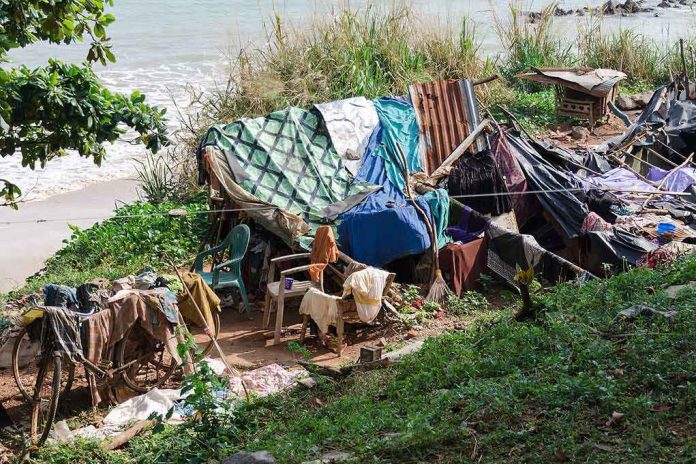
For Pacific Island countries, climate change is not a distant abstraction; it is a stress multiplier that tightens three interlocking constraints at once—coastlines sink relative to rising seas, freshwater becomes less reliable, and local food systems shoulder more risk—together shifting communities from periodic scarcity toward chronic food insecurity if emissions and adaptation both lag.
The Short Version
- Global warming is on track to overshoot 1.5°C under current pledges, intensifying sea-level rise, hydrological stress, and climate extremes that undermine Pacific food systems.
- Small islands face distinctive exposure: thin soils, limited aquifers, and reliance on rain-fed crops and nearshore fisheries magnify climate shocks into food-security risks.
- Risk pathways are well-characterized: salinization of groundwater and taro pits, cyclone damage to crops and reefs, marine heat weakening fisheries, and drought disrupting staple production.
- Adaptation works when designed locally—from salt-tolerant crops and water storage to reef and agroforestry stewardship—but cannot fully offset unchecked warming.
Why overshooting 1.5°C reframes Pacific food security
The emissions arithmetic is blunt. Analyses of the UNEP Emissions Gap Report indicate that even if today’s national pledges were fully executed, the world would still head toward roughly mid-2°C warming, not 1.5°C. UNEP’s 2024 key messages are explicit: without significantly stronger near-term cuts, 1.5°C will slip out of reach within a few years and the 2°C guardrail will come under threat. For a region where centimeters of sea-level rise translate to saltwater in wells and staple-crop pits, and tenths of a degree raise the odds of severe marine heat and tropical cyclones, the difference between 1.5°C and 2°C is the difference between difficult and destabilizing. The emissions gap is therefore not an abstract target shortfall; it is a forecast of tighter water, land, and fisheries constraints that compound into food insecurity across the Pacific arc.
What makes these islands uniquely sensitive is physical geometry as much as climate: small landmass, low elevation, and aquifers that recharge from rainfall rather than snowpack or large river basins. As warming climbs, aridity shifts and extreme precipitation both tend to intensify, straining water storage and contaminating supplies through flood-borne pathogens and salt intrusion. The IPCC’s small-islands assessment projects growing freshwater stress, with materially less stress if warming is limited to 1.5°C than at 2.0°C. That hydrological squeeze is the hinge on which much of Pacific food security turns.
The mechanism: how climate risk translates into food shortages
Start with water. Many atolls and low islands rely on thin freshwater lenses and rain-fed agriculture. Sea-level rise elevates the saline boundary and penetrates soils; storm surges push salt into taro pits; prolonged droughts fail to recharge lenses. A UN assessment of Pacific freshwater systems warned that this dependence on rainfall puts livelihoods at persistent risk as variability rises. Saltwater intrusion and erratic rains reduce yields of staples like taro and breadfruit, while heat stress raises evapotranspiration, demanding more water that is increasingly scarce. The agronomy is straightforward: salinity hobbles root function; heat and moisture stress derail flowering and tuber formation; soils degrade faster when storms strip protective cover.
Next, fisheries. Nearshore reefs and coastal ecosystems supply protein and cash income to millions across the region. Marine heatwaves bleach coral, weakening habitat complexity; cyclones physically shatter reefs; acidification impairs calcifiers; and altered currents shift pelagic species beyond small-boat range. The consequence is a less reliable protein base and tighter seasons for safe, productive fishing—constraints that can ripple quickly into market prices and household diets when imports are costly or disrupted. As with crops, the risk is not purely yield; it is volatility layered onto already narrow margins, which is how episodic shortfalls compound into chronic food insecurity.
History and structure: why the Pacific is exposed
Vulnerability here is partly historical. Traditional agroforestry—diverse, layered plantings of breadfruit, coconut, bananas, root crops, and medicinal shrubs—once provided redundancy and microclimate buffering across wind, salt spray, and drought. Colonial and post-colonial shifts toward monoculture and imported staples thinned that resilience. Urbanization tightened dependence on supply chains that are long and price-sensitive. The resulting food systems—rain-fed plots, nearshore fishing, and imported rice or flour—are exquisitely sensitive to climate swings and shipping shocks. This is why Pacific-focused reviews emphasize the coupling of climate hazards with structural constraints: small catchments, limited groundwater storage, and high reliance on rainfall mean that freshwater and food security rise or fall together.
The science has carried this signal for decades. FAO and IPCC lines of evidence have consistently linked warming, sea-level rise, extreme events, and aridity shifts to agricultural and fisheries risks across small islands, with household-level food security expected to deteriorate as these hazards intensify absent adaptation and stronger mitigation. The nuance often lost in headline shorthand is that “food shortages” are not a monolith; they emerge from multiple, interacting pathways—crop losses, reef degradation, water contamination, price spikes, and supply interruptions—that vary island by island yet share common drivers.
What credible disagreement actually covers
In Pacific climate discourse, disagreement rarely contests the hazard pathways; it debates inference and emphasis. Researchers ask how to apportion risk among climate factors versus governance, land tenure, market access, and nutrition transitions. That framing matters for policy design but does not dilute the climate signal. The IPCC’s quantified finding that freshwater stress is materially lower at 1.5°C than 2.0°C underscores that mitigation trajectories set the baseline difficulty of adaptation, while local choices determine how much that difficulty translates into hunger or reliance on expensive imports. In short: structure sets exposure; governance sets resilience; warming sets the slope of the hill everyone must climb.
Adaptation that works—and what it cannot replace
Effective adaptation in the Pacific is practical and place-specific. On land, salt-tolerant cultivars, raised or lined taro pits, mulching and shade to reduce evapotranspiration, agroforestry canopies that deflect wind and salt spray, and rainwater harvesting stretch limited freshwater further. In fisheries, community-based reef management, tabu areas, and restoration of herbivore populations help reefs rebound between bleaching events, while improved small-scale cold chains and safety gear extend access to shifting pelagic stocks. Local programs in Fiji and elsewhere that establish climate-resilient model farms and farmer training have shown how agronomic practice can lift yields and buffer shocks, especially when youth groups and village councils co-own the work.
Yet adaptation has ceilings. A hotter baseline loads the dice for marine heatwaves and cyclone intensification; higher seas convert marginal farmland into brackish flats; prolonged droughts outstrip storage even with efficient capture. Mitigation pathways therefore remain decisive for the Pacific’s long-run food security. UNEP’s 2024 gap framing is clear on required scale: aligning with 1.5°C pathways demands cutting global emissions roughly 42 percent by 2030 from 2019 levels—a threshold the world is not on track to meet under current plans.
We are returning from Palau today after a seriously successful visit to the Pacific Islands Forum Leaders Week.
We were particularly pleased to announce with the US and Cook Islands a major port upgrade at Penrhyn in the northern Cooks, with the US contributing $84m.
This…
— Winston Peters (@NewZealandMFA) September 2, 2026
What this means for decision-makers and communities
For governments and development partners, the priority stack is concrete. Protect the freshwater base first: safeguard recharge zones; control leakage; build distributed rainwater storage; monitor and manage salinity in wells and taro pits. Rebuild ecological buffers: mangroves for surge protection and juvenile fisheries habitat; coral stewardship to preserve nearshore protein. Modernize agronomy without erasing tradition: diversify crops and varieties, restore agroforestry layers, and pair them with soil moisture conservation and heat-resilient practices. Finally, design safety nets for volatility: strategic food reserves sized to shipping lead times, reliable early-warning systems for cyclones and drought, and procurement channels that stabilize prices when local output dips.
Sources:
newclimate.org, carbonbrief.org, wedocs.unep.org, fao.org, climate-adapt.eea.europa.eu, ipcc.ch