

In U.S. politics, foreign policy rarely redraws party lines on its own; Israel may be an exception inside today’s Democratic coalition, where a decade of shifting attitudes has turned a once-manageable disagreement into a potential litmus test that some elected Democrats now say could determine whether they stay in the party at all.
At a Glance
- Sen. John Fetterman has drawn a bright line: if Democrats become “the anti-Israel party,” he says he would leave, signaling that Israel policy is a potential party-breaking fault line, not a routine intra-caucus squabble.
- The disagreement is no longer abstract; it is producing overt electoral and organizational consequences, including a Michigan case where Rep. Haley Stevens endorsed a Republican over her own party’s Senate nominee.
- Polling shows a sustained realignment among Democrats toward greater sympathy with Palestinians, intensifying tension between progressive activists and establishment officeholders over aid, war conduct, and the boundaries of criticism of Israel.
- This is not yet a settled realignment; the evidence documents sharp conflict and meaningful votes, not comprehensive proof that Israel policy alone is reshaping national election outcomes.
How a foreign-policy dispute became a party identity test
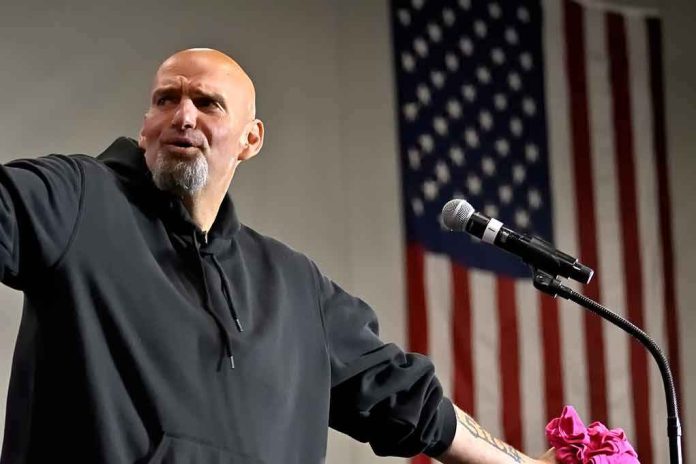
Sen. John Fetterman has treated Israel policy not as a routine floor-vote difference but as a question of party identity. In a 2026 interview, he warned that if Democrats “officially” become anti-Israel, he would leave the party—framing his concern around concrete trends: primary winners he sees as hostile to Israel and Democratic support for proposals to end military assistance. His articulation matters because it moves the disagreement from policy calibration—how much aid, with what conditions—to coalition definition: who belongs in a party that still backs Israel’s security and who does not. The Hill’s reporting captured his language unambiguously, including his focus on recent primaries and a House vote to end security aid as proximate evidence of drift.
Fetterman’s argument is, at core, a warning about thresholds. Parties absorb intense internal debate on abortion, energy, policing, and immigration without members threatening to exit. When a senator says a single foreign-policy stance could be disqualifying, he is telling donors, activists, and colleagues that this is not bargaining terrain; it is identity terrain.
When rhetoric hardens into electoral behavior
The line from ideological disagreement to electoral consequence rarely runs cleanly, but Michigan supplied a stark case. Rep. Haley Stevens, a pro-Israel Democrat, withdrew support from her party’s Senate nominee, Abdul El-Sayed, and endorsed Republican Mike Rogers late in the race. Stevens publicly cast the break as a matter of values, denouncing what she called hateful rhetoric and asserting she would be “living a lie” to back El-Sayed—language that signaled not a tactical dispute but incompatibility inside the same party coalition.
Why does one endorsement matter? Because it demonstrates a willingness among some establishment Democrats to impose a real cost on their own side over Israel-adjacent issues, even at the price of fueling the “Democrats in disarray” narrative. It also illustrates how conflicts over Israel rarely remain siloed: they entangle policing, speech norms, and the boundaries between anti-Zionism and antisemitism. That entanglement raises the stakes for electeds who see themselves as guardians of a pluralistic coalition’s red lines.
The progressive case: from critique to replacement policy
The progressive case is not limited to moral condemnation of specific Israeli governments; it advances an alternative policy architecture. The Democratic Socialists of America calls for ending U.S. military and economic aid to Israel and frames Palestinian rights—including return, self-determination, and resistance to military occupation—as foundational positions, tying them to a broader anti-militarist domestic agenda. Whether or not every progressive candidate is DSA-aligned, this published platform clarifies the end state many activists seek, not merely a pause or conditionality debate.
Candidates like Abdul El-Sayed have articulated a rights-first framework that rejects current U.S. military funding while leaving constitutional end-states in Israel-Palestine open so long as they emerge from equal self-determination by both peoples. He has described the Gaza war as genocide while explicitly rejecting antisemitism and affirming Jewish safety as non-negotiable—an attempt to separate policy critique from prejudice and to anchor support thresholds in human rights rather than alliance habits.
What public opinion has actually done—and what it hasn’t
The intraparty clash maps onto measurable shifts. Over two decades, Democrats moved from reliably favoring Israel to near parity and, more recently, to greater sympathy with Palestinians. Gallup’s trend series reports that by 2026 roughly two-thirds of Democrats said their sympathies lay more with Palestinians than with Israelis—an extraordinary reversal in a short span that supplies progressives with a claim that party elites lag their voters.
But attitude change does not automatically dictate vote choice. The evidence package documents statements, a dramatic cross-party endorsement, and specific congressional votes; it does not furnish longitudinal election analyses proving that hard-line Israel positions have, by themselves, cost Democrats general elections. That gap matters because national coalitions turn on issue salience, not just preference direction; if voters prioritize health costs or safety over foreign policy, Israel may reorder primaries and committee dynamics without deciding November outcomes.
Congressional behavior: from symbolism to roll calls
Symbolic caucus letters are easy; roll calls are not. Fetterman’s alarm rested in part on a House vote where many Democrats supported ending or restricting military aid to Israel—a notable departure from decades of near-automatic support. The Philadelphia Inquirer’s coverage underscored that this was not a messaging vote confined to the fringe; it reflected a caucus-wide divide that could, with different leadership or external events, harden into binding party planks.
Once roll-call behavior shifts, external networks move accordingly. Pro-Israel organizations have invested heavily to shape primaries and defend incumbents aligned with security assistance; progressive groups have counter-mobilized, framing their case in human-rights terms and depicting establishment resistance as donor-driven. This spending race does not resolve the argument; it ensures it will remain visible and expensive.
The WSJ did a piece on Democratic infighting and it is worth reading closely.
With control of the Senate potentially in play, the party is already finger-pointing between its moderate and progressive wings instead of unifying. The clearest flashpoint is Michigan, where… pic.twitter.com/vBraLvPxNo
— Jan (@Jan812314) November 2, 2026
Where the genuine disagreement lies
There are three real disputes, and conflating them only deepens mistrust. First, moral framing: is Gaza best understood through the language of genocide and settler colonialism, or through the language of wartime proportionality and counterterrorism? DSA and many progressive candidates adopt the former; Fetterman and allied Democrats reject it as a disqualifying redefinition of the U.S.-Israel relationship. Second, instruments: should U.S. policy suspend aid, condition it, or maintain it? The center of gravity inside the Democratic Party has shifted toward at least conditionality; the end-aid position still collides with a substantial bloc of incumbents. Third, coalition boundaries: does harsh criticism of Israel cross into antisemitism within Democratic spaces, and who adjudicates that line? Michigan’s rupture crystallized how accusations of bigotry, once introduced, make compromise far harder to sustain.
Implications: fracture, realignment, or recalibration?
Fetterman’s threat to walk sets a ceiling on how far the party can move without losing visible officeholders. The endorsement break in Michigan sets a floor on how intense the penalties can become when activists and incumbents collide. Between those markers, most Democratic politicians will try to inhabit a conditional-aid middle that emphasizes civilian protection, hostages, and a credible political horizon for Palestinians while preserving the alliance. Whether that balance holds depends on events: the conduct and duration of war, the posture of Israel’s governing coalition, and whether primary electorates continue to reward maximalist positions on either side.
The bottom line is clear: Israel has become a coalition-defining question for Democrats in a way it was not a decade ago. The evidence demonstrates real behavioral consequences—threats to leave, cross-party endorsements, and meaningful votes—aligned with a documented opinion shift among Democratic voters. What it does not yet show is a durable national electoral penalty or benefit pinned chiefly to this issue. That is why the party’s near-term future will be decided not by who “wins” the argument in principle, but by who can translate a morally satisfying position into a coalition-preserving policy that voters prioritize when they actually cast ballots.
Sources:
nationalreview.com, timesofisrael.com, washingtonexaminer.com, inquirer.com, thejewishnews.com, kutv.com, dsausa.org, shirazsocialism.wordpress.com, en.wikipedia.org