

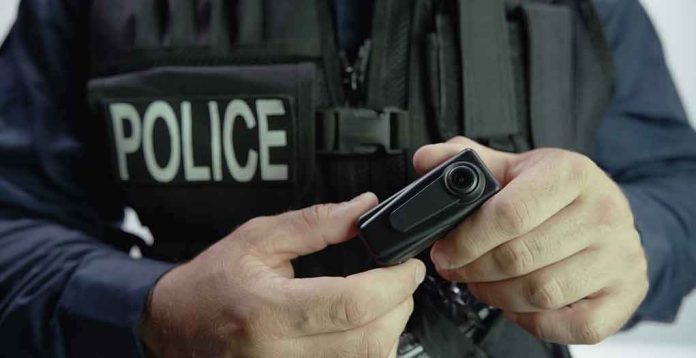
Hidden-camera arrests are built on simple devices and complex law: what looks, at first glance, like an open-and-shut upskirting case ultimately turns on whether investigators can trace specific recordings, devices, and moments to an identifiable victim under California’s privacy statutes—so the early investigative facts matter a great deal.
At a Glance
- Berkeley police detained an Oakland man after reports of a shoe-mounted camera aimed up a teenager’s skirt near UC Berkeley; officers later recovered a discarded mini-camera and found a second concealed camera in a nearby restaurant.
- Detectives executed a residential search warrant and seized multiple electronic devices tied to the case.
- Arrest bookings referenced California Penal Code sections involving concealed recording, annoying or molesting a child, and destruction of evidence.
- The department is seeking additional victims while assembling the evidentiary chain that these statutes require.
What Police Say Happened Near South Campus
According to the Berkeley Police Department, the sequence began when a teenage girl reported seeing a camera pointed up her skirt while in line at Lox Stock and Bagel. Separately, a passerby told police a man was using a shoe-mounted camera to record up women’s skirts near Durant Avenue and Bowditch Street. Officers detained a suspect in the area, searched the vicinity, and recovered a mini-camera discarded in a trash can. Later that night, detectives discovered a stationary concealed camera inside the Taco Bell Cantina on Durant. The investigation then moved to the suspect’s Oakland residence, where a search warrant yielded multiple electronic devices. Police booked the man on Penal Code sections 647(j)(2), 647.6(a)(1), and 135—respectively addressing covert upskirt recording, child annoyance or molestation, and destruction of evidence.
Those are concrete investigative milestones: independent witness accounts, physical recovery of recording hardware, and a residential seizure of electronics pursuant to a warrant. They are also the building blocks of any future charging decisions. The department publicly asked for additional victims to come forward, signaling detectives believe the conduct may have spanned several weeks in the South Campus area, though the scope ultimately turns on what the recovered devices and any business surveillance reveal.
The Law Behind “Upskirting” Cases in California
California prosecutes covert upskirt recording under Penal Code 647(j), a disorderly conduct statute that focuses on privacy invasions accomplished by optical or electronic means. Subdivision (j)(2) addresses secretly filming an identifiable person “under or through” clothing to view the body or undergarments for sexual arousal or gratification. Subdivision (j)(3)(A) covers the use of a concealed camera to secretly record another identifiable person in a place where a reasonable expectation of privacy exists, again for a prohibited purpose. Put plainly: it is not merely the presence of a device that matters; it is the covert recording of an identifiable person, without consent, under qualifying circumstances and for a proscribed purpose.
Appellate decisions underscore those elements. In People v. Johnson, the court analyzed what it means for a recorded person to be “identifiable” for 647(j)(2); a face shot is not strictly required, but the prosecution must show that the person could reasonably be recognized from the totality of the evidence—clothing, context, timestamps, distinguishing features—sufficient to tie a particular recording to a particular victim. The Johnson court’s careful parsing of instructions and proof highlights why investigators emphasize device forensics, video extraction, and situational corroboration in cases like Berkeley’s.
From Hardware to Charges: What Investigators Must Establish
The practical arc of a hidden-camera case runs from seizure to attribution. First, detectives must extract data from recovered cameras and any associated storage—SD cards, internal memory, paired phones, or cloud accounts. Second, they work to align file timestamps, GPS or EXIF metadata (if present), and visual cues with the witness timeline and physical locations. Third, they evaluate identifiability and the “sexual gratification” or other prohibited-purpose intent embedded in 647(j)—which can be inferred from camera placement, angles, concealment methods, and repeat conduct. All of that folds into a chain-of-custody narrative that can survive evidentiary challenges in court.
Berkeley’s public account fits that template: shoe-mounted and stationary cameras, a discarded mini-device, and a search-warrant seizure of electronics create multiple on-ramps for forensic work. If any device captured upskirt imagery of a person who can be reasonably recognized, the state’s burden on identifiability strengthens. If technicians recover installation traces at the Taco Bell Cantina—adhesives, mounting points, or overlapping footage with store surveillance—that can help establish control and purpose regarding that camera’s use.
Why “Identifiable Person” and “Concealed Camera” Are Pivotal
Two phrases in the statute do much of the legal heavy lifting. Identifiable person is the gatekeeper for transforming an invasive attempt into a chargeable recording event: courts ask whether someone who knows the victim could recognize them from the recording plus context, even if a face is off-frame. Concealed camera speaks to surreptitiousness—how the device was hidden or disguised to evade detection, from a shoe mount to a camouflaged lens in a fixed location. Case law has clarified both terms, ensuring the statute reaches covert electronic peeping without sweeping in benign, open recording in public spaces. That is why, in practice, cases turn on details like camera angle, mounting, field of view, and whether the imagery plainly seeks undergarments or intimate areas for sexual arousal.
The alleged shoe-mounted device described in Berkeley’s notice, if corroborated by recovered footage, tends to satisfy concealment and purpose simultaneously: a camera aimed upward from a shoe is rarely consistent with any legitimate documentation need. A stationary camera inside a restaurant, if aimed to capture upskirt imagery or restroom/queue vantage points with a privacy interest, would likewise implicate 647(j)(3)(A). These are quintessential fact questions that forensic and scene documentation can answer.
What Comes Next: Evidence, Process, and Public Safety
From here, the center of gravity shifts to digital forensics and prosecutorial screening. Expect investigators to inventory every device seized under the Oakland warrant, extract and catalog media, and compare it with dispatch logs, body-worn camera footage, and nearby business surveillance. If recordings exist that meet the statutory elements, each discrete video can support a separate count with victim notification to follow. If not, prosecutors may proceed on attempt- or evidence-destruction theories where the facts permit. The police appeal for potential victims is standard in pattern cases near campuses and transit hubs; it can surface corroborating witnesses or prompt businesses to preserve footage that would otherwise cycle out.
Sources:
nypost.com, thesanfrancisco.org, nextdoor.com