

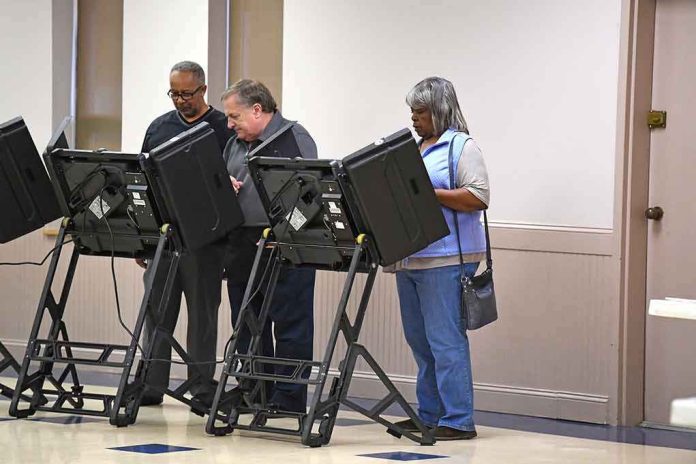
A scanner that chokes on a ballot is not the same thing as an election that fails — the two get conflated constantly, and the distinction is the whole story of what happened in Westchester County, New York, on Election Day.
Key Points
- Optical-scan machines across Westchester County stopped accepting paper ballots countywide shortly after polls opened on November 3, 2026, in the midst of a closely watched House race.
- The Westchester County Board of Elections activated its paper-ballot contingency: voters’ completed ballots went into sealed, monitored orange emergency bags for later tabulation rather than being scanned on-site.
- Rep. Mike Lawler, the state attorney general’s office, and county officials all publicly affirmed that every affected ballot would be secured and counted under bipartisan observation.
- Investigators pointed to ballot-paper and ballot-programming issues as the likely mechanical cause — not tampering — a diagnosis consistent with decades of documented optical-scan failure patterns nationwide.
- The episode is a textbook case of why paper-ballot systems with chain-of-custody procedures are built to survive hardware failure without losing votes.
What Happened on Election Day in Westchester County
Shortly after polls opened at 6 a.m. on November 3, 2026, voters across Westchester County began encountering a problem that would end up affecting every polling location in the county: scanners simply would not accept completed paper ballots. County Executive Ken Jenkins confirmed the scope quickly, stating plainly that “there is a county-wide issue at all of the polling locations where the ballot is not going through the scanner”. The timing mattered. Westchester was hosting one of the most closely watched House contests in the country, the 17th Congressional District race between Republican incumbent Mike Lawler and Democratic challenger Kate Connolly, a contest with implications for control of the chamber.
The Board of Elections moved immediately into its documented contingency posture. Voters kept filling out paper ballots by hand exactly as they would under normal conditions; those ballots were then placed into designated orange emergency ballot bags rather than fed through the jammed machines. The Board’s formal statement was unambiguous about what would happen next: “Ballots will be placed in designated orange emergency ballot bags, which will remain secure and monitored. These ballots will subsequently be counted in accordance with applicable election procedures”.
The Mechanics of an Emergency Ballot Procedure
It is worth understanding why this procedure exists and why election officials reach for it instinctively rather than improvising. Optical-scan voting, the dominant method in most American counties, separates the act of marking a ballot from the act of reading it. When the reading machine fails, the marked ballot — the actual legal record of the voter’s intent — is untouched. Poll-site observers on the ground described a process built around that separation: two Democratic and two Republican monitors staffed each table, jointly handling ballots to preserve bipartisan custody from the moment of casting through eventual transport to central counting facilities in White Plains. One voter, describing the backup process, compared it to mailing in a ballot: “it’s like the old school… it gets to get counted.”
Diagnosing the Failure
The explanation for the malfunction shifted over the course of the day, which is normal in a live diagnostic process rather than evidence of concealment. Officials first attributed the jam to the thickness of the printed paper ballots overwhelming scanner feed mechanisms. Governor Kathy Hochul floated a similar mechanical explanation publicly. By the following days, state officials and independent reporting traced the root cause to a ballot-programming mismatch: some polling locations’ scanners were running updated programming that newly printed Election Day ballots did not match, while older machines elsewhere retained original programming that also failed to recognize the ballots in use. Cyberscoop’s reporting on the final day of voting similarly described the problem as ballots being rejected because they did not conform to what the machines were configured to accept. New York Attorney General Letitia James’s office confirmed it was monitoring the situation as it unfolded.
Official Response and the Case for Confidence
Every official voice involved converged on the same message, delivered with notable speed and consistency. Lawler, appearing publicly as the scanner failures were still active, acknowledged “there is a problem with every ballot scanner in Westchester” while insisting the resolution path was already known: hand-marked paper ballots secured and hand-counted. Connolly, his opponent, echoed the same reassurance to her own supporters — an instance where both campaigns in a contested race had identical incentive to question the process and instead backed it. Hochul described the fix as proceeding “in a bipartisan way,” and local coverage carried the Board of Elections’ direct appeal to voters that “your vote matters, your ballot will be secure and your vote will be counted”. That alignment across a Republican incumbent, a Democratic challenger, a Democratic governor, and a nonpartisan county board is itself evidence worth weighing: it is difficult to manufacture that kind of cross-partisan consensus unless the underlying contingency procedure is genuinely sound.
Why Scanner Failures Happen — and Why They Rarely Cost Votes
Westchester’s breakdown fits a pattern documented well before this election. A recent academic taxonomy of optical-scan systems catalogs recurring, non-adversarial failure modes — paper jams, double-feeds, sensor degradation, paper-stock incompatibility, and programming mismatches — as routine hazards of mechanical vote-reading equipment, distinct entirely from fraud or manipulation. The Brennan Center for Justice, reviewing hundreds of reported voting-system problems over an eight-year span and studying fourteen in depth, found that most involved a temporary miscount or delay rather than a permanent loss of votes, precisely because paper backups existed to correct the record. Verified Voting’s Pamela Smith has noted that paper-thickness mismatches between printing batches and scanner calibration are “not a new issue” in American elections. A 2020 case in Cranston, Rhode Island, saw a scanner initially fail to count 9,000 emergency ballots before manual reconciliation caught and corrected the gap — a reminder that the reconciliation step, not the scanner, is what ultimately protects the count. Legal scholarship on election-emergency response likewise emphasizes that officials “had contingency measures at their disposal” in nearly every documented failure of this kind.
62/ NEW YORK, Westchester (NY-17) – County Exec Ken Jenkins now blames a "PRINTER ERROR" for the COUNTYWIDE scanner failure. He says NO software issue and NO machines hacked. Up to about 250,000 EMERGENCY BALLOTS (his max estimate) legally CAN'T be counted until polls close at 9…
— Brian Skellenger on all Platforms (@brianskellenger) November 3, 2026
What This Means Going Forward
The lasting lesson from Westchester is not that voting technology is fragile — it unquestionably is, and always has been, given machines with finite lifespans operating under enormous one-day load. The lesson is that a well-designed paper-based system is engineered to absorb exactly this kind of hardware failure without losing a single valid vote, provided custody and reconciliation procedures are followed. Westchester’s bipartisan dual-custody tables, sealed emergency bags, and centralized hand-count protocol performed as designed. The deeper, durable takeaway for any voter watching a scanner fail at their own polling place in a future election is this: ask not whether the machine broke, but whether the paper ballot survived intact and was reconciled under observation. In Westchester, by every account available, it was.
Sources:
youtube.com, timesunion.com, nbcnewyork.com, fox5ny.com, westchestercountyny.gov, dw.com, news.bgov.com, patch.com, abc7ny.com, thecrotonchronicle.substack.com, cyberscoop.com, cs.princeton.edu, eac.gov, pennstatelawreview.org, stage.eac.gov, brennancenter.org