

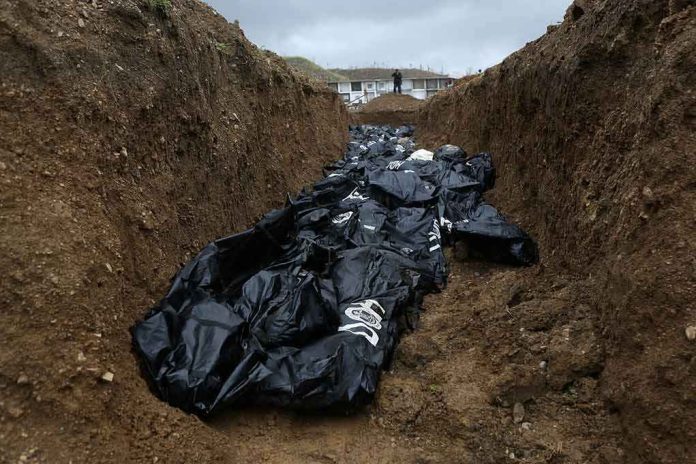
Sudan’s capital has become a place where the dead reshape the living, a city whose unmarked graves quietly predict what happens when the world stops paying attention.
Story Snapshot
- Khartoum and surrounding areas now hold thousands of unmarked and improvised graves after years of urban warfare and lawless burials.[1][4]
- Mass killing patterns in El-Fasher and Darfur help explain why so many bodies in the capital were never properly claimed, counted, or mourned.[1][4]
- Rapid Support Forces commander “Abu Lulu” became a symbol of brutality, video-documented shootings, and contested accountability.[1][2][3]
- The same technologies that distract us—phones, satellites, social platforms—now serve as the only witnesses left when graves have no names.[4]
A Capital That Turned Into A Cemetery Without A Ceremony
Khartoum did not wake up one morning as a city of graves; it drifted there one shallow burial at a time. When fighting between the Sudanese army and the Rapid Support Forces erupted into full urban war, morgues overflowed, cemeteries were shelled, and families began digging in parks, medians, and backyards.[1] Reporters later described bodies wrapped in sheets or plastic, buried at night without prayer or marker as gunfire echoed nearby, a complete breakdown of the basic human ritual of saying goodbye.[1][4]
Authorities eventually counted at least twenty-three thousand bodies collected from streets, homes, and looted sites around the capital and reburied in formal cemeteries, yet that number barely scratched the surface.[1] Estimates of the dead from the wider war run into the hundreds of thousands; millions fled their homes, leaving behind neighbors or relatives who vanished into unmarked pits.[1] Those who stayed often lacked even the tools to dig properly, scraping graves in hard ground with household shovels before the heat forced them away.
From El-Fasher To Khartoum: How Mass Killings Become Missing People
The horror in Khartoum connects directly to the more publicized massacres in places such as El-Fasher, the capital of North Darfur. Human-rights reporting and regional outlets describe how Rapid Support Forces units, sometimes under commanders like the man known as Abu Lulu, allegedly swept through districts executing civilians and prisoners, torching homes, and leaving hundreds or thousands dead in a matter of hours.[1][4] When front lines moved, many of those bodies were burned, bulldozed into pits, or left where they fell, far from any official record.
The El-Fasher massacre has become a case study in how modern atrocity forensics works. Investigators did not rely on a neat stack of government documents. They pieced together cellphone clips, satellite images of fresh earthworks, survivor testimony, and hospital logs to build a picture of coordinated killings.[4] Yet for every body counted in those files, many more in the capital and countryside slipped past any ledger, buried quickly by terrified relatives or strangers who feared looters and militias more than disease.
The Rise, Denial, And Symbolism Of “Abu Lulu”
Within this chaos, the figure of Abu Lulu emerged as a kind of dark celebrity. Arab News and others describe him as a senior Rapid Support Forces commander, distinguishable by long hair and a reputation for extreme brutality.[1] Video clips circulated that appear to show him personally shooting unarmed detainees at point-blank range after the capture of El-Fasher, turning him into the face of a broader pattern of killing already alleged against his forces.[1][2][3] For many Sudanese, his name became shorthand for the whole nightmare.
Rapid Support Forces leadership responded with a familiar modern script: public acknowledgment that crimes occurred, promises of internal investigations, and reports that Abu Lulu had been arrested by his own side.[3] That move let supporters claim the group took accountability seriously, while critics argued it looked more like damage control than justice, especially as reports later suggested he was free again.[3] From a conservative common-sense perspective, any system that allows an accused war criminal to drift in and out of custody without transparent trial fails the basic test of rule of law.
Why Unmarked Graves Matter Far From Sudan
The global audience usually reacts to places like Khartoum with a brief spike of outrage, then slips back to normal life. Yet unmarked graves carry consequences that cross borders. When no one reliably counts the dead or prosecutes the killers, armed groups everywhere learn the same lesson: atrocity pays as long as it happens off-camera or behind a blockade. That dynamic helped make Darfur’s earlier violence a prelude rather than a warning.[4] Failure to enforce lines abroad often invites erosion of norms at home.
Distinguishable by his long hair and extreme brutality, RSF commander Abu Lulu became the public face of the October 2025 massacre in al-Fashir, Sudan, after broadcasting numerous videos of himself slaughtering unarmed civilians.https://t.co/PTU6373oCZ
— Ranbir Singh (@RanbirS11414092) May 21, 2026
There is another cost, less obvious but just as corrosive. Societies built on mass anonymous death struggle to rebuild trust, markets, and basic civility. Property disputes multiply when owners vanish without documents; children grow up without knowing where their parents lie; conspiracy theories thrive because facts are literally buried. A culture that believes life is cheap enough to dump in an unmarked grave rarely produces the stability, enterprise, or ordered liberty that conservatives prize and investors quietly demand.
Sources:
[1] Web – What the RSF’s slaughter of civilians in El-Fasher reveals …
[2] YouTube – Sudan War: How Abu Lulu Became ‘The Butcher Of Al …
[3] YouTube – RSF fighter accused of atrocities freed: Arrested ‘Abu Lulu’ …
[4] Web – El Fasher massacre – Wikipedia