

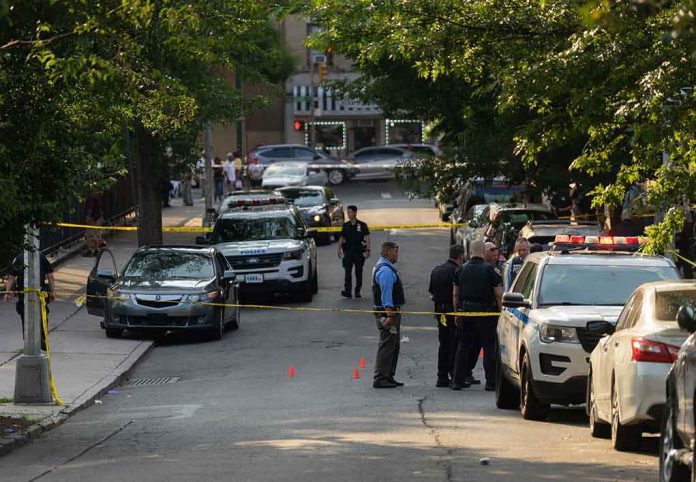
Autopsies don’t settle every question in a disputed shooting—but when they are clear on wound path and range, they redraw the boundaries of any credible account; in the Tyrin Johnson case, the official autopsy places the fatal bullet’s entry in his back, which materially contradicts the initial account that he was facing the Tennessee National Guard when they fired.
The Short Version
- The Shelby County medical examiner’s autopsy documents a single bullet entering Johnson’s back and exiting his chest; trajectory is back-to-front.
- Authorities first said Johnson turned toward National Guard members with a gun; the autopsy constrains that narrative.
- The death was ruled a homicide by the medical examiner, a classification of manner of death, not a criminal determination.
- Forensic trajectory narrows possibilities but cannot, by itself, reconstruct posture, timing, or threat without scene evidence, video, and witness testimony.
What the autopsy establishes and why it matters
According to reporting based on the Shelby County medical examiner’s autopsy, 20-year-old Tyrin Johnson sustained a single gunshot wound that entered the right side of his back and exited the upper right chest; the described trajectory is back-to-front, slightly upward, and to the right. Separate outlets that obtained or reviewed the report reached the same core conclusion: the fatal shot entered from the back. Local coverage likewise noted the examiner’s finding and added that the death was certified a homicide—the standard medicolegal term when death results from another person’s volitional act, irrespective of criminal culpability. Those concrete elements are not semantic; entry location and ruled manner of death are load-bearing facts that shape any defensible reconstruction.
The initial public account from authorities said Johnson turned toward National Guard members with a firearm during a foot chase, prompting them to shoot. That description, if taken at face value as the moment of firing, is difficult to reconcile with a single round entering the back. It does not, on its own, answer every question about how fast events unfolded or whether body orientation changed within fractions of a second; it does, however, place a high burden on any theory that hinges on Johnson squarely facing the shooters at the time of the shot.
What trajectory can tell you—and what it cannot
Gunshot trajectory documented at autopsy can be probative. When a bullet’s path is back-to-front and slightly upward, it narrows plausible relative positions: the shooter was somewhere behind the decedent at the instant of penetration, and vertical angles may reflect height differences or body motion. Yet decades of casework and published guidance make clear that wound trajectory alone cannot resolve posture, threat perception, or sequence without correlates: scene ballistics, recovered projectiles, stippling or soot that indicate range, time-synced video, and witness accounts. Bodies bend and rotate in motion; bullets yaw in tissue and can deflect off bone. An honest reconstruction integrates all of it or refrains from overreach.
Here, press accounts of the autopsy emphasize the absence of close-range markers—no soot, stippling, or muzzle imprint—around the wound, which suggests the shot was not at contact or near-contact range, though precise distance requires weapon and ammunition-specific test-firing. That finding, paired with a single back entry, rules out a struggle at arm’s length at the moment of penetration but leaves open the broader geometry of a nighttime foot pursuit.
The competing narratives and the current evidentiary weight
There are two public narratives. The first, from police and echoed in early statewide briefings, asserts that Johnson turned toward National Guard members with a gun and was then shot. The second, grounded in the medical examiner’s autopsy as reported by multiple outlets, documents a back entry wound with a back-to-front trajectory and notes the manner of death as homicide. No publicly cited material in the record offered a technically specific rebuttal to the autopsy’s wound-path conclusion. In an evidence-weighing exercise, the autopsy’s concrete anatomy typically carries more force than a generalized “turned toward” description—especially when the two are in tension.
None of this, by itself, adjudicates criminality or policy compliance. The Tennessee Bureau of Investigation opened a use-of-force review and stated that two Guard members fired their weapons—an important fact for later scene reconstruction and round attribution. That process, if thorough, will test firearm function, examine trajectory rods through strike evidence at the scene, and correlate times and positions from body-worn cameras (if any were in use by local police partners), fixed cameras, and radio logs. Until that composite record is public, the most defensible statement is narrow: the fatal round entered Johnson’s back, which materially conflicts with the straightforward version that he was facing the shooters at the moment they fired.
How we got here: the operational and oversight context
The soldiers involved were Tennessee National Guard members assigned to a federal-local anti-crime initiative operating in downtown Memphis. Such task forces pair military personnel in Title 32 or state active-duty statuses with local agencies for presence patrols and response. When Guard troops serve in support of law enforcement, their use-of-force authorities, training currency in urban policing scenarios, supervision, and equipment (including cameras) vary by mission order and memorandum of understanding. Disputed shootings in these blended teams place unusual stress on oversight systems: civilian investigative agencies must parse mixed chains of command, distinct records systems, and sometimes divergent training doctrines. That is not an argument against such deployments; it is a practical reason why documentation discipline—who fired, how many rounds, what policy governed those rounds—has to be crisp.
In Memphis, coverage indicates that two Guard medical specialists rendered aid immediately after the shooting, and Johnson was pronounced dead at the scene. The TBI assumed the lead investigative role, as is customary in Tennessee for officer-involved shootings that may involve state actors beyond local police. Those are process guardrails; their integrity will ultimately be judged by the transparency and completeness of the public case file.
🔔MEMPHIS: “Authorities said Tyrin Johnson turned toward the National Guard with a gun while running from them… But autopsy shows a bullet went in his back and exited through his chest…”
One Guard member who fired was 19 years old, even too young to be Memphis PD.
No body… pic.twitter.com/jafQtENUr5— DulceBiatch (@BiatchDulce) August 28, 2026
Practical implications for accountability and policy
When an autopsy circumscribes the plausible moment-to-moment narrative as sharply as this one appears to, agencies face a choice. They can either produce corroborating evidence that reconciles the back-entry finding with the moment of perceived threat—say, video capturing a near-simultaneous turn and shot fired from behind—or revise the public account to conform to the physical record. The worst option is to leave the contradiction hanging; it erodes credibility beyond the single case. For families, the homicide ruling is often misunderstood as a legal conclusion. It is not; it is the medical examiner’s classification that the death resulted from another person’s action. Prosecutors still decide whether that action was legally justified.
The larger lesson is not novel but bears repeating: in use-of-force controversies, avoid overweighting any single datum in isolation, but also resist flattening inconvenient facts into ambiguity. Here, the single datum—a back-entry wound—does real work. It does not tell us everything, but it does tell us some things. Any final account that asks the public to believe Johnson was squarely facing the shooters when the bullet struck must carry the burden of explaining how a back entry occurred; until such an explanation is supported by scene evidence, the autopsy’s constraint stands at the center of the case.
Sources:
military.com, commercialappeal.com, actionnews5.com, abcnews.com, apnews.com, independent.co.uk, dailymemphian.com, shelbycountytn.gov