

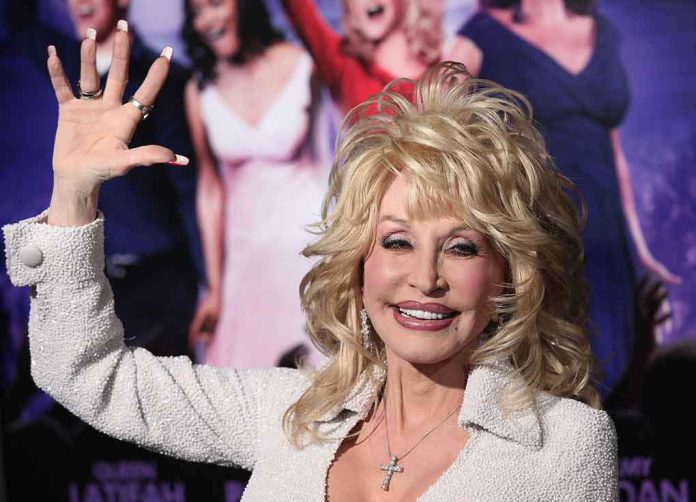
When a newsroom misidentifies a face in a moment of national mourning, it’s not a trivial production glitch; it’s a stress test of editorial discipline in the very medium—television—where images carry the authority of truth.
The Short Version
- CNN apologized after airing a photo of tribute artist Kelly Vohnn during coverage of Dolly Parton’s death, calling it a mistake tied to a specific Laura Coates Live segment.
- Multiple independent outlets described the same sequence: a mistaken image on air followed by CNN’s “we regret the error” apology to Parton’s family.
- Vohnn publicly clarified she has never represented herself as Dolly and criticized the lapse in verification.
- Misidentifying a photo is a well-documented newsroom failure mode—especially in fast-turn obituary coverage—and it predictably damages credibility even when corrected.
What actually happened and why it matters
The core facts are straightforward and broadly uncontested across mainstream and entertainment press. During an evening edition of Laura Coates Live, CNN’s on-air package about Dolly Parton’s death included an image that was not the country icon but Las Vegas tribute performer Kelly Vohnn. After the broadcast, CNN issued a brief apology to Parton’s family—“We regret the error”—acknowledging the misidentification and tying the mistake to that segment rather than a vague network-wide mishap. Independent coverage from multiple outlets replicated the backbone of events: a wrong photo aired, the person pictured was a professional Dolly tribute artist, and CNN apologized. As postmortem errors go, this one lands in a particularly sensitive genre—obituary reporting—where even small inaccuracies feel disrespectful and the audience’s tolerance for sloppiness collapses.
Vohnn, for her part, made two clarifying points that cut through speculation. First, she rejects any suggestion that her public persona sowed confusion—she presents herself as a tribute act, not Dolly Parton. Second, the image CNN used was from a prior red-carpet event, not the night of the broadcast, reinforcing that the error originated in newsroom selection and verification, not in an ambiguous real-time scene. None of that absolves or damns CNN; it simply fixes responsibility on the editorial pipeline that chose and cleared the frame.
How this kind of error happens on television
Television newsrooms build tribute packages under time pressure: producers commission a voice-over, segment editors assemble B-roll, and a graphics team sources stills—often drawing from internal archives and agency wires. The failure modes are predictable. An image can be miscaptioned in an archive years earlier and resurface with false authority. A search query can surface a visually plausible but wrongly labeled photo from a third-party source. A producer can match “the look” rather than the provenance and skip the final, tedious cross-check: does this image exist elsewhere with a consistent caption; does reverse image search return the same person; do the facial features match verified samples across decades? Visual misinformation research has documented how often incorrect photos slip through when verification discipline gives way to speed; corrections are feasible, but the reputational hit is real.
Best-practice playbooks in visual verification are not exotic. They emphasize triangulation (compare with agency and staff archives), metadata review (date, creator, caption history), and quick reverse-image searches to surface prior uses and captions. They also recommend maintaining internal “tricky images” lists for high-profile subjects frequently impersonated or costumed, precisely to prevent tribute-coverage misfires. In other words: this is a solvable operational problem when teams institutionalize the checks and treat photo IDs as editorial, not cosmetic, work.
What we know—and don’t—about CNN’s internal breakdown
The public record establishes the apologetic outcome but is thin on the internal autopsy. We don’t have CNN’s full control-room rundown, the asset manifest for the segment, or a standards-and-practices memo laying out where the chain failed. That leaves open which of the classic failure modes applied: a mislabeled internal asset, an agency pull with a flawed caption, or a last-minute production swap that bypassed review. Importantly, there is no credible counter-claim disputing that the wrong photo aired or that CNN apologized; the disagreement is not over the occurrence but over what the lapse signifies about institutional reliability.
In the absence of a formal debrief, common sense suggests the weak link lived where it usually does: the coupling of fast-turn packaging with insufficient image provenance checks. That diagnosis isn’t a culture-war flourish; it is the mundane reality of broadcast workflows under deadline. The corrective action that would actually restore trust is equally unglamorous: document the sourcing path, fix the archive labels, reinforce the verification gate, and state publicly what changed.
Why obituary coverage heightens the stakes
Obituaries are not just “any” content block. They carry affective weight for audiences and reputational weight for newsrooms. The line between tribute and exploitation is thin; mistakes that might be tolerable in less charged contexts feel callous or amateurish when attached to a death notice. Industry ethics guidance on corrections underscores two imperatives here: speed in acknowledging and fixing the error, and transparency sufficient to persuade a skeptical reader that the root cause has been addressed. A minimalist apology may be necessary, but it is rarely sufficient to inoculate a brand when the error concerns a figure as beloved and visually distinctive as Dolly Parton.
There’s also a technical dimension: the more iconic a subject’s “look,” the more plentiful and convincing the imitations, and the greater the need for provenance-first verification over appearance-first selection. Tribute economies in entertainment cities like Las Vegas virtually guarantee that high-fidelity likenesses will be widely photographed and shared, making reverse-image search and caption history reviews table stakes rather than optional steps.
The signal from the noise: what this does—and doesn’t—prove
Does one misidentified image prove a network is systemically unreliable? No. It proves what the research literature has said for years: under deadline pressure, visual verification is a brittle control unless it is ritualized into process and audited routinely. At the same time, the public is not obliged to grade on a curve; for viewers, the screen either gets the face right or it doesn’t. Reputations are cumulative, and visible mistakes punch above their statistical weight. That’s the communications reality any broadcaster must manage—especially when the subject is a cultural icon whose image is itself part of the story.
What would a proportionate, credibility-enhancing response look like? Three moves. First, a precise correction log that identifies the image source and the exact verification step that failed. Second, a standards update that formalizes reverse-image checks and multi-source caption confirmation for all obituaries and memorial packages, with a named gatekeeper accountable for sign-off. Third, a brief on-air correction in the same program slot to close the loop with the audience. None of this is punitive; it’s how institutions translate contrition into competence.
CNN has offered the family of Dolly Parton an apology after erroneously showing viewers a photo of a Las Vegas-area impersonator rather than the actual country music legend while airing a tribute.https://t.co/jSxU0SGqHv
— Katie Liane (@TheKaterPotater) August 28, 2026
The durable lesson for any newsroom
Television trades on visual authority; that authority is earned in the unglamorous layers of sourcing, labeling, and verification that most viewers never see. The CNN–Dolly Parton mix-up is a reminder that in the age of high-fidelity impersonation, getting the picture right requires process that is as disciplined as the words read from the prompter. Build that discipline into the workflow, and these errors become rare and containable. Treat images as decoration, and you will eventually apologize in prime time.
Sources:
washingtontimes.com, noticias.foxnews.com, x.com, reddit.com, instagram.com