

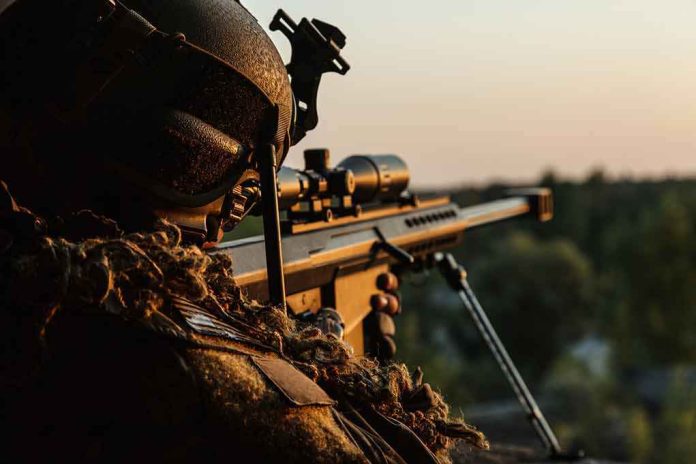
A Marine sniper veteran traveled to Ukraine to meet the Ukrainian intelligence operative known as “Lektor,” the man publicly credited with a 2,069-meter combat shot; that encounter anchors a forthcoming short documentary and offers a rare window into how elite sniping, wartime storytelling, and military craft intersect.
The Short Version
- Air Force Times reports Marine sniper veteran Colby Barrett went to Ukraine to spend time with “Lektor,” the DIU sniper tied to a 2,069-meter shot.
- Ukraine’s Defence Intelligence attributes the shot to Lektor and published technical specifics: rifle, caliber, posture, moving target, and date.
- The visit is tied to a short documentary, positioning first-person material to reach the public.
- The 2,069-meter distance is significant but should be understood as a caliber- or country-level benchmark, not an all-time world record.
What happened and why it matters
Air Force Times identifies Barrett as a Marine sniper veteran who “headed to Ukraine to spend time with one of Ukraine’s elite snipers, call sign Lektor,” with that trip feeding a short documentary project that will bring new primary material to an otherwise carefully guarded operational world. Lektor is the sniper Ukraine’s Defence Intelligence (DIU) credited with hitting a Russian soldier at 2,069 meters on December 16, 2024—using a Sako M10 chambered in.338 Lapua Magnum, firing from a trench position, and striking a moving target with the first shot. Independent Ukrainian outlets repeated those details soon after DIU’s publication, underscoring the same core elements: weapon, caliber, date, call sign, and range.
This pairing—an American veteran engaging directly with the Ukrainian sniper at the center of a widely cited long-range event—matters for two reasons. First, elite sniping is a craft where the mechanism of success is largely invisible to the broader public; contextualizing technique, equipment, and process helps readers understand what “skill at range” really entails. Second, the meeting and documentary promise first-person testimony that moves beyond terse communiqués, without breaching operational security. In the world of precision marksmanship, narrative is often the only unclassified artifact left standing after the smoke clears.
How a 2-kilometer shot is built: mechanism and constraints
At 2,069 meters, ballistic realities dominate. A.338 Lapua Magnum projectile fired from a Sako M10 exits at supersonic speeds, but by two kilometers it is arcing steeply, spending several seconds in flight while gravity, temperature, air density, crosswinds, and spin drift compound. Even small misreads amplify downrange; a one-mile-per-hour wind error can shift point of impact by feet, not inches. The shooter’s team must solve a fluid calculus: confirmed range via laser or mil reticle; wind calls broken into near, mid, and far-field bands; Coriolis and spin drift applied; rifle leveled to avoid cant error; and elevation dialed to meters of drop rather than centimeters. On moving targets, lead must reflect both target speed and wind vector; a first-round hit implies not only a clean firing solution but disciplined trigger work, recoil management, and a stable, natural point of aim—made harder still if the shooter is standing in a trench, as DIU described.
Snipers do not work at the edge of capability by accident. The Sako M10 is a modular precision platform with the build quality to maintain sub-minute-of-angle accuracy; paired with match-grade.338 LM, it provides the exterior-ballistics headroom required to keep the bullet stable at long range. Yet hardware does not carry the day alone. Planning, observation, and rehearsed corrections make the improbable possible, which is why elite units devote disproportionate training to reading mirage, counting cycles in gusting wind, and verifying dope (the rifle’s ballistic dataset) across temperatures and elevations.
What the record actually is—and what it isn’t
When reports invoke “record,” the term needs a frame. DIU and subsequent coverage highlighted the 2,069-meter figure and the.338 Lapua Magnum chambering; that combination—caliber, platform, conditions—defines the meaningful benchmark here. It is not the longest reported sniper shot in history. British Army sniper Craig Harrison recorded a 2,475-meter confirmed combat hit in Afghanistan in 2009, using an Accuracy International L115A3 in.338 LM—an often-cited standard in the community. Framing the Ukrainian shot as a national record or a notable.338 LM achievement—rather than an absolute global superlative—keeps the claim precise and useful. Precision in language mirrors precision in marksmanship.
The crucial takeaway is not leaderboard vanity; it is capability signaling. A trained sniper, properly equipped and supported, can deliver decisive effects well beyond what most ground units experience daily. Across a front where drones, artillery, and electronic warfare dominate headlines, a two-kilometer rifle shot is a reminder that disciplined human skill can still exploit a fleeting window and change the tactical equation.
Documentation, narrative, and the role of a documentary
Barrett’s visit is part of a short documentary effort described in Air Force Times and echoed by Army Times’ coverage slate, which positions forthcoming footage and interviews to add granularity to the bare facts now in circulation. Wartime intelligence services communicate for multiple audiences—domestic, allied, adversary—and long-range sniper narratives serve tactical morale and strategic messaging alike. Scholarly and defense-community work has mapped how militaries use social media and public messaging to signal competence, recruit, and shape perception of capability; DIU’s release lives in that ecosystem without reducing to it. A well-made documentary can complement official statements with practitioner detail: terrain selection, range confirmation methods, wind-reading heuristics, and how a team manages risk when a target is moving inside a narrow time window.
There is a necessary boundary. Active operators guard identities, locations, and techniques that would aid an adversary. That is why much of what matters in elite sniping is conveyed through disciplined storytelling rather than raw, disclosive data. The task for any filmmaker in this space is to honor operational security while still showing viewers the craft—the checklists, the mental models, the friction—behind the shot. Done right, that balance educates without compromising.
Why elite sniping still matters on a sensor-saturated battlefield
Modern battlefields teem with sensors, drones, counter-battery radars, and AI-enabled target recognition. Yet marksmanship at range retains asymmetrical value. It is quiet, discriminating, and psychologically potent; it can disrupt leadership movement, force an opponent to slow or mask, and shape micro-terrain behavior along a sector. Long shots, even when rare, expand the decision space of small units: they create a bubble where enemy exposure entails unacceptable risk. For allies and observers, the combination of trained shooters, proven rifles, and well-understood ballistics demonstrates that precision lethality does not require exquisite, high-signature platforms to be decisive.
What to watch next
Three practical developments will determine how this story evolves. First, the release of Barrett’s documentary—especially if it includes on-camera conversation with Lektor—will add texture to the DIU account and show the human processes behind the 2,069-meter event. Second, continued Ukrainian and partner reporting may refine the “record” taxonomy around caliber, national benchmarks, and conditions, keeping public conversations tethered to technically accurate categories. Third, whether or not additional operational detail can be shared, the enduring lesson is already visible: long-range precision is a systems skill, requiring sound rifles, quality ammunition, disciplined range and wind work, and teams trained to solve a complex shot rapidly and cleanly. That is the quiet craft behind the headline range.
Sources:
airforcetimes.com, gur.gov.ua, focus.ua, mil.in.ua, armytimes.com, cyberdefensereview.army.mil, apps.dtic.mil, en.wikipedia.org, interestingengineering.com, costsofwar.watson.brown.edu, sto.nato.int