

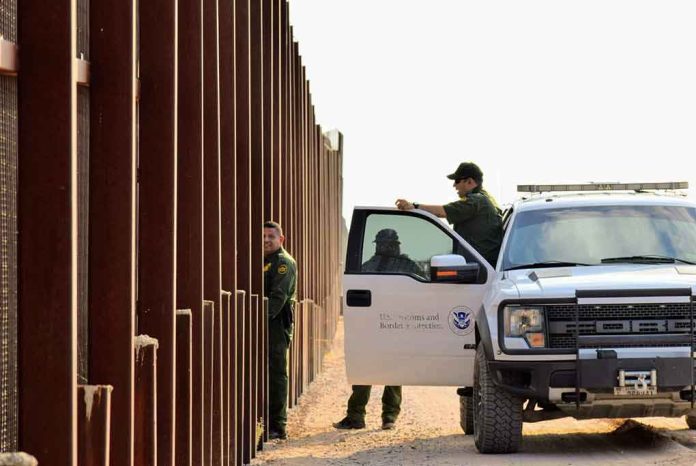
Emergency Supreme Court bids are never just about procedure; they are about what a government says it must do immediately to avert concrete harm. In the Big Bend border-wall case, the Justice Department’s application puts a sharp point on that claim: it argues that leaving a 300-plus-mile opening in fortified sectors invites displacement of crossings and cartel activity into one of the most remote stretches of the Rio Grande, and that Congress armed DHS with waiver tools to move fast in precisely these circumstances.
At a Glance
- The Justice Department asked the Supreme Court to lift a district-court injunction halting DHS’s wall and road work in the Big Bend Sector, invoking the Court’s emergency authority.
- The government argues that a prolonged gap in border infrastructure will redirect illegal crossings and smuggling to this 500-mile frontier, frustrating enforcement.
- The dispute centers on DHS waivers that set aside environmental and historic-preservation laws; the district judge preliminarily found DHS likely exceeded its authority.
- Opponents warn of irreparable environmental harm, loss of river access, and cultural impacts, and say Big Bend’s terrain already deters crossings.
What the government is asking the Supreme Court to do—and why
The Justice Department has taken the unusual step of seeking emergency relief from the Supreme Court to resume wall and related infrastructure construction in West Texas’s Big Bend Sector, after a district judge issued and then declined to pause a preliminary injunction blocking DHS waivers. The filing asks the justices to lift that injunction, characterizing it as a constraint on efforts to secure a large portion of the southern border. Reporting on the application quotes Solicitor General D. John Sauer asserting that the order “significantly frustrates the government’s ability to stop the flow of illegal aliens and drugs,” and warning that a 300-plus-mile gap acts as a “dangerous magnet” for exploitation as neighboring routes harden.
Scale is central to the appeal. The Big Bend Sector spans more than 500 miles of river border and covers 77 Texas counties—roughly a quarter of the southern frontier by the administration’s framing. In the government’s account, allowing litigation to idle construction across that expanse creates operational risk disproportionate to a single project segment. Emergency stays are extraordinary; the government must show a likelihood of success on the merits and that irreparable harm will occur absent immediate relief. Here, DOJ places its weight on both the breadth of the injunction and the predicted displacement effects on trafficking patterns.
The legal hinge: DHS waiver authority and the district court’s contrary view
The case turns on a statutory device Congress has used for nearly two decades: DHS’s power to waive laws that would otherwise slow border-barrier projects. Plaintiffs targeted three DHS waivers that cleared the way for barriers, roads, and related works across a planned stretch in the Big Bend corridor; the district court enjoined their use, concluding DHS had likely exceeded its authority or applied it unlawfully. That preliminary finding—combined with the court’s rejection of a stay—forced the federal government to seek immediate appellate intervention rather than wait for a full merits judgment.
Waiver authority has withstood multiple challenges, but its contours are contested. Critics argue that serial, large-scale waivers transform a targeted tool into a blank check to bypass dozens of environmental and cultural-protection statutes; defenders answer that Congress anticipated urgent border infrastructure needs and insulated DHS determinations to avoid paralysis. The government’s Supreme Court bid implicitly leans on that latter reading. Yet in this case the district judge credited the plaintiffs’ claims enough to freeze the waivers and cite probable illegality and irreparable harm—an institutional headwind the government must overcome to win an emergency stay.
Security need versus evidence: what we know and what is predicted
The administration’s core operational claim is a prediction: left unfortified while other corridors harden, Big Bend becomes the path of least resistance. The filing, as described in coverage, does not put forward sector-specific interdiction data, dated intelligence assessments, or a model tying barrier placement in that terrain to measurable reductions in crossings or smuggling. That does not mean the risk is illusory; displacement and route adaptation are a constant in border enforcement. But as a matter of record, the government has not publicly anchored its warning in granular Big Bend analytics within the reporting available here.
The broader empirical literature neither rescues nor defeats the claim on its face. Studies of barriers show mixed effects: some find meaningful reductions at treated segments; others find no net effect once route substitution is accounted for. Global and U.S.-focused work has documented that physical barriers can deter at a point but often shift flows rather than eliminate them; conversely, country-specific analyses—such as research on the Israel–Egypt barrier—have found sharp drops in unauthorized entries, albeit in very different geographic and operational contexts. In short, the effectiveness question is location- and design-contingent; predictive judgments deserve scrutiny proportional to the environmental and legal tradeoffs they justify.
Environmental, cultural, and access objections raised by opponents
Opposition in this case coalesces around two themes: process and place. Process-wise, plaintiffs say DHS’s waivers unlawfully set aside bedrock protections to fast-track a 175-mile stretch of barrier and roads. Place-wise, they argue the works would carve through sensitive Chihuahuan Desert habitat, isolate wildlife populations such as black bears and Carmen Mountains white-tailed deer, damage archaeological and Indigenous resources, and sever public and outfitter access to iconic segments of the Rio Grande corridor. These harms, they contend, are irreparable and demand a halt while courts test DHS’s authority.
The district court credited that posture at the preliminary stage, citing public interest and irreparable harm in issuing the injunction. Some advocates go further rhetorically, labeling the project an attack on a national park; while advocacy language is not proof, the legal hook is concrete: were the waivers unauthorized or improperly applied, the underlying environmental statutes would again restrain construction pending compliance. The government responds that Congress anticipated just such tensions at the border and empowered DHS to navigate them via waiver when operational necessity requires it.
How emergency stays are decided—and what will matter most
On an emergency application, the Supreme Court weighs four familiar factors: likelihood of success, irreparable harm, the balance of equities, and the public interest. The government’s challenge here is twofold. First, it must persuade the justices that DHS’s waiver authority—as used in Big Bend—is likely lawful despite the district court’s contrary assessment. Second, it must carry the irreparable-harm showing with more than a general proposition that barriers help; it needs to tie the injunction to concrete, near-term operational risk across a region the size of a small country. The sector’s vast, rugged geography cuts both ways in that analysis: it complicates construction and maintenance, but it also magnifies the consequences of a policy vacuum if displacement pressure is real.
The equities are likewise divided. Delay risks sunk costs and lost time if the government ultimately prevails; proceeding risks permanent alteration of landscapes and resources if plaintiffs are right. That is why the Supreme Court’s emergency docket—fast, blunt, consequential—tends to favor clear legal authority and well-substantiated harm over contested predictions. In this record, the legal question about the scope and deployment of DHS waivers is the hinge. If the Court sees a strong likelihood that Congress permitted precisely this waiver posture, the balance may tip toward allowing construction to resume while litigation continues. If not, the injunction is more likely to stand through the ordinary appellate path.
Trump asks US Supreme Court to allow Big Bend border wall construction https://t.co/SarhhqJvwt
— The Straits Times (@straits_times) October 21, 2026
The policy stakes beyond this case
Big Bend is not an outlier but a reprise of an enduring border-policy dynamic: executive urgency met by statutory and environmental guardrails. There is no single, universal answer to whether walls “work”; they can measurably reduce traffic in built segments yet fail to reduce overall flows if the system merely re-routes. That uncertainty places a premium on sector-specific evidence—crossing patterns, seizure data, terrain-informed engineering, hydrology—before invoking waivers that suspend laws designed to protect irreplaceable places. However the Supreme Court disposes of the stay, the lasting lesson is the same: decisions at the emergency margin are strongest when the government couples clear legal authority with a transparent, location-grounded operational case.
Sources:
cbsnews.com, news.bloomberglaw.com, bloomberg.com, washingtontimes.com, thehill.com, newsday.com, clearinghouse.net, unu.edu, washingtonexaminer.com