

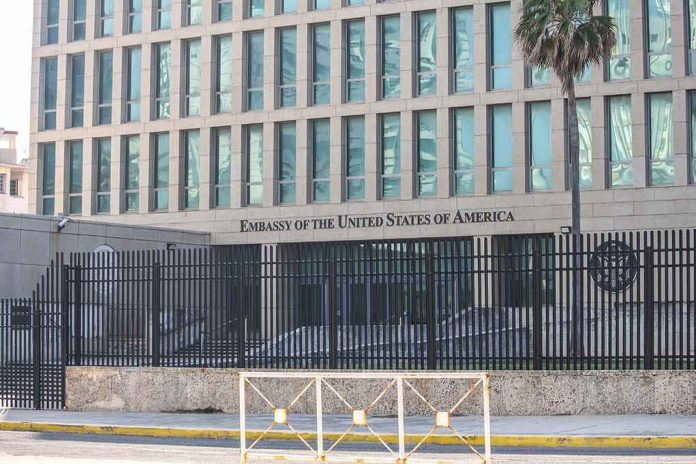
When Washington places an embassy on ordered-departure status, it is not theater; it is a hard pivot in risk management that keeps core diplomacy running while moving non-essential people out of a deteriorating threat envelope.
The Short Version
- The U.S. Embassy in Saudi Arabia shifted from authorized to ordered departure on March 8, 2026, directing non-emergency U.S. government employees and all U.S. government family members to leave.
- The order followed a worsening security environment tied to Houthi attacks, including threats to Red Sea shipping and civilian infrastructure inside the kingdom.
- State clarified that the order applied to Saudi Arabia only, countering early broad media characterizations that implied a region-wide evacuation.
- “Ordered departure” is a technical operating status: essential diplomatic functions continue while headcount is reduced to mitigate risk.
What Washington Ordered, and Why It Matters
On March 8, 2026, the U.S. Embassy in Saudi Arabia announced that the Department of State had moved post to an ordered-departure footing, requiring non-emergency U.S. government employees and all U.S. government family members to depart the country. The notice explicitly referenced the security environment and amended a March 3 authorization that had allowed voluntary departure; by the 8th, the calculus had shifted from “may leave” to “must leave.” The advisory also pulled a salient threat vector into view: recent Houthi attacks in the Red Sea were now part of the risk picture facing U.S. government dependents and non-essential personnel in the kingdom.
State Department spokesperson Tommy Pigott underscored the scope in plain language the same day: the ordered departure applied in Saudi Arabia only, and it covered non-emergency personnel and family members. He linked the decision to Iranian-supported Houthi activity, citing attacks on civilian airports and critical infrastructure that produced casualties and disrupted travel—exactly the sort of pattern that raises risk tolerance questions for dependents and staff whose presence is not mission-critical.
How “Ordered Departure” Works in Practice
Inside the State Department’s personnel system, ordered departure is a formal security and resourcing status change. It compels a reduction of the footprint to essential operations—ambassadorial representation, political and economic reporting, consular crisis response, security, logistics—while mandating that family members and non-emergency employees leave. It is not synonymous with “embassy closed” or even “skeleton crew.” As past drawdowns in Kabul and Kyiv demonstrated, the designation can persist while a post continues high-tempo work; in Afghanistan, ordered departure coexisted with an intensive final phase of withdrawal planning, secure material disposition, and coordination with interagency partners.
That distinction is not pedantry. Headlines often compress any headcount reduction into “evacuation,” which suggests a complete shutdown. In reality, ordered departure is designed to sharpen the mission, reduce exposure for those not needed to execute it, and give Diplomatic Security tighter control over protective assets and safe-haven planning. Flights, manifests, and safe-haven locations are handled through established lanes; some families depart commercially, others via charter or coordinated lifts, while the core team implements continuity-of-operations plans and prepares for contingencies.
The Threat Picture Driving the Decision
The embassy’s advisory tied the departure order to recent Houthi attacks affecting the Red Sea corridor, a shipping lane whose disruption reverberates well beyond maritime insurance markets. When state or proxy actors extend targeting from sea lanes to airports and energy or transport nodes, the risk to non-essential personnel and dependents rises nonlinearly: shelter-in-place becomes less viable if critical infrastructure and travel arteries are themselves intermittently targeted or shut. That is precisely the risk framing State referenced when connecting the order to attacks on civilian airports and infrastructure that produced casualties and significant travel disruption.
The maritime side of the threat picture was also well documented by U.S. transportation and maritime security bulletins during this period, which cataloged Houthi missile and drone activity against commercial shipping in the Red Sea approaches and along the Saudi coast. Incidents such as strikes reported off Yanbu illustrated both reach and persistence—capabilities that force U.S. risk managers to assume broader, less predictable spillover effects when calculating post status and family safety.
Why Early Media Framing Diverged—and Why the Official Scope Stands
Initial wire reports leaned into the language of sweeping departure—“all American staff and families”—and, in some instances, gestured toward a multi-country drawdown across Gulf posts based on unnamed officials. Within hours, State publicly tightened the aperture: the ordered departure applied to Saudi Arabia only, and specifically to non-emergency personnel and all family members. The embassy’s own advisory aligns with that narrower, technical scope.
Two dynamics explain the gap without resorting to conspiracy: first, “ordered departure” and “evacuation” are routinely conflated in public shorthand; second, interagency planning often contemplates multiple posts and scenarios before a formal order is issued, and those preparatory conversations can surface in reporting. The decisive data point is the named, on-record guidance and the post’s published advisory. On both counts, the scope is clear.
Continuity, Not Closure: What Keeps Running at Post
For American citizens and Saudi partners, the practical question is what continues. The answer: almost everything that requires an embassy to be an embassy. Consular sections prioritize emergency services—lost passports for citizens, crisis assistance, and coordination on detainee or casualty cases. Political and security reporting intensifies rather than contracts during an ordered departure, feeding Washington with threat and stability assessments. Security teams harden residential and chancery sites for the reduced footprint, adjust motorcade profiles, and coordinate with host-nation counterparts for rapid response. Public-facing services that are labor- and space-intensive—routine visas, cultural programming—may slow or pause, but the machinery of statecraft remains engaged.
Historically, ordered departure is also reversible; as the security environment stabilizes, State can authorize return of dependents and non-emergency staff in phases. The inflection points are empirical: attack tempo and type, host-nation mitigation efficacy, mobility reliability (airports, airspace, and main supply routes), and the posture of U.S. and partner defensive systems covering likely threat vectors.
U.S. Gulf Embassy Evacuations: Iran War and Airline Disruption: U.S. Gulf embassy evacuation plans raise Iran escalation fears as Saudi airport attacks threaten airlines, tourism and… dlvr.it/TW10D4 #AirspaceRestrictions #Gulfairlines #Iran #Qatar | breaking news | pic.twitter.com/nJNJqVnzi2
— eTurboNews | Trends | Travel News (@eTurboNews) October 21, 2026
Implications for Americans in the Kingdom and the Region
For private U.S. citizens living or traveling in Saudi Arabia, the embassy’s status shift is a signal to refresh personal risk calculations. It does not mean “get out now,” but it does mean build redundancy into travel plans, monitor embassy alerts, and maintain a higher baseline of situational awareness. Employers with duty-of-care obligations should validate evacuation and shelter-in-place plans against a scenario set that includes short-notice airport closures and air defense activity near urban centers—conditions that we have seen correlate with travel disruption and heightened civilian risk when ballistic or drone threats extend beyond front-line zones.
What to Watch Next
The ordered departure will endure only as long as its predicates hold. Three indicators matter most. First, attack patterns: a sustained reduction in Houthi long-range strikes on Saudi infrastructure and commercial shipping would lower ambient risk. Second, transport resilience: consistent airport operations and reliable commercial lift in and out of the kingdom are prerequisites for bringing families back. Third, host-nation and partner defense effectiveness: improved interception rates and credible deterrence change Washington’s personnel risk calculus. Until then, the status accurately reflects a sober reading of an elevated threat environment, not a retreat from the mission.
Sources:
nampa.org, sa.usembassy.gov, trtworld.com, worldisraelnews.com