

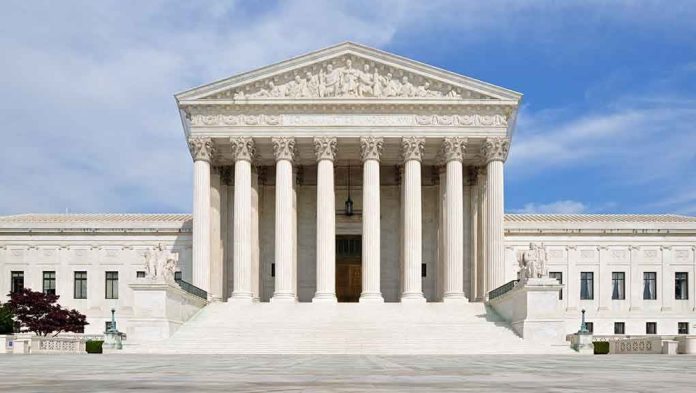
The Trump Justice Department is asking the Supreme Court to bless a tough no-bond detention rule that could reshape the nation’s fight against illegal immigration.[1]
Story Snapshot
- The Department of Justice (DOJ) wants the Supreme Court to approve mandatory detention without bond for illegal immigrants during removal cases.[1]
- The policy treats anyone who entered the country illegally as an “applicant for admission,” making detention automatic and closing a major loophole.[17]
- Appeals courts are split: some say the policy is lawful, others claim it raises serious constitutional due process concerns for millions of detainees.[6][10]
- The case could decide whether federal judges can weaken Congress’s detention mandate and tie the hands of immigration enforcement.[1][11]
What DOJ Is Asking the Supreme Court to Do
The Trump administration’s Department of Justice has petitioned the Supreme Court in a case called Raycraft v. Lopez-Campos, asking the justices to back its policy of detaining illegal immigrants without releasing them on bond while removal proceedings move forward.[1] The petition argues that Section 1225(b)(2)(A) of the Immigration and Nationality Act says people seeking admission “shall be detained” when they are not clearly entitled to enter, and that this rule applies to aliens who slipped into the country illegally and were later caught.[1]
Under this newer reading of the statute, individuals who crossed the border years ago without inspection are still treated as applicants for admission when they are placed into deportation proceedings.[17] That means they are held in custody until their case is decided, with no bond hearing before an immigration judge. The Justice Department insists this approach follows Congress’s intent in the Illegal Immigration Reform and Immigrant Responsibility Act, which strengthened detention rules to stop catch-and-release and ensure that those ordered removed can actually be deported.[1]
How We Got to a National Legal Showdown
The fight grew out of a 2025 directive from the Department of Homeland Security that reclassified almost all undocumented immigrants as applicants for admission, sweeping long-term residents into mandatory detention rules that once mainly covered recent border crossers.[17] For years, many of these individuals could ask an immigration judge for bond and continue working and raising families while their cases moved through the system. Under the new policy, bond hearings were cut off nationwide, turning what used to be a targeted tool into a broad detention mandate that could reach millions.[17]
Several federal judges pushed back, ruling that this broad reinterpretation went beyond what Congress allowed and raised serious due process concerns for people detained for months or years with no individual review.[17] A panel of the Second U.S. Circuit Court of Appeals in New York held that the administration could not jail immigrants without any chance to seek bond, calling the policy possibly the largest mass-detention-without-bond effort in U.S. history and warning about “serious constitutional questions.”[6] By contrast, the Fifth Circuit and Eighth Circuit courts upheld the policy, saying the government could treat all illegal entrants as applicants for admission and detain them without bond during their removal cases.[8][10]
The Core Legal Clash: Statute Versus Due Process
At the heart of the dispute is a simple but high-stakes question: does federal immigration law require the government to offer bond hearings, or does it instead demand detention without bond until a case ends? The Justice Department points to statutory language that many immigrants “shall be detained” and notes that the Supreme Court has already ruled in earlier cases, including Jennings v. Rodriguez, that the immigration laws themselves do not grant a right to periodic bond hearings.[12] That earlier decision sent the issue back to lower courts to address the constitutional due process question, which remains unsettled.[12]
Immigrant-rights groups and some appellate judges argue that prolonged detention without any bond review can violate the Fifth Amendment’s guarantee of due process once the time in custody becomes excessive.[15] Legal scholarship has tracked a pattern in which nearly every federal appeals court that examined the issue has found that, at some point, holding someone for many months or years without a bond hearing crosses a constitutional line, even if the statute itself is silent.[16] One federal appeals court in New York, for example, ruled in 2024 that the due process clause requires a bond hearing for noncitizens held for long periods, a decision the Trump administration attacked as “seriously misguided” and is now challenging.[11]
What This Means for Border Security and American Communities
For many conservatives, the case is about restoring common sense to a broken system where illegal immigrants can live in the country for years while their cases drag on and activist judges chip away at basic enforcement tools. The administration and its allies note that detention without bond helps ensure that people show up for hearings and prevents dangerous individuals from disappearing into communities after arrest.[1] They argue that Congress, not courts, wrote these rules to stop repeat failures of past catch-and-release policies that fueled more illegal crossings.[1]
DOJ Asks Supreme Court To Approve No-Bond Immigration Detention Policy https://t.co/pFZJ1iOQcw
— zerohedge (@zerohedge) June 28, 2026
Opponents respond that mass detention comes with high financial and human costs, pointing to reports that many people in immigration custody face inhumane conditions and have no real chance to challenge their confinement.[18][20] Policy briefs estimate that a large share of detainees fall under “mandatory detention,” meaning they cannot seek release even if they pose little flight risk or danger.[18] As the Supreme Court takes up the Trump administration’s petition, the justices are being asked not only to settle a deep split among lower courts, but also to decide how far the government can go in locking up illegal immigrants without bond while still respecting the Constitution and the limits Congress set in law.[6][11]
Sources:
[1] Web – DOJ Asks Supreme Court To Approve No-Bond Immigration Detention Policy
[6] Web – Trump administration asks US Supreme Court to endorse … – Reuters
[8] Web – US Supreme Court to Review Prolonged Immigrant Detention …
[10] Web – DOJ Asks Supreme Court to Approve No-Bond Immigration Detention Policy
[11] Web – Supreme Court Considers Challenge to Detention of Immigrants Without …
[12] Web – Supreme Court to decide if migrants detained for months must receive …
[15] Web – Supreme Court Denies Bond Hearings to Detained …
[16] Web – The Scattered Right to Bond Hearings in Prolonged Immigration …
[17] Web – THE SCATTERED RIGHT TO BOND HEARINGS IN …
[18] Web – Trump administration’s immigrant detention policy broadly rejected …
[20] Web – Featured Issue: Immigration Detention and Alternatives to Detention