

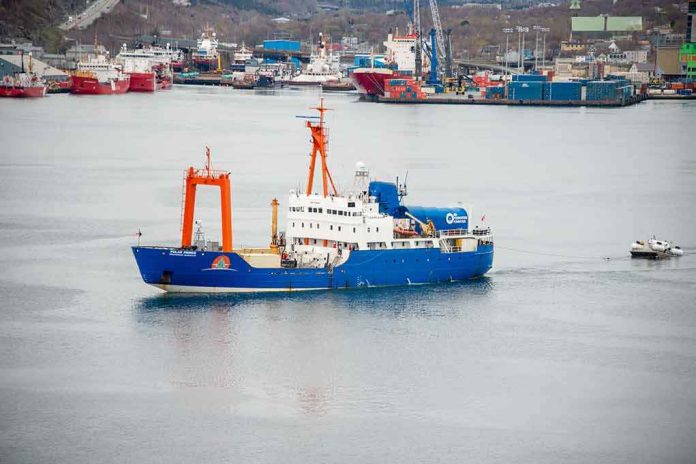
The CIA’s fake mining ship became one of the boldest covert operations of the Cold War, but it did not fully get the prize it chased.
Quick Take
- The Central Intelligence Agency used Howard Hughes and a mining cover story to hide Project Azorian.
- The Glomar Explorer raised only part of the Soviet submarine K-129 from the Pacific floor.
- Official CIA records say the mission failed to meet its full intelligence goals, even after key recoveries.
- The story still matters because the Glomar response began here, and it still shields secret records today.
How the CIA Hid the Mission
In the early 1970s, the Central Intelligence Agency built the Glomar Explorer as a fake deep-sea mining ship. The cover story tied the project to billionaire Howard Hughes and a plan to harvest manganese nodules from the ocean floor. That disguise let the agency work in plain sight while it tried to reach the Soviet submarine K-129, which had sunk nearly three miles down in the Pacific Ocean.
The operation was approved during the Cold War and ran under heavy secrecy for years. The ship used a giant capture device and a long pipe system to try to lift the submarine from the seabed. This was an engineering gamble on a huge scale. The CIA later described Project Azorian as a major intelligence effort, even though it never recovered the full submarine or all the material it wanted.
What Was Recovered, and What Was Lost
The CIA’s own declassified history says the mission did not meet its full intelligence goals. It also says the crew recovered a portion of the submarine, six bodies, and at least two nuclear torpedoes after plutonium contamination showed the weapons had been damaged. Other public accounts say the lift failed partway through, and much of the submarine broke away and sank back to the ocean floor before the operation could finish.
That mixed result is the key fact behind the debate. Supporters of the mission point to the recovered torpedoes, the burial at sea for six Soviet sailors, and the fact that the CIA considered the project a great intelligence success. Critics point to the same declassified material and note that the ballistic missiles, code books, and other top targets were not fully brought home. Both points are true, which is why the story remains contested.
Why the Story Still Hits a Nerve
Project Azorian also gave the world the word “Glomar response,” the government phrase for “neither confirm nor deny.” That tactic became a lasting shield for federal secrecy, and it still blocks outside scrutiny in cases far beyond this submarine story. For readers who value limited government and open accountability, that is the real lesson. The state can hide a massive operation for years, then reveal only the parts it chooses.
How do you raise a submarine from the ocean floor without anyone noticing? This was the question the CIA asked in the 1970s, and the answer was Project Azorian.
Project Azorian was the codename for an operation aimed at recovering the Soviet submarine K-129, which sank in 1968,… pic.twitter.com/DEGGbDAFUf
— Stories Cut Short (@trohstucseirots) June 18, 2026
The operation also shows how fast public memory gets blurred by sensational retellings. Some accounts stress the engineering feat. Others stress the cost, the secrecy, or the failure to recover the missiles. The strongest reading, based on the declassified record, is simple: the CIA pulled off an extraordinary lift, recovered some sensitive items, and still fell short of its main goal.
Sources:
[1] Web – The CIA Built a Fake Mining Ship With Howard Hughes as Cover, Then …
[2] Web – The CIA Mission to Raise a Soviet Sub
[3] Web – Project AZORIAN: The CIA’s Attempt to Recover the Soviet … – MBARI
[4] Web – Project Azorian – Wikipedia
[5] Web – Project Azorian: The CIA’s Declassified History of the Glomar Explorer
[6] Web – The CIA Heist of a Russian Nuclear Sub May Have a Final Twist
[7] Web – Project Azorian and the Quest for a CIA Submarine … – Instagram
[8] Web – The Loss—and the Mysteries—of the K-129 | Naval History
[9] Web – Why was the CIA willing to invest so much money in Project Azorian …
[10] Web – During the Cold War, the CIA Secretly Plucked a Soviet Submarine …
[11] YouTube – SHOCKING: How The CIA Stole A Nuclear Submarine
[12] YouTube – The CIA Operation That Stole a Soviet Submarine | Cold War Vault
[13] YouTube – The Secret CIA Operation to Steal a Soviet Submarine | Project Azorian …
[14] Web – How Howard Hughes Helped the CIA Try to Steal a Russian Nuclear Sub
[15] Web – That Time The CIA And Howard Hughes Tried To Steal A Soviet …
[17] YouTube – The $800 Million CIA Mission to Steal a Submarine From the Ocean Floor
[18] Web – A Project Called Azorian: Doing The Impossible
[19] Web – Project Azorian and Cold War Espionage – NC DNCR
[20] YouTube – A Brief History of: Project Azorian
[21] Web – Central Intelligence Agency (CIA) – Facebook
[22] Web – Inside Project Azorian | Naval History – December 2025, Volume 39 …
[23] Web – The Deep-Sea Nuclear Heist . . . . . . . . . . #submarine … – …