

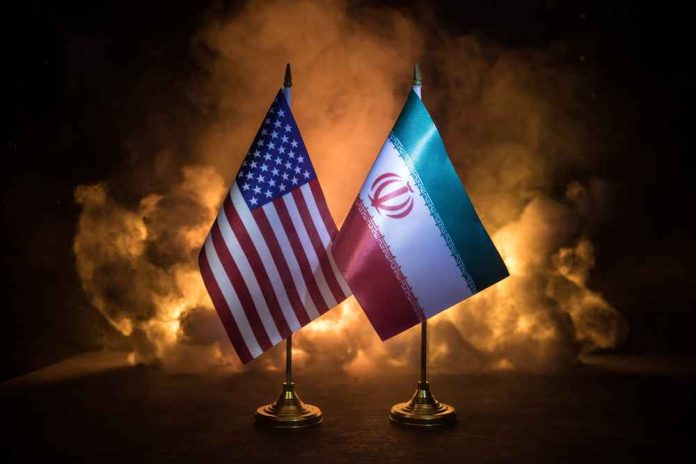
U.S. negotiators say Iran talks made “great progress,” but Tehran still refuses to give up uranium enrichment—putting verification and enforcement squarely on the line for America’s security.
Story Highlights
- Vice President JD Vance reported “great progress” in the first round of U.S.-Iran talks in Switzerland [6].
- A senior U.S. diplomat said teams held substantial discussions on all nuclear deal aspects and will continue technical talks [6].
- Iran’s president insists Tehran will “never relinquish” its enrichment rights, signaling tough battles ahead [1].
- The memorandum sets a 60-day window to nail down nuclear terms, inspections, and uranium stockpiles [5][19].
Vance Says Talks Advanced, But Details Decide Safety
Vice President JD Vance said negotiators in Switzerland made “great progress” and laid the “beginning of a technical negotiation” to settle nuclear issues and a broader peace track. A senior U.S. diplomat said teams covered all main parts of a future nuclear deal and would keep working through the night, pointing to active technical talks on enrichment, inspections, sanctions, and dispute steps [6]. These talks matter because the current document is brief and defers critical nuclear specifics to the next 60 days [19].
Vance’s public message stressed performance-based relief and clear consequences if Iran funds terror or violates nuclear terms. He argued Iran would only gain economic benefits if it changes behavior and accepts verification. He also said the plan aims to stop Iran from rebuilding a nuclear weapons program, with inspectors set to return as part of the framework [3][5]. That approach aligns with a simple rule: rewards flow only after proof, not before—crucial after years of broken promises from Tehran.
Tehran’s Enrichment Red Line Tests Any Deal’s Spine
Iran’s president declared that the country will never give up its “right” to enrich uranium, a core point that has sunk past efforts and could undercut real limits now [1]. Iran has also said it is no longer bound by the 2015 nuclear deal limits, so there is no standing cap to fall back on [10]. That makes the next 60 days vital. Without firm terms on enrichment levels, centrifuges, and what happens to Iran’s existing enriched uranium, the “progress” claim will not hold under pressure [19].
The memorandum says Iran reaffirms it will not obtain nuclear weapons and that both sides will resolve the enriched stockpile’s fate, with at least some downblended under International Atomic Energy Agency oversight [19][22]. But it leaves out exact figures, removal requirements, and centrifuge limits. Those were the teeth that made or broke past agreements. If Tehran keeps enrichment at home without strict checks, any pledge not to build a bomb becomes hard to verify in real time.
Verification, Stockpiles, and Sequencing Will Make or Break It
The White House says inspectors will “definitely” go back, which would rebuild eyes on the ground that have faded in recent years [5]. That is essential because Iran’s higher enrichment levels and growing stockpiles raised alarm among nuclear experts after 2025. A short, vague memo must now be turned into hard numbers, fixed timelines, snap inspections, and automatic penalties for cheating. Anything less invites delay tactics and hidden work that threaten U.S. allies and our troops.
🚨 𝗕𝗥𝗘𝗔𝗞𝗜𝗡𝗚: 𝗪𝗛𝗢’𝗦 𝗜𝗡𝗦𝗜𝗗𝗘 𝗜𝗥𝗔𝗡’𝗦 𝗗𝗘𝗟𝗘𝗚𝗔𝗧𝗜𝗢𝗡 𝗔𝗧 𝗧𝗛𝗘 𝗦𝗪𝗜𝗦𝗦 𝗧𝗔𝗟𝗞𝗦?
🇮🇷 As high-stakes U.S.–Iran peace talks begin in Switzerland, attention is shifting to the powerful figures representing Tehran — a delegation packed with political,… pic.twitter.com/Sa3eUBZB2e
— 🦋 Laraib Fatima 🦋 (@Laraib_Fatiima) June 21, 2026
For conservative readers, the standard is simple: no cash without compliance, no oil revenue without inspectors, and no relief until uranium is reduced, locked down, or shipped out. Washington must secure a mechanism that removes or irreversibly alters Iran’s most sensitive material, sets strict enrichment caps, and locks in access for the International Atomic Energy Agency. The administration says the ceasefire and trade steps are temporary and tied to behavior. The final text must prove that, line by line [5][19].
Congress, Allies, and Voters Expect Proof, Not Press Lines
Americans remember how past deals front-loaded benefits and back-loaded enforcement. This time, the memo’s two-month sprint demands clear triggers, including snapback penalties if Iran stalls, funds terror proxies, or blocks inspectors. Mediators say a roadmap exists, and traffic through the Strait of Hormuz is part of the near-term relief. But without hard nuclear limits, that relief could fund the same actors who target our partners and threaten energy security [6][9][19].
Bottom Line: Progress Is Welcome, Guarantees Are Non‑Negotiable
The administration can claim an opening. Yet Iran’s refusal to drop enrichment means the United States must insist on strict verification and an enforceable plan for uranium stockpiles. The next 60 days will show if this is a turning point or a rerun. Peace without power is a slogan. Peace with enforcement is a strategy. The final deal must protect American lives, Israeli security, and global energy flows—without gifting Tehran leverage it can use against us [1][5][19].
Sources:
[1] Web – BREAKING: VP Vance announces major progress made by the United States …
[3] YouTube – ‘Great progress’ at US-Iran talks says US Vice-President JD Vance
[5] Web – ‘High drama’ over Trump threats and Lebanon at US-Iran talks in …
[6] Web – Trump may release US-Iran deal before Friday, Vance says – BBC
[9] Web – Vice President JD Vance is expected to travel to Switzerland for the …
[10] Web – U.S. and Iran agree to ‘roadmap’ for final deal, mediators say – NPR
[19] Web – Iran nuclear agreement: Congressional review – Ballotpedia
[22] Web – 2025–2026 Iran–United States negotiations – Wikipedia