

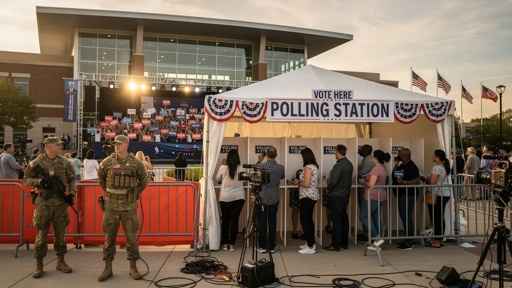
The real issue is not whether ICE could be rhetorically recast as “protective” at a polling place; it is whether a federal immigration force belongs anywhere near the ballot box at all. On the record available here, Markwayne Mullin’s answer is narrow, conditional, and politically explosive: he says only a “specific threat” could justify such a presence, while election-law advocates and state officials argue that the very image of armed federal agents near voters is inherently coercive and likely unlawful.[3][4][7]
Intro Header
- The dispute turns on a single dividing line: targeted security in response to a real threat versus federal presence that voters experience as intimidation.
- Mullin’s public posture is not a blanket endorsement of ICE at polls; it is a hypothetical exception built around an unspecified “specific threat.”[3][6]
- Critics do not need to prove bad intent to object; they argue that federal law, election norms, and plain common sense all cut against ICE involvement at polling places.[2][4]
- The practical problem is that ambiguity itself changes the political terrain. Once officials refuse to categorically rule out deployment, every silence becomes evidence for suspicion.[1][6]
The Core Claim: A Conditional Exception, Not a Routine Policy
Mullin’s testimony, as captured in the hearing footage and repeated in subsequent coverage, is more constrained than the alarmed headlines suggest. He did not say ICE should stand outside polling locations as a matter of routine. He said officers would be there only if there were a “specific threat,” and that the response would be coordinated with local law enforcement and openly explained.[3] That matters, because it places his answer in the language of contingency: not a standing policy, but an exceptional deployment triggered by some unidentified danger.
That framing is also the weakness of his position. A conditional justification is only as strong as the condition itself, and the record provided here never identifies the threat he says could warrant deployment.[1][3][6] No incident file, intelligence assessment, or operational directive appears in the materials. So while Mullin’s language is precise, the evidentiary base behind it is thin. He has described the circumstances in which he would allow ICE presence; he has not shown that such circumstances exist, nor that immigration agents are the necessary instrument if they do.
Why Election Officials See This as More Than a Hypothetical
Election administrators do not evaluate this kind of question as an abstract seminar in constitutional theory. They evaluate it through the lived mechanics of turnout: lines, confusion, fear, and whether voters believe the state wants them there. That is why state officials have moved quickly to demand written assurances that ICE and other immigration-enforcement personnel will not be stationed at voting or election-administration sites.[7] Their concern is not only legal. It is administrative. A polling place is supposed to be a low-friction civic environment, and armed federal presence changes that atmosphere immediately.
The Brennan Center’s argument is blunt: ICE has no role in election enforcement, and sending armed federal agents to polling places would violate federal law and intensify intimidation risk.[2] Its legal theory is broad, but it is not frivolous. Election sites occupy a highly protected category in American law, and the historical background matters. The United States has long treated armed force near elections as a special danger, precisely because the legitimacy of voting depends not just on the absence of overt coercion but on the absence of credible fear. Once federal immigration officers enter that space, the burden of justification becomes severe.[2][4]
The Legal Fight Is About Authority, Not Just Optics
At the center of the dispute is a harder question than public relations: what, exactly, is ICE’s lawful mandate near a polling place? The materials here do not include a DHS directive or legal memorandum authorizing deployment, and that absence is not a trivial gap. It means the public debate is happening in a vacuum, with advocates and officials arguing over principle while the actual operational theory remains undisclosed.[1][4][6] In disputes like this, silence from the executive branch is never neutral. It invites opponents to assume the worst and supporters to insist that no decision has been made.
That ambiguity is precisely why the issue has spread beyond a single hearing exchange. Spotlight PA reports that DHS and the White House have refused to give categorical assurances that federal agents will never be near polls, even while some officials have said there are “no plans.”[6] Those statements are not identical, and the difference matters. “No plans” is a snapshot of intent; “won’t happen” is a commitment. When administrators stop short of the latter, critics are left with a policy space wide enough to fear abuse. That is politically costly even if deployment never materializes.
BREAKING NEWS: DHS Secretary Markwayne Mullin says ICE agents would only be deployed to midterm polling places if a threat arises, and not for voter identification. pic.twitter.com/xqdSkOKPtd
— WorldAxis News (@WorldAxisNews) June 14, 2026
What the Counterargument Gets Right, and What It Cannot Prove
The strongest case against Mullin’s posture is that federal presence near polling sites is so loaded with coercive meaning that intent cannot cleanse it. The Brennan Center’s reporting treats the location itself as the problem: if ICE shows up at or near a ballot box, voters may reasonably experience that as intimidation, regardless of whether officers claim a protective mission.[2] That is a powerful argument because election law is not built only to punish overt suppression; it is built to prevent conditions that chill participation before anyone can be singled out.
Still, the countercase is not complete in the record provided. It is persuasive as warning, but it does not produce a court ruling on this exact fact pattern or an empirical turnout study showing that mere proximity of federal agents suppresses voting in comparable situations.[4][6] In other words, critics have a strong legal and normative position, but the current materials do not supply the kind of adjudicated, fact-specific proof that would settle every hypothetical Mullin could raise. That leaves the dispute where these fights often sit: in the overlap between law, institutional trust, and the public meaning of force.
Why This Became a Broader Trust Test
The political significance of the issue is larger than ICE itself. It is a test of whether federal election governance is being administered as a neutral safeguard or as a coercive instrument in reserve. That is why state election chiefs, civil-rights advocates, and Democratic lawmakers have treated the question as urgent rather than symbolic.[1][7] Once a government official refuses to rule out armed federal presence at polling places, every subsequent reassurance must work against the memory of that refusal. Trust in elections is cumulative, and it is fragile; one ambiguous answer can contaminate many carefully worded denials.
There is also a structural asymmetry here. Supporters of deployment can always say they mean only a rare emergency. Opponents must prove not only that the idea is bad in principle, but that no workable scenario exists in which it is lawful or necessary. That is a difficult position to occupy in public debate, even when the legal and historical instincts are on their side.[2][4] The burden therefore falls on the administration to narrow the theory with actual policy language, not just rhetorical restraint. Without that, “specific threat” remains a slogan, not a governing standard.
The Bottom Line in Evidence Terms
On the evidence available here, Mullin’s position is best understood as a conditional refusal to rule out ICE near polls, not a robust defense of routine deployment.[3][6] The counterargument is stronger in law and institutional principle: polling places are protected civic spaces, and armed federal immigration agents there are exactly the kind of presence that can be read as intimidation.[2][4][7] What remains missing is the decisive operational record — the threat, the directive, the legal memo — that would move this from speculative controversy to justified exception. Until that appears, the burden stays squarely on anyone who wants to bring ICE anywhere near the ballot box.
Sources:
[1] Web – ICE at Polling Places? Sec. Mullin Defends Potential Role in 2026 …
[2] Web – Trump’s pick for DHS chief won’t rule out ICE at polls
[3] Web – At a DHS Secretary confirmation hearing, Sen. Elissa Slotkin …
[4] YouTube – Sen. Elissa Slotkin questions Markwayne Mullin on ICE at polling …
[6] Web – Senator Markey Statement Opposing Markwayne Mullin as …
[7] Web – Trump admin won’t rule out placing federal agents at polls