

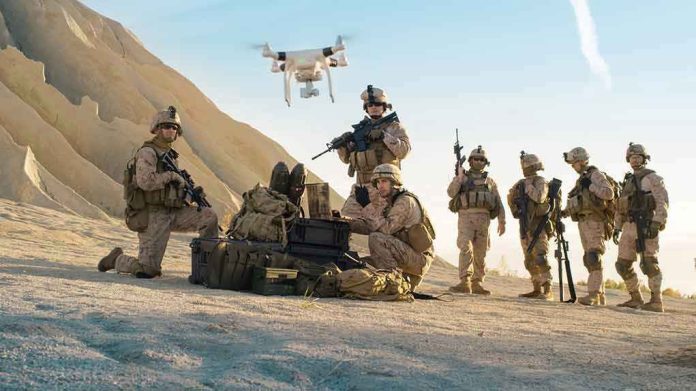
A new initiative by the U.S. Army Special Forces is set to revolutionize warfare, embedding robots across all domains, raising both strategic promises and constitutional concerns.
Story Highlights
- Special Forces are institutionalizing robots across land, air, maritime, cyber, and space.
- The Special Operations Robotics Detachment (SORD) was established in March 2024.
- A new 390A Robotics and Autonomous Systems Technician warrant officer MOS is being implemented.
- Robots aim to keep humans out of first contact and expand operational reach.
Army Special Forces Pioneering Robotics in Warfare
The U.S. Army Special Forces are leading a revolutionary shift by integrating robots and autonomous systems into their operations across all domains. This initiative is driven by lessons learned from conflicts in Iraq, Syria, and Ukraine, where drones and ground robots have proven crucial for reconnaissance and combat logistics. The institutionalization of these technologies emphasizes a significant doctrinal shift, aiming to minimize human risk in initial combat contact.
The Special Operations Robotics Detachment (SORD), established in March 2024, serves as the core of this initiative, tasked with developing and integrating robotic systems in support of Special Forces teams. This effort is not merely experimental; it represents a formal commitment to embedding robotics within military operations, supported by the creation of a new 390A Robotics and Autonomous Systems Technician warrant officer specialty.
Strategic Implications and Technological Integration
The integration of robotics within Special Forces is seen as a strategic move to enhance operational reach and survivability while reducing manpower needs. This comes at a time when the Army has updated its force structure, cutting 3,000 Special Operations Forces billets. Robots are expected to act as force multipliers, enabling smaller teams to manage more extensive and complex missions.
Training has been prioritized to support this transition. Since October 2023, a six-week Robotics and Unmanned Systems Integration Course has been available for Green Berets, building a pipeline of operators knowledgeable in robotics and autonomous systems. The first pilot course for the 390A MOS is scheduled to begin in January 2026, with plans to expand training for higher-grade warrant officer levels.
Constitutional Concerns and Future Outlook
While the integration of robotic systems promises to enhance military capabilities, it raises questions about the balance of power and the potential for government overreach. There is concern that such advancements could lead to increased surveillance and reduced transparency, infringing on constitutional rights. As these technologies are further institutionalized, close scrutiny will be necessary to ensure that their deployment aligns with American values and principles.
Army Special Forces Embracing Robots in All Domains | Story by @LauraHeckmann | #specialops #army #robots
Read now: https://t.co/jpNEAHGEJM pic.twitter.com/tLyzwFrG1M
— National Defense (@NationalDefense) December 8, 2025
Looking ahead, the development of human-machine integration doctrine will be critical in defining the role of robots alongside human operators. This doctrine will shape how unmanned systems are utilized in both conventional and special operations, potentially setting a precedent for future military engagements. The ongoing evolution of this initiative will likely drive significant changes in military tactics and the broader defense industry.
Sources:
Robots in the Ranks: Army Integrating Robots in Two Platoons
Interwar Mechanization to Transformative Robotization
Army Special Forces Embracing Robots in All Domains