

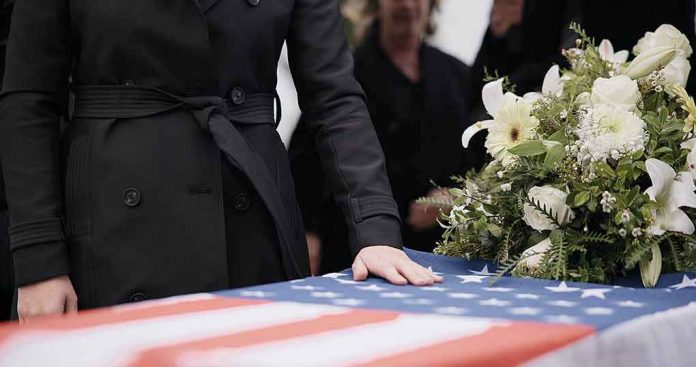
A 98-year-old sailor died thinking he had no one left, and then an entire town quietly proved him wrong.
Story Snapshot
- A single Facebook post from a local veterans office turned an almost-empty funeral into a packed church for World War II Navy veteran John Bernard Arnold III.
- Hundreds of strangers, police, firefighters, and fellow veterans lined up down the sidewalk to say goodbye to a man they never met.[1][3]
- The phrase “no known family” revealed how fragile our social ties can become—and how quickly Americans can still rally when honor is on the line.[1][2]
- The turnout raises a blunt question: if a town will show up for a stranger’s last day, why are we leaving so many elders and veterans alone on all the days before that?
A nearly empty funeral that turned into a civic gut check
Hanover and Hanson Veteran Services in Massachusetts saw a problem that should bother every decent American: World War II United States Navy veteran John Bernard Arnold III had died at 98 with “no known living family” to attend his funeral.[1][2] Instead of shrugging, the office posted a public invitation on Facebook, asking anyone who could to come stand in for the family he no longer had.[1][2] That tiny digital plea lit a fuse under an old-fashioned instinct: show up, or admit you no longer care.
https://www.youtube.com/watch?v=pbYTS74JEKs
Local outlets picked up the story, spelling out when and where Arnold would be laid to rest: visitation in the morning, a funeral Mass at Saint Joseph the Worker Church in Hanson, and a procession to the cemetery afterward.[2] The facts were simple and stark. A man who had worn the uniform of the United States in World War II would otherwise be buried almost alone. No culture that still respects service can hear that without feeling judged.
The day strangers became stand‑in family
When the doors opened at Saint Joseph the Worker Church, the scene did not look like an afterthought. WBZ NewsRadio reported that hundreds of people came to the funeral.[1] Other coverage described a line of mourners stretching down the sidewalk, with veterans, police officers, firefighters, emergency medical personnel, and ordinary citizens filing in side by side.[3] Media were not allowed inside, but every report agrees on the basic picture: the pews were packed for a man few attendees could have picked out of a lineup a week earlier.[1][3]
Those who did speak on camera did not hide their motives behind vague civic language. A fellow veteran told 7NEWS Boston, “We’ll never let one of our veterans pass without being honored and sent off with respect and dignity and the way that a veteran should go to their final resting place.”[3] That is not academic talk about “civil society.” That is a moral vow rooted in the conservative idea that certain duties—to country, to elders, to the fallen—are non-negotiable, even when there is no personal payoff.
Honor, numbers, and what really counts
Some details of the story are fuzzy at the edges. Different outlets give different impressions of the exact crowd size, ranging from “hundreds” to higher estimates, and there is no official headcount.[1][3] Reporters also rely on the phrase “no known family” as given by the veterans office and funeral organizers, without producing probate files or genealogical proof.[1][2][3] From a strict evidence standpoint, that leaves loose ends. But those gaps do not erase the core facts: the call for help went out, the community responded in force, and Arnold did not go to his grave unnoticed.
The more uncomfortable question is why this story feels so extraordinary. America once assumed that communities would naturally surround the old, the poor, and the lonely, especially those who had worn the uniform. Today it takes a viral post to achieve what used to happen as a matter of routine. Social media can create a halo effect—uplifting quotes get repeated, and critical questions about numbers or logistics fade into the background.[3] Yet the turnout still reveals something stubborn in the American character: when people are given a clear, concrete chance to do right by someone who served, they still step up.
What this funeral says about the rest of us
Arnold’s story follows a larger pattern. Across the country, when word spreads that a veteran will be buried alone, neighbors and strangers often rearrange their day to stand graveside, carry flags, or simply fill empty chairs. Sociologists note that older adults who outlive their families often depend on institutions and community rituals for the recognition that kin once supplied. This funeral showed that, in at least one Massachusetts town, the web of obligation has not completely snapped; it has just gone slack, waiting to be tugged.[1][2]
[Hundreds of Patriotic Citizens Gather to Honor Orphaned WWII Veteran John Bernard Arnold III]
In a profound and moving display of national gratitude, hundreds of citizens unexpectedly gathered at the funeral of John Bernard Arnold III, a 98-year-old World War II veteran who… https://t.co/7wD66rsPA2
— Daniel Jeong (@DanielJ41413) May 19, 2026
American common sense says that a country which can mobilize hundreds of people for one man’s last hour ought to find a way to notice men like him while they are still alive. That means churches, veterans halls, and local governments keeping track of their oldest citizens; it means asking who will sit with them long before asking who will attend their funerals. The people who lined that sidewalk in Hanson proved that the instinct for duty is still there. The next test is whether we use it on ordinary Tuesdays, not just on the day the bagpipes play.
Sources:
[1] Web – Hundreds Attend Funeral Of WWII Veteran With No Known Living …
[2] Web – Public invited to funeral for WWII veteran with ‘no known family to …
[3] YouTube – Community honors World War II veteran laid to rest with no known …