

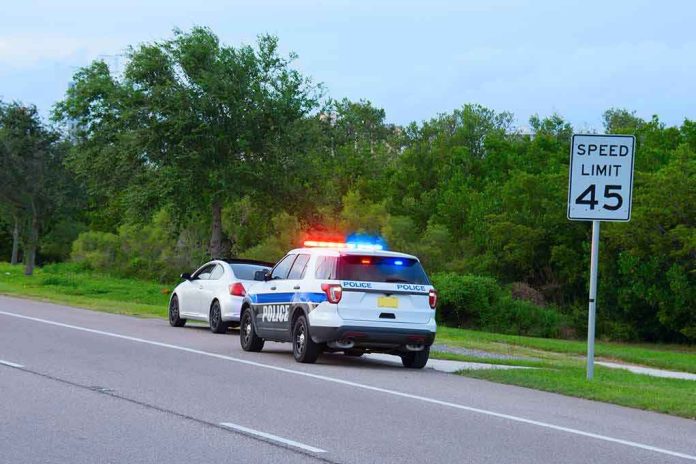
Two Colorado State Patrol troopers were shot during an early-morning traffic stop west of Woodland Park; one suffered serious wounds, the other minor, and a rapid, multi-agency search ended with a suspect in custody. The incident is a crisp example of how a “routine” stop can turn volatile in seconds — and how modern alerting, interagency coordination, and public guidance now shape both the police response and the community’s experience of danger.
At a Glance
- Shots were fired around 7:15 a.m. on U.S. 24 near milepost 286 during an attempted traffic stop; two troopers were wounded and reached a hospital on their own.
- Authorities broadcast a suspect and vehicle description, issued shelter-in-place alerts for nearby subdivisions, and launched a large manhunt.
- The Colorado Bureau of Investigation later reported the vehicle and suspect were located; the suspect was taken into custody and alerts were lifted.
- State and local leaders confirmed the core sequence — traffic stop, shooting, search, arrest — and praised coordinated law-enforcement work.
What happened on U.S. 24 near Woodland Park
Shortly after daybreak, about 7:15 a.m., two Colorado State Patrol troopers attempted a traffic stop along U.S. 24 near milepost 286, west of Woodland Park. During that stop, both troopers were shot. Reporting from multiple independent outlets aligns on the core sequence and location framing, even as neighborhood references vary (Piney Point Lane, Trout Creek Road, and nearby subdivisions all appear in dispatches). One trooper sustained serious injuries; the second suffered minor wounds. Both made it to a hospital without waiting for an ambulance — a detail that underscores the urgency and also suggests they were stable enough to move immediately under their own power or with minimal assistance.
Authorities moved quickly to contain the threat. Public alerts described a blue Subaru Impreza hatchback with obscured or tinted plate covers and a male driver with shoulder-length brown-blond hair and facial hair — a field-useful description for patrol and residents inside the search perimeter. Teller County issued shelter-in-place orders for the Westwood Lakes and Woodland West areas, advising residents to remain indoors while ground units, K9s, and aerial assets canvassed the neighborhoods. As the morning unfolded, state officials confirmed a suspect and vehicle had been located; by later updates, the suspect was in custody and the shelter-in-place was lifted.
Why traffic stops so often become high-risk encounters
To seasoned patrol officers, the volatility here is sadly familiar. Traffic stops are both ubiquitous and inherently uncertain; they unfold at the edge of roadways with limited cover, variable lighting, and minimal control over a driver’s state of mind. National analyses have repeatedly found that stops are a leading context for officer shootings. A Department of Justice “Blue Alert” year-end assessment, for instance, counted traffic stops and disturbance calls as the two most common incident types in which officers were shot, together accounting for more than two in five such shootings nationwide in 2024. Earlier COPS Office research reviewing 2010–2016 fatalities likewise identified traffic stops as the most common self-initiated activity preceding officer killings in the cases examined.
That risk profile does not mean most stops are dangerous — the opposite is true; millions occur uneventfully — but it does explain patrol tactics that may look cautious to civilians. Officers position vehicles deliberately, approach angles to keep hands and waistlines in view, and watch for plate obscuration, vehicle irregularities, or driver behavior that can signal evasion or contraband. The moment car doors open or a driver leans out of sight lines, the tactical equation changes, sometimes irreversibly. When violence erupts, seconds matter; self-transport to a trauma center, as occurred here, can be the fastest survivability choice when distance and road access cooperate.
Public alerting, perimeter control, and interagency coordination
The Teller County response reflected the modern playbook for an armed fugitive search in a mixed residential and rural interface: define a search box quickly, push reliable suspect descriptors, and warn residents via geotargeted alerts to reduce civilian movement that could mask or aid flight. The descriptions of a blue Subaru hatchback with concealed plates, paired with broadcast hair and clothing notes, are typical field-level details that help both patrol and the public filter sightings. Shelter-in-place messaging for Westwood Lakes and Woodland West reduced traffic friction in the search corridors and signaled households to secure doors and avoid line-of-sight exposure near windows and roadways.
The manhunt drew resources across agencies — state patrol, the county sheriff’s office, and the Colorado Bureau of Investigation among them — which is standard for an on-foot or vehicle-borne suspect who could cross jurisdictions in minutes. The end-to-end cycle here was tight: stop, shooting, suspect description, perimeter, custody. Colorado’s governor commended the swift coordination and specifically tied the arrest to that multi-agency integration — a reminder that interoperable radio channels, common operating pictures, and practiced incident command systems are not abstractions but the backbone of outcomes like a same-morning apprehension.
What we know — and the limits of operational detail at this stage
The essentials are not in dispute: two troopers were shot during an attempted stop on U.S. 24 west of Woodland Park; one was seriously hurt, one had minor wounds; both reached a hospital without delay; a shelter-in-place was issued and later lifted; and a suspect is in custody after authorities located both the individual and the vehicle linked to the shooting. Early public updates in an active criminal investigation rarely include granular ballistics or the precise shot sequence; those belong to the case file and will typically surface through court filings or later agency briefings. The absence of that fine-grained chronology does not change the settled spine of the event described above.
For communities, the most practical takeaways are behavioral and infrastructural. Heed shelter-in-place directives immediately; they are not rhetorical. Expect a visible surge of law-enforcement presence, drone overflights, and roadblocks that seem overbroad from a single driveway’s vantage point but are necessary to keep search vectors clean. And when agencies publish a vehicle description with plate anomalies — as with tinted covers or missing tags here — understand that those cues are among the quickest ways to separate signal from noise on busy corridors.
According to our partners at @CBI_Colorado, the search is over for a man wanted for allegedly shooting two Colorado state troopers during an attempted traffic stop near Woodland Park, CO this morning. https://t.co/L2bKG97M4s
— 18th Judicial District Attorney's Office (@DA18th) August 25, 2026
The broader pattern and its implications
Events like Woodland Park fit an established national pattern: a high-volume activity (traffic enforcement) that is usually mundane but statistically overrepresented among episodes where officers are shot. In the 2024 DOJ Blue Alert report, traffic stops accounted for 39 of the year’s officer-shooting incidents, part of the plurality combined with disturbance calls. Prior COPS Office research covering 2010–2016 found that, within self-initiated officer activities reviewed, traffic stops were the single most common setting for fatal attacks — a function of frequency, exposure, and the tactical disadvantages of roadside encounters. The operational lesson is not to avoid traffic enforcement but to continue refining stop protocols, equipment placement, communications discipline, and rapid medical self-evacuation options when conditions favor speed over scene-hold.
Sources:
youtube.com, gazette.com, cpr.org, abcnews.com, kktv.com