

Raw sewage from Mexico continues to flood Southern California beaches in 2026, denying families access to their coastline and poisoning the air they breathe despite multi-billion-dollar binational promises.[1][2]
Story Snapshot
- Up to 30 million gallons of untreated sewage flows daily from Tijuana into the Pacific Ocean, closing beaches in Imperial Beach and Coronado for over 1,000 consecutive days.[1][2]
- Hydrogen sulfide gas spikes above 300 parts per billion trigger respiratory illnesses, headaches, rashes, and school absences in South San Diego communities.[3]
- A 2023 U.S.-Mexico agreement commits $474 million to infrastructure, yet no 2026 progress reports confirm reduced flows or resolved health impacts.[10]
- Tijuana’s wastewater plant, built for 700,000 residents, now serves 2.2 million, discharging 25-43 million gallons of partially untreated sewage daily.[2][6]
- Both conservatives and liberals decry federal inaction, as cross-border pollution exposes elite promises over real solutions for everyday Americans.[7]
Sewage Flows Overwhelm Border Infrastructure
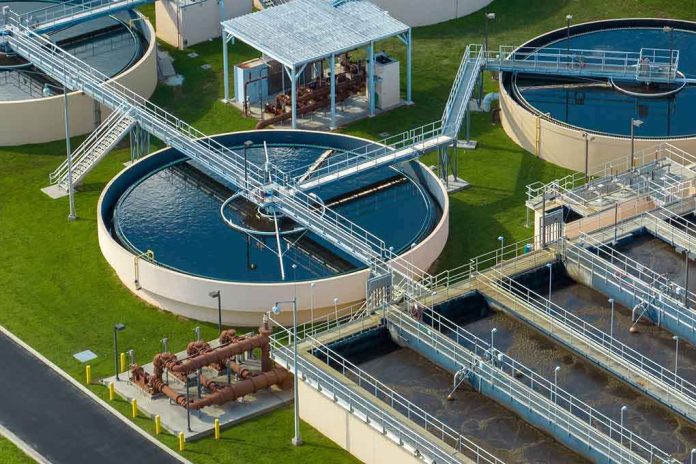
The Tijuana River carries billions of gallons of untreated sewage, industrial chemicals, and trash across the U.S.-Mexico border annually.[1] Up to 30 million gallons of contaminated water flow daily into the Pacific Ocean near Imperial Beach.[2] Ocean currents push this pollution north, contaminating beaches in Coronado, including areas near the Hotel del Coronado.[2] Mexican facilities fail due to outdated infrastructure; Tijuana’s San Antonio de los Buenos treatment plant, designed for 700,000 people, now handles 2.2 million, releasing 25 million gallons untreated daily.[2][6]
https://www.youtube.com/watch?v=K9PCTqs2yCs
Imperial Beach’s public beach remained closed for over 1,000 consecutive days as of 2026 due to high bacteria levels.[1][4] County health officials issue urgent warnings against ocean contact.[2] The crisis escalates during wet weather, when Mexican wastewater systems overflow into the river.[4] U.S. canyon collectors capture some dry-weather flows, but they cannot handle the volume.[11]
Health Crisis Hits Schools and Residents
Hydrogen sulfide gas from decomposing sewage spikes to 600 parts per billion along the Tijuana River, far exceeding the safe level of 5 parts per billion.[1] At Berry Elementary in Imperial Beach, sensors recorded 500 parts per billion on March 19, 2026, over 15 times California’s standard.[3] Residents report asthma attacks, migraines, rashes, nausea, eye irritation, dizziness, and brain fog.[3] Children miss school; nearly two-thirds of surveyed households linked absences to pollution symptoms.[3]
Public health studies confirm disruptions: 20 percent of households faced school or work interruptions in the prior month.[3] The airborne pathogens confirm long-held fears, as warm weather worsens gas emissions.[1][3] Surfers, swimmers, and Navy SEAL trainees face illness risks from waterborne bacteria.[17] No comprehensive studies fully document student impacts, but symptoms keep kids indoors from playgrounds and beaches.[3]
Binational Promises Fall Short Amid Frustrations
The U.S. and Mexico signed International Boundary and Water Commission Minute 328 in 2023, pledging $474 million ($330 million U.S., $144 million Mexico).[10] Projects include doubling South Bay International Wastewater Treatment Plant capacity and upgrading Tijuana’s San Antonio de los Buenos plant.[10] Goals target 50 percent fewer transboundary flow days and 80 percent less untreated wastewater by 2027.[10] Mexico holds primary responsibility under the 1944 Water Treaty.[11]
San Diego leaders are trying to speed up solutions to sewage pollution from the Tijuana River, while investigating the scope of the problem. https://t.co/JqXL66xKkj
📸 Adriana Heldiz pic.twitter.com/dPbGlSfIcW
— CalMatters (@CalMatters) May 8, 2026
Despite commitments, 75 percent of Tijuana’s wastewater network and half its pump stations require urgent repairs.[7] Population growth projects a 40 percent increase, outpacing fixes.[7] No May 2026 Mexican reports detail construction progress, treatment volumes, or reduced discharges.[2][7] U.S. officials, including EPA Administrator Zeldin, hailed past wins, but locals see no relief.[7] This cross-border failure fuels shared anger across political lines: conservatives blame globalist neglect, liberals decry environmental racism, yet all agree federal elites prioritize power over clean water and health.[1][3]
Sources:
[1] Web – Support for Mitigating Contaminated Transboundary Flows in … – ERG
[2] Web – USMCA Tijuana River Watershed | US EPA
[3] Web – [PDF] TRANSBOUNDARY ISSUES IN THE TIJUANA RIVER BASIN …
[4] Web – Tijuana River Valley Transboundary Pollution Crisis
[6] Web – Clean Border Water Now – Surfrider Foundation
[7] Web – How the U.S. and Mexico can clean up the Tijuana River – CalMatters
[10] Web – U.S. and Mexico agree to invest $474M to address Tijuana River …
[11] Web – Sewage Pollution within the Tijuana River Watershed | San Diego …
[17] Web – how San Diego leaders are responding to a sewage pollution crisis