

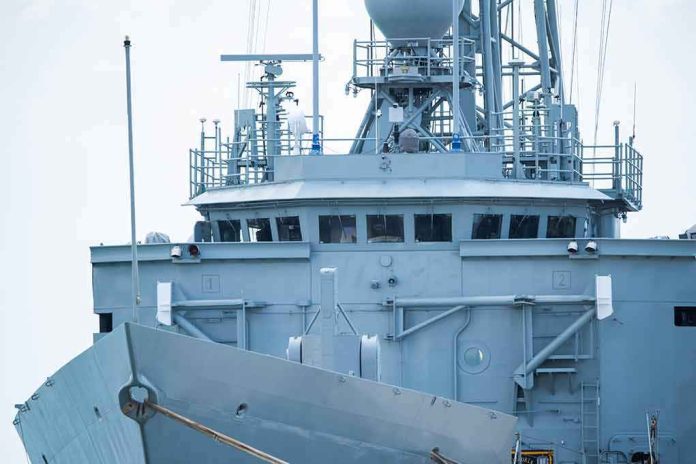
When a warship dies in port, the cause matters less to physics than to politics; yet separating accident from attack is exactly what turns a local fire into a theater-wide signal. The Benghazi blast that engulfed the Russian corvette Merkury sits at that junction: an event conclusively destructive, but only provisionally explained.
At a Glance
- A Russian Steregushchiy-class corvette, provisionally identified as Merkury, burned catastrophically at Benghazi’s naval base; imagery-supported assessments judged the ship almost certainly destroyed.
- Initial Libyan civil-defense statements framed the incident as an ammunition-depot explosion; later, the eastern administration said the blast occurred aboard the vessel and was likely caused by drones.
- Open-source analysts and several outlets pointed to a suspected Ukrainian sea-drone strike; attribution relies on official statements, anonymous sourcing, and OSINT, not a public forensic report.
- The shift from “depot fire” to “drone attack” reflects a familiar pattern in naval incidents, where narrative outruns evidence before technical findings appear.
What is firmly established: a corvette burned, and destruction is the baseline
Across independent imagery and specialist reporting, the consensus is that a Russian missile corvette at Benghazi suffered a devastating fire after a large explosion. Open-source naval analysts identified distinctive superstructure features and mast geometry that match the Steregushchiy-class Merkury; multiple passes of commercial satellite imagery captured the vessel ablaze and, in later frames, capsized or submerged within the harbor. While Moscow and Benghazi have not released a full technical dossier, the visible outcomes—prolonged fire, progressive list, and loss of buoyancy—meet any reasonable threshold for “mission kill” and likely total loss.
The mechanism of destruction on board a modern corvette is rarely singular. A blast that initiates topside can propagate via heat into ammunition magazines; a below-decks fire in ammunition handling spaces can ladder into adjacent compartments and compromise firefighting systems. Either pathway explains the signature seen from overhead: intense, localized thermal sources followed by smoke plumes and hull instability. That is the physics. The question is what started it.
Two competing accounts: mishap at an ammunition site versus deliberate sea-drone strike
The earliest official word from Benghazi’s civil-defense service described the incident as an explosion at an ammunition depot with fires contained—no mention of an attacking force, and no explicit confirmation that the ship itself was the initiating point. A representative of the National Security Directorate in eastern Libya similarly spoke of ammunition detonations at the base and deferred causation to later expert review. Those are standard immediate-response descriptions: identify the hazard class, isolate the fire, and promise an investigation.
Within hours, the eastern-based administration publicly shifted: “initial investigations” now indicated the explosion occurred aboard a Russian ship in port; the likely cause was a drone attack. Officials announced a joint inquiry with Russia to establish the source and responsible party. Major outlets echoed that framing, situating the blast in the wider pattern of uncrewed surface vessel (USV) attacks on Russian maritime assets since 2022. The Kyiv Independent and Bloomberg relayed Libyan statements leaning toward drones, while AP cited two unnamed Libyan military officials attributing the strike to Ukrainian sea drones launched from western Libya—claims significant for directionality, yet unsupported by released radar tracks, recovered fragments, or CCTV.
What the evidence can and cannot carry right now
On destruction and identification, the open-source record is strong: imagery corroborates an inferno aboard a Steregushchiy-class corvette at Benghazi, and specialist assessments treating Merkury as a write-off are defensible. On attribution, the evidentiary bar is not yet cleared in public. No blast-fragment catalog, explosive-residue profile, or intact USV component has been exhibited to distinguish an internal initiation from an external sea-drone hit. The eastern Libyan government’s revised account and OSINT analysts’ probability judgments are consequential—but they are not, by themselves, a forensic conclusion.
This sequencing—local authorities voice an accident or ammunition narrative, then pivot toward sabotage as political actors and external media take interest—has deep precedent in naval history. Early attributions often reflect institutional incentives as much as facts on the pier; only methodical reconstruction settles whether heat, handling, design vulnerability, or hostile action initiated the chain. Readers should therefore resist both premature closure and reflexive doubt. One can accept the ship is essentially destroyed without granting that a specific flag sank it absent technical proof.
Mechanism and plausibility: how a USV attack would look—and why accidents also fit
Modern sea drones—low-profile, GPS/INS-guided craft with EO/IR seekers—are optimized to run inside harbor defenses at night, striking at or below the waterline to induce rapid flooding or to set off sympathetic detonations in nearby ordnance. Evidence you would expect after a successful USV attack includes: hull breach signatures consistent with external blast loading, recovered fastener or electronics fragments unique to known Ukrainian platforms, and harbor security footage capturing a surface track. Conversely, an internally initiated detonation in ammunition spaces produces spall patterns, plating deformation outward from the origin, and explosive-residue mixes aligned with the ship’s own stores rather than a delivered warhead. None of that discrimination has been published publicly to date.
Plausibility cuts both ways. Ukraine has repeatedly demonstrated reach against Russian maritime targets far beyond Crimea, and open-source trackers have chronicled iterative USV design improvements and expanded operating radii. At the same time, naval ammunition handling remains an ever-present hazard; historical Boards of Inquiry have closed with “cause undetermined” even after exhaustive reconstruction when sympathetic detonation and structural collapse erased initiating clues. In Benghazi, either path could produce the observed outcome; which occurred is an empirical question awaiting released findings.
Why Benghazi matters in the wider contest
Even without a signed chain-of-custody report, consequences are already visible. For Russia, the loss of a modern multi-mission corvette outside its home waters underscores exposure of expeditionary logistics and influence operations that rely on permissive ports. For eastern Libyan authorities, the oscillation from “ammunition depot” to “drone attack” highlights a credibility problem that only transparent publication of investigative materials can solve; ambiguity invites external narratives to fill the gap. For Ukraine—if attribution eventually lands there—the message would be strategic: sanctuary is shrinking for Russian naval assets, even in friendly harbors. If not, the lesson is different but equally sharp: port safety protocols and ammunition segregation must be treated as warfighting imperatives, not routine housekeeping.
BREAKING: A suspected drone attack caused an explosion on a Russian navy corvette at Benghazi naval base on Sunday. Satellite imagery showed the Merkury had capsized and sunk, with only its bow visible. No one has claimed responsibility.#Libya #Russia
— 69 (@az6I9za) November 23, 2026
What would resolve attribution
Three disclosures would close most of the gap. First, a joint Libyan–Russian preliminary report with time-stamped harbor CCTV, air-defense logs, and radar surface-tracking for the relevant window; second, a fragment and residue catalog documenting warhead composition, initiation geometry, and plating deformation vectors; third, a clear vessel-status record—loading manifest, ammunition stowage plan, and firefighting system telemetry in the minutes before the first detonation. These are standard pillars of maritime incident reconstruction and would anchor or overturn the drone thesis decisively. Until then, the prudent position is firm on outcome, cautious on cause: the ship is effectively lost; attacks are plausible; proof awaits daylight.
Sources:
thestate.com, latimes.com, defence-blog.com, situationroom.io, aljazeera.com, ilpoliticoweb.it, ilfoglio.it, usni.org, history.navy.mil