

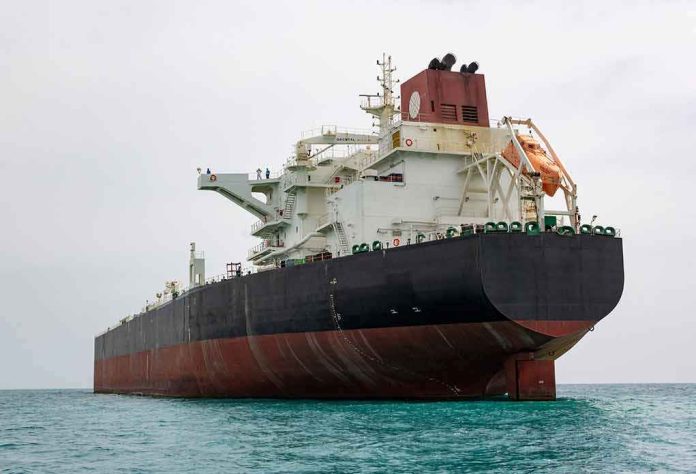
Control of chokepoints is rarely about the ships themselves; it is about the leverage that flows through them. In the Strait of Hormuz today, Iran and the United States are running parallel campaigns to define what “free navigation” means under a wartime blockade—and the evidence shows both an expanding U.S. enforcement architecture and an Iranian coercive play aimed at reshaping traffic patterns rather than reliably breaking the perimeter.
At a Glance
- The U.S. blockade is constraining Iran’s crude exports while U.S.-escorted flows for other Gulf producers have largely resumed.
- Iran is contesting the strait with threats and force, framing interdictions as enforcement of “unauthorized” routes and U.S.-enabled violations.
- The most dramatic Iranian claims—mines and tanker explosions—lack independent forensic confirmation; identities and causes remain murky.
- Open-source shipping data points to clustering of Iranian tankers and workarounds like ship-to-ship transfers, not a named, declared convoy push.
What the competing campaigns are actually doing, not just saying
The clearest, documentable development is the breadth of U.S. enforcement. Washington has formally widened the aperture beyond port interdiction to include vessels receiving Iranian cargo at sea: under CENTCOM guidance disseminated via maritime advisories, ship-to-ship transfers tied to Iranian loadings are treated as blockade evasion and subject to diversion, boarding, or capture. That framework explains why escorted traffic for non-Iranian oil could rebound to near prewar levels while Iranian crude flows contracted—a distinction between protecting third-country flows and denying Iranian exports, not a contradiction in policy aims. Independent assessments echo the effect size: a U.S.-aligned analysis cites CENTCOM estimates of roughly 150 vessels diverted and more than $30 billion in Iranian crude exports denied since midsummer, alongside five disabled ships in enforcement actions.
Iran’s approach is reciprocal but differently instrumented. Through IRGC Navy communiqués and state-linked media, Tehran asserts a right to police routing inside and adjacent to the strait, warning ships off “unauthorized” southern corridors it portrays as U.S.-controlled. When explosions and fires were reported aboard multiple tankers, Iranian channels alternated among explanations—enemy fire, route violations, and naval mines—while admonishing masters accused of disabling navigation systems and ignoring Hormuz traffic-control warnings. The through-line in these divergent explanations is intent: to deter compliance with U.S.-directed routing by increasing perceived risk to ships that choose it.
Where the evidence is strong—and where it is not
Two claims travel on sturdy evidentiary rails. First, that U.S.-protected tanker flows for regional exporters have largely recovered; NPR’s on-record reporting cites this restoration to roughly prewar levels even as Iranian exports remain squeezed. Second, that Iran has broadened its retaliation doctrine beyond maritime signaling, with reports of attacks on U.S.-linked facilities in Kuwait and Bahrain, as well as escalatory rhetoric threatening U.S. bases farther afield; those statements and strikes are documented across multiple outlets.
By contrast, the most cinematic elements of Iran’s maritime narrative—the mine strikes and spectacular explosions—rest on state-mediated assertions without independently verified hull forensics, named casualty reports, or a stable list of affected vessels. Reuters coverage itself flags shifting Iranian explanations and the absence of corroborating identifiers, which keeps the causes and even the targets contested in the public record. That evidentiary gap does not exonerate anyone; it simply means prudence requires bracketing definitive judgments about method of attack until a neutral casualty investigation puts metal, residue, and geometry to the claims.
How the traffic picture actually looks on the water
If Tehran were preparing to “break the blockade” in the classic sense—an openly declared, Iranian-flag convoy forcing a transit—the observable signatures would include named hulls, predictable departure sequencing, insurance and classification breadcrumbs, and AIS behavior indicative of a shielded push. The public record does not provide that kind of manifest. Instead, shipping monitors describe clustering of Iranian-laden tankers in coastal anchorages and incremental leakage through workarounds: approximately a dozen small LPG carriers have slipped the line, and at least one ship-to-ship crude transfer south of Kharg Island has been observed—tactics optimized for ambiguity, not for a showdown. A complementary report quotes a tanker-tracking source seeing a crude STS in the Gulf and a U.S. Treasury statement that no Kharg Island loadings had occurred, with production faltering—again, signatures of constraint more than of a convoy challenge.
This pattern is consistent with blockade dynamics elsewhere: where direct breakout is costly, sanctioned exporters probe with gray-market logistics while the enforcing navy targets enabling functions (STS, spoofed AIS, shadow fleets). It also matches the lessons of the 1980s Tanker War—convoys help against missiles and guns but are fragile against mines—pushing both sides toward risk transfer and denial tactics rather than a single decisive transit.
Why Iran’s threat language still matters even without a named convoy
Threats shape maritime economics. Insurers price not only loss but uncertainty; when an actor credibly signals it will treat certain lanes as “closed” or “mined,” underwriters and charterers adapt faster than investigators can apportion blame. That helps explain how U.S.-escorted lanes can be “open” for non-Iranian flows while war-risk premia and operational frictions remain elevated: the risk calculus differs by cargo origin, escort status, and perceived red lines. Policy statements that the southern route is a “minefield of fire,” carried by global business outlets, function as cost multipliers regardless of the forensic outcome of any single blast. The coercive dividend is real even if the tanker identities are not public; fewer masters volunteer for a route branded as punishable.
For Tehran, this is leverage by uncertainty. For Washington and Gulf capitals, the counter is procedural certainty: escorts, advisories, interdiction authorities, and a messaging drumbeat that Hormuz remains open—except to sanctioned Iranian barrels. The clash of narratives is not epiphenomenal; it is an instrument of policy competing with kinetic interdiction in shaping flows.
What to watch to separate narrative from breakout
Three indicators distinguish a genuine bid to crack the perimeter from the current coercive posture. First, paperwork: a surge in Iranian-flag departures with consistent flagging, class, insurance reinstatements, and port-clearance records would suggest institutional preparation, not media theater. Second, geometry: AIS-on transits in convoy pattern under Iranian naval overwatch would be hard to hide and unnecessary if the aim is merely to signal. Third, consequences: if U.S. advisories begin listing named interdictions of large, Iranian-laden crude carriers rather than shadow-fleet auxiliaries or LPG minis, enforcement would be colliding with a declared breakout rather than trimming its edges. Until then, the observable center of gravity remains tightening U.S. rules on evasion and Iranian efforts to raise the cost of compliance with those rules.
None of this trivializes the escalation risk. Iran’s parallel strikes against U.S. and allied targets—reported in Kuwait and Bahrain—tether the maritime contest to a broader retaliation doctrine, raising the probability that a future at-sea incident cascades ashore or vice versa. That is precisely why past experience in Hormuz cautions against fetishizing convoy drama at the expense of mine countermeasures, forward-deployed clearance capability, and data transparency that underwrites insurer confidence.
TankerTrackers reports that a vessel has begun loading Iranian crude through a ship-to-ship transfer in the Gulf. It could become the first tanker to export Iranian oil since the U.S. imposed its naval blockade in July. https://t.co/XdHLpI66y2
— LVB VOZ (VOICE) (@LVBVOZ) November 19, 2026
The bottom line
The strongest, verifiable claim is not that Iran has prepared a named convoy to smash through the blockade. It is that the United States has built a scalable enforcement regime that keeps non-Iranian Gulf oil moving while choking Iranian exports—and that Iran is fighting back asymmetrically by threatening routes, harassing shipping, and testing the seams of that regime with gray-market logistics and episodic violence. In a chokepoint contest, that is what control looks like: not an uncontested parade of hulls, but the power to decide who moves, on what terms, and at what price.
Sources:
pbs.org, rmb.reuters.com, criticalthreats.org, abcnews.com, globalsecurity.org, cdapress.com, news.usni.org, unitedagainstnucleariran.com, cnbc.com, inss.org.il, congress.gov