

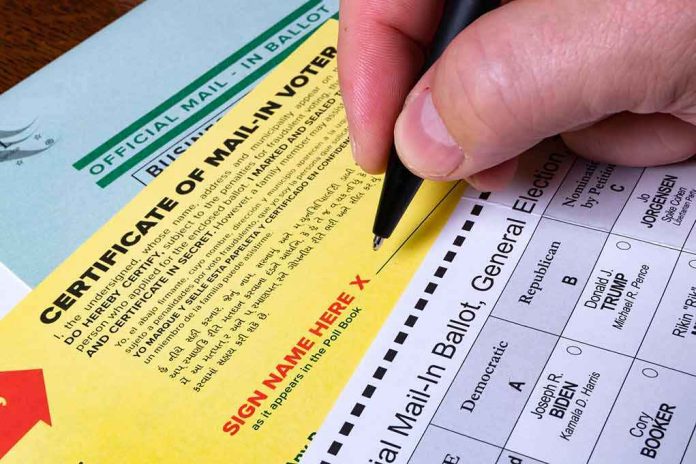
Texas’s mail-ballot ID rule is not a generic “voter ID” debate; it is a document-matching system that inserts two separate points of potential failure into an already eligibility-limited form of voting, and a federal appeals court has now restored it as lawful for upcoming elections.
At a Glance
- Texas requires eligible mail voters to provide a specific identification number on both the application for a mail ballot and again on the ballot’s carrier envelope.
- Election officials accept the application and ballot only if at least one number provided matches the voter registration record; otherwise, the voter must cure the defect.
- Eligibility to vote by mail in Texas is tightly constrained (age 65+, disability, confinement, or absence), so the rule falls on voters who often rely on mail ballots.
- A federal appeals court has upheld the legality of the number-matching requirement, framing it as a valid identity verification tool under federal law.
What Texas’s mail-ballot ID rule actually requires
Texas’s rule is exacting by design. To vote by mail, eligible voters must supply one of a narrow set of identifiers—Texas driver’s license or personal ID number, an Election Identification Certificate number, or, if none of those exist for the voter, the last four digits of the Social Security number—on two different instruments: first on the application for a ballot by mail (ABBM) and later on the carrier envelope used to return the ballot. The Secretary of State’s public guidance states this plainly and cautions voters not to confuse the requested numbers with their voter registration VUID. The requirement is not a one-time check; it is duplicated at both stages of the process.
Mechanically, election officials compare the ID number(s) the voter writes to the number(s) on the voter’s registration record. The state’s own explanation emphasizes the acceptance rule: as long as at least one of the numbers provided matches the voter’s record, the application and then the ballot may be accepted. Conversely, if the numbers are absent or do not match, the application or ballot can be rejected, triggering a notice and the opportunity to cure the defect using a portal or other prescribed method.
Why the “twice” matters: error pathways and cure
For in-person voting, Texas uses photo ID with fallback procedures; for mail voting, it uses document-matching. These are different integrity tools with different failure points. Requiring a number on the ABBM and again on the carrier envelope doubles the number of fields a voter must get exactly right and creates two separate acceptance decisions by officials. That structure does not automatically disenfranchise anyone—Texas maintains a cure process and publishes clear instructions—but it does convert small form-completion mistakes into legal defects that must be resolved quickly and correctly to count. From an administrative perspective, that is the point: the rule transforms identity verification into an objective match test rather than a subjective signature comparison.
Because mail voting in Texas is already limited to discrete categories—age 65 and older, disability, confinement in jail (if otherwise eligible), overseas or out-of-county absence—the population encountering these checkpoints skews toward voters who choose or need absentee voting. That makes the rule consequential even if the overall number of mail ballots is smaller than in universal-absentee states. Public-facing voter guides summarize these eligibility limits consistently, underscoring that the stake here is not systemwide turnout but the reliability of ballot return for those eligible to use the channel at all.
What courts have said and what the state argues
After a period of lower-court uncertainty, a federal appeals court restored the mail-ballot ID provisions of Texas’s 2021 election law for future elections. The Texas Attorney General characterized the outcome as a defense of identity verification and a rejection of claims that the number-matching rule violates federal law, including Section 101 of the Civil Rights Act of 1964. In the state’s telling, confirming that a mail voter is who they claim to be is plainly material to the act of voting and therefore lawful to require. That is the legal posture now governing the rule’s implementation unless and until a higher court says otherwise.
Texas’s administrative messaging aligns with that legal position: the state highlights that voters may use an SSN-last-four if they have no Texas-issued number, that a match of any provided number suffices, and that cure mechanisms exist for errors or omissions. This is not merely public relations; it is how acceptance is operationalized in county offices. The practical question has shifted from whether the rule may be enforced to how cleanly voters and administrators can execute it at scale within statutory timelines.
Burden versus integrity: where the real dispute lies
The policy fault line is not about whether identity verification is legitimate in the abstract; most Americans accept that premise. The dispute turns on instrument choice and error cost. Advocates of the Texas approach argue that number matching is an objective, uniform way to authenticate the voter that reduces reliance on subjective signature reviews and deters opportunistic misuse of mailed ballots. They also point to fallback options—using the SSN-last-four if no state ID exists—and to cure pathways as evidence that the system is stringent but fair.
Critics contend that document-matching rules of this sort create predictable friction that a subset of voters will fail to navigate, not because they are ineligible but because the process is unforgiving: write the wrong number on the ABBM, forget to repeat it on the carrier envelope, transpose digits, or register years ago with a different identifier, and you risk a rejection that must be cured on tight deadlines. They also note that Texas limits who can vote by mail, so the burdens cluster among older voters, people with disabilities, or those absent from their county—exactly the groups for whom streamlined mail voting can be most protective. While guidance and portals exist, critics question how well those tools perform when scaled under election-week time pressure.
How the rule fits national patterns
Texas’s approach sits within a broader national pattern: states that emphasize absentee ballot security tend to migrate from signature-only regimes to additional data-matching steps—driver’s license numbers, portions of SSNs, or other file-based identifiers. These rules are attractive to administrators because they convert a handwriting judgment call into a database comparison. The trade-off is familiar from any compliance system: objective checks surface more clerical errors, and every error demands process capacity to notify, cure, re-check, and record within statutory windows.
States that choose this route typically add infrastructure to mitigate error costs. Texas’s public materials explain the two-stage requirement, specify acceptable numbers, and describe the acceptance standard and cure process. Advocacy guides mirror those instructions, which, while they do not remove the underlying friction, at least reduce the probability that a voter is surprised by the requirement at the point of return. The integrity-benefit argument, in short, rises or falls on whether the match substantially improves authentication security relative to signature-only review, and whether the cure architecture is fast enough to save ballots that initially fail.
What we know—and what we still don’t
Two things are established with confidence. First, the mechanics: Texas requires mail voters to place an eligible identification number on both the ABBM and the carrier envelope, and officials accept the documents only if at least one listed number matches the voter’s registration record or the voter cures a mismatch. Second, the legal posture: after litigation and a district-court ruling against the state, the Fifth Circuit restored the ID provisions, and the Attorney General has declared the requirement lawful heading into future election cycles.
What is less documented in the public record is scale. How many applications or ballots are rejected for number problems? How many are cured successfully? Do rejections cluster among voters who lack Texas-issued IDs and rely on SSN-last-four? County-level reports would answer these questions definitively. In their absence, arguments about burden and benefit remain largely qualitative. That said, the operative law now expects voters and administrators to work within the number-matching framework; the most constructive practical response is voter education ahead of deadlines and robust, well-staffed cure operations during the return window.
BREAKING: Federal Court Hands Texas MASSIVE Election Integrity Win –
The Fifth Circuit just slapped down a lower court and upheld Texas’s 2021 election security law requiring ID verification for mail-in ballots — a huge win for states’ rights and ballot integrity
This reversal…— JaneDoe (@JaneOpines) August 14, 2026
Practical guidance for voters and administrators
For voters using mail ballots in Texas, two habits minimize risk. Use the same identifier on both the ABBM and the carrier envelope, and check that the number you provide is also present in your voter registration record; if you registered years ago, consider confirming which number is on file. If you have no Texas-issued ID, use the SSN-last-four option consistently. Finally, watch for notifications—paper mail, email, text—and use the state’s tracker and cure process promptly if a rejection notice arrives.
Sources:
foxnews.com, votetexas.gov, texasdemocrats.org, content.govdelivery.com, harrisvotes.com