

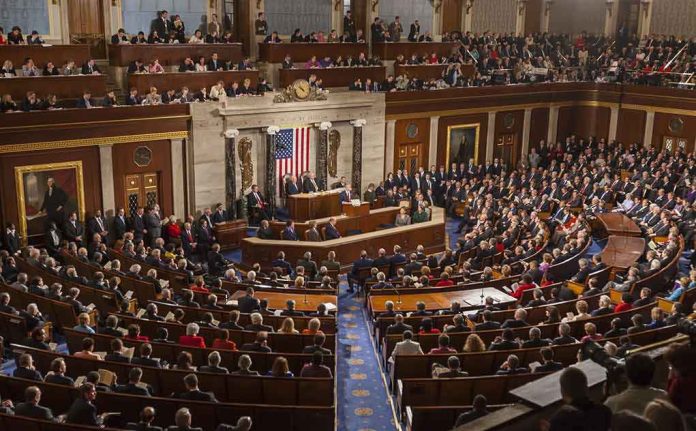
Congress just proved how deep the swamp really runs when 198 House Democrats voted to protect their own stock perks rather than slam the door on insider-style trading.
Story Snapshot
- House passed the Stop Insider Trading Act to block new individual stock buys by members and families.
- Every “no” vote came from Democrats, despite huge public support for cracking down on congressional trading.
- The bill keeps current stock holdings intact, raising real questions about how tough this “ban” really is.
- A voter identification rider turned an ethics vote into a partisan brawl over election rules.
What Congress Actually Voted On
The Stop Insider Trading Act is not a vague slogan. It is a specific bill, numbered H.R. 7008, that passed the House with a vote around 232 to 198, with just 13 Democrats crossing party lines to back it. The bill bars members of Congress, their spouses, and their dependent children from purchasing new individual publicly traded stocks while in office. It also requires public notice between seven and fourteen days before selling stocks, and it sets fines with real dollar amounts for rule breakers.
The penalty structure matters. Violators face at least a $2,000 fine or ten percent of the transaction value, whichever is higher, plus any net gain from the improper trade. A stock bought in violation would have to be sold. Supporters, including Republican leaders, describe this as the toughest step Congress has taken so far against lawmaker stock trading. For voters who have watched members get rich while “serving,” that sounds like long overdue common sense.
Why Democrats Balked Despite Public Anger
The political split is sharp. All 198 “no” votes came from Democrats. That looks strange against national polling that shows about 86 percent of Americans support banning members of Congress from trading individual company stocks. Democratic leaders did not simply stand up and defend congressional stock trading. Instead, they attacked how the bill was built. First, they pointed to a key loophole: lawmakers can keep the stocks they already own and even reinvest dividends from them. That is not a full clean-up of conflicts.
Second, Democrats hit the bill for riding alongside a national voter identification rule. The package Republicans moved also requires voters to show identification at the polls, giving Democrats a ready-made reason to frame the bill as an election law power play. Some Democrats and left-leaning commentators called the bill a “scam” because it preserves existing holdings and bundles in voter ID. From a conservative, common-sense view, that defense rings hollow. Voter ID is widely popular, and stopping new stock buys is better than leaving the swamp untouched.
How Tough Is This Crackdown Compared With Other Plans?
This bill sits in the middle of a bigger reform fight. Other proposals already on the table go further. The Bipartisan Ban on Congressional Stock Ownership Act would force members and spouses to divest almost all stocks, bonds, and similar securities within 180 days of enactment. A group of Democratic senators has pushed the Ending Trading and Holdings in Congressional Stocks Act, which would ban lawmakers and immediate family from owning or trading stocks while in office and uses blind trusts to remove day-to-day control. Yet these tougher ideas are still stalled, not law.
House Democrats have also rolled out their own sweeping stock ban plan that would cover members of Congress, Supreme Court justices, and senior executive officials, and would require divestment or blind trusts within set timelines. These bills go beyond H.R. 7008’s approach, which blocks new purchases but lets sitting lawmakers stay invested. That contrast is real. But there is a key point many critics skip: none of the stricter bills has cleared both chambers and reached President Trump’s desk. Until that happens, arguing for a “better” bill can sound like another excuse to do nothing now while insiders keep trading.
The Swamp Optics: Ethics, Insider Gains, And Voter ID
Voters look at this picture and see something ugly. They know many members have access to market-moving information. They know a shocking number of politicians leave office far richer than they entered. When the House finally passes a serious curb on new stock trades, and every single “no” vote comes from Democrats, it reinforces the feeling that the swamp protects its own first and the public second. That is especially true for conservatives who have long argued Washington is a class apart.
Anyone else sick of politicians becoming millionaires off our tax dollars. It's time to start throwing out the trash and getting honest people in office
The Swamp Protects Its Own: 198 House Democrats Reject Congressional Stock-Trading Crackdown – RedState https://t.co/KkQegieiqF— richard (@R_conservative1) July 23, 2026
At the same time, the voter identification rider offers a revealing test of priorities. Many Americans, including majorities of minorities, support voter ID as a basic integrity measure. For conservatives, pairing voter ID with a ban on congressional stock buying is not a “bait and switch.” It is a two-for-one deal on trust in elections and trust in government. When Democrats choose to die on that hill, they signal that protecting their own political coalition and trading flexibility matters more than cleaning up insider-style access to the market.
Sources:
redstate.com, noticias.foxnews.com, facebook.com, nytimes.com, washingtonexaminer.com, youtube.com, publicconsultation.org, en.bloomingbit.io, deseret.com, businessinsider.com, thehill.com, congress.gov, pbs.org, magaziner.house.gov