

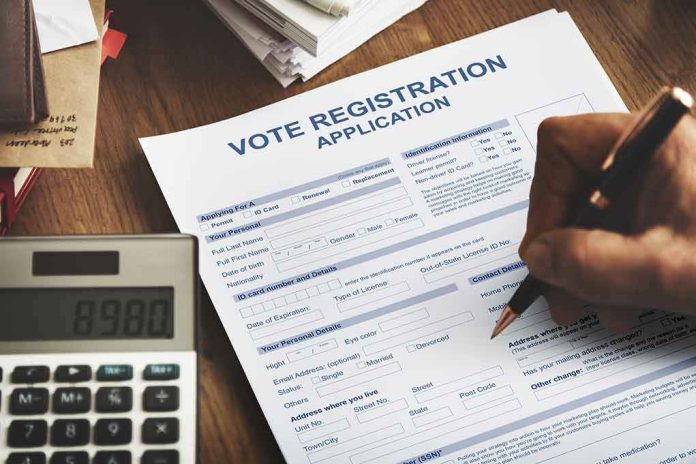
When New Jersey admitted that thousands of non‑citizens were wrongly added to its voter rolls and hundreds cast ballots, it confirmed the core point Scott Jennings had been hammering for years: the state’s systems were not built for zero tolerance, and that failure is real even if it did not flip an election.
Key Points
- New Jersey’s own review found roughly 6,600 non‑citizens were improperly registered between mid‑2023 and mid‑2024, with about 400 casting ballots.
- The cause was a systemic software error in the Motor Vehicle Commission’s “motor voter” pipeline, not a one‑off clerical typo.
- State officials stress there is no evidence any election outcome was changed, but they now concede a significant eligibility‑screening failure.
- Jennings’ insistence on “zero tolerance” for non‑citizens on the rolls is supported by these facts, even as debate continues over whether the problem counts as “widespread.”
What New Jersey Admitted Happened
The starting point for any serious discussion is the state’s own disclosure. In a State House news conference, Gov. Mikie Sherrill reported that about 6,600 non‑U.S. citizens had been registered to vote in New Jersey because of a software error in the Motor Vehicle Commission’s (MVC) system. These registrations were not the product of a single miskeyed form; they accumulated over roughly a year, from June 2023 to June 2024, as the MVC’s “motor voter” integration quietly accepted ineligible applicants who had indicated they were not citizens.
An early review by Sherrill’s administration found that roughly 400 of the erroneously registered individuals went on to cast ballots in at least one election. The governor emphasized that those 400 voters were not clustered in a single race or party, and state officials said there was “no evidence at this time that any elections were swayed.” That caveat matters for outcome‑focused arguments, but it does not erase the underlying eligibility failure: New Jersey’s system allowed hundreds of clearly ineligible voters to participate because its controls did not work as intended.
How the “Motor Voter” System Broke Down
To understand why this incident resonates beyond partisan talking points, you need to look at how New Jersey’s registration system is built. Like many states, New Jersey uses a “motor voter” model through its MVC: when residents interact with the agency to obtain or renew licenses, they can be automatically registered to vote if they certify they are U.S. citizens and meet basic eligibility requirements. In theory, the design streamlines registration, increases participation, and relies on self‑attestation combined with backend checks.
In practice, the MVC’s software failed at the critical step where citizenship status should have blocked ineligible applicants. According to the state’s description, the error allowed people who explicitly indicated they were not citizens to be passed through to the voter file as registrants. That is not a case of registrants lying; it is a case of a system disregarding its own gatekeeping field. The glitch persisted long enough to affect thousands of records, suggesting that the state lacked robust exception handling and monitoring on a data flow that touches the core of democratic eligibility.
New Jersey responded by replacing the vendor responsible for that part of the system and by beginning the process of identifying and removing the improper registrations. But the episode lays bare a structural vulnerability: when automatic registration is tightly coupled to another high‑volume bureaucratic process, a relatively simple software defect can propagate eligibility errors across the electorate silently and at scale.
Scale, “Widespread” Problems, and Why Numbers Cut Both Ways
On CNN and across commentary outlets, much of the argument turned not on whether the incident occurred—that point is now conceded by all sides—but on how to describe its scale. One panelist noted that 6,600 registrations amounted to roughly 0.6% of New Jersey’s 6.8 million registered voters, and that the governor’s margin of victory was around half a million votes, framing the problem as numerically insignificant in electoral terms. Sherrill’s own message reinforced this framing by repeating that no election appeared to have been swayed.
Jennings pushed in the opposite direction. His position is straightforward: for eligibility, the only acceptable number of non‑citizens on the rolls is zero, and the only acceptable number of ballots cast by non‑citizens is zero. From that vantage point, 6,600 ineligible registrations and 400 ballots are not a rounding error; they are proof that the system cannot guarantee what it promises. The term “widespread” here does not refer to outcomes, but to the fact that the flaw was systemic—embedded in a statewide registration pipeline, not isolated in a single clerk’s mistake.
This tension—between statistical impact and systemic integrity—is at the heart of modern election debates. Administrators and many analysts tend to talk in terms of margins and base rates: did the error change who won? Did it touch a meaningful share of the electorate? Security advocates and skeptics like Jennings talk in terms of processes: if a known class of ineligible voters can move from application to ballot because a gate failed, the system is, by definition, not secure enough.
Fraud, Mistake, and the Question of Intent
One point both state officials and critical commentators stress is that the New Jersey episode does not, on current evidence, prove a coordinated fraud scheme. The MVC error registered people who had indicated they were not citizens, and no public record has tied the incident to an organized effort by any party, campaign, advocacy group, or foreign actor to exploit the system. For many of the affected individuals, the key failure appears to have been administrative: the state added them to a civic process they were not legally allowed to join.
That distinction between intent and effect is legally important. Voting as a non‑citizen can be a serious offense under federal and state law, but the mental state of the voter—whether they knowingly misrepresented themselves or reasonably relied on government processes—matters for prosecution. In New Jersey’s own description, some people told the system they were not citizens and were registered anyway. That complicates any narrative that treats all 400 ballots as deliberate fraud in the colloquial sense.
Jennings’ argument, however, does not depend on proving that each of those voters acted with criminal intent. His focus is on the responsibilities of the state: it is up to the election system, not the registrant, to enforce eligibility rules consistently. On that question, the New Jersey case is clear. A mandatory citizenship gate was not enforced, thousands of records were contaminated, and hundreds of ballots were cast by people the law says should not have been on the rolls at all.
Automatic Registration, SAVE Act Politics, and System Design Trade‑offs
The New Jersey incident landed in the middle of a national fight over the SAVE America Act, a bill backed by President Trump and congressional Republicans that would require in‑person documentary proof of citizenship before registration and a photo ID at the time of voting. Supporters point to the MVC glitch as Exhibit A: if self‑attestation and existing backend checks can fail so badly in a single state, stricter, document‑based controls are warranted.
Critics counter that non‑citizens are already prohibited from voting in federal and statewide elections and that the SAVE Act would add new burdens—fees, travel, time off work—to the process of obtaining documents for millions of low‑income, elderly, and minority citizens. Civil‑rights advocates highlight that substantial numbers of Americans lack ready access to the required paperwork or ID, and fear that expanding documentary requirements will suppress lawful participation more than it prevents rare instances of ineligible voting.
From a systems perspective, both sides are wrestling with the same design trade‑off: how much friction can you add to the front end of the process to guarantee eligibility without deterring eligible voters or over‑policing bureaucratic edge cases? New Jersey’s experience shows that highly automated, low‑friction registration pipelines can fail in ways that go undetected until after ballots have been cast. Advocates of the SAVE Act would argue that documentary proof and photo ID are the necessary counterweight to such hidden vulnerabilities.
Is “Jennings Was Right” a Fair Reading of the Evidence?
Jennings made two key claims in the CNN exchanges that have since circulated widely. First, he said he has “zero tolerance” for any fraud or mistake that puts non‑citizens on voter rolls. Second, he argued that the New Jersey revelations showed “widespread” problems in the state’s system, contradicting years of dismissals of such concerns as right‑wing fantasies.
On the first claim, the evidence now squarely backs him: New Jersey itself has documented thousands of ineligible registrations and hundreds of ballots that should never have been cast. Even if every one of those votes ended up in elections decided by comfortable margins, they represent a categorical breach of the eligibility rules that define who gets a say in representative government.
On the second claim, whether “widespread” is the right word depends on what you mean by it. If you define “widespread fraud” as organized, outcome‑changing manipulation of results, New Jersey’s own review says this incident does not meet that threshold and has produced no evidence of coordination or changed winners. If, however, you define “widespread problem” as a systemic failure embedded in statewide infrastructure that quietly affected thousands of records and hundreds of ballots over multiple election cycles, the MVC glitch fits that description.
Jennings’ deeper instinct—that the political class has been too complacent about eligibility integrity and too quick to dismiss any concern about non‑citizen voting as a fringe obsession—now looks less like alarmism and more like a hard‑edged reading of the facts. New Jersey’s admission confirms that non‑citizen registrations are not just a theoretical possibility; they occurred, in appreciable numbers, because a real system in a real state failed to enforce its rules.
🚨 A viral video is drawing attention to CNN *NewsNight* host Abby Phillip after New Jersey Gov. Mikie Sherrill confirmed that approximately 6,600 noncitizens were mistakenly added to the state's voter rolls between June 2023 and June 2024 — due to a software error at the New… pic.twitter.com/I0NGoC50Zf
— Lincoln Media Foundation (@LincolnMediaHQ) August 1, 2026
Where the Debate Should Go Next
The most productive questions after an incident like this are technical, not rhetorical. How quickly did New Jersey identify and isolate the problem? How complete is the cleanup of the rolls? Has the state conducted a full ballot‑level reconciliation to determine exactly how many of the roughly 400 ballots were counted, and in which contests? Has it audited the motor‑voter integration back to its inception to test whether earlier errors were missed?
Answering those questions requires more than press conferences. It requires public release of incident reports, data‑matching logs, vendor communications, and election‑board analyses. Without that transparency, trust erodes on both sides: skeptics suspect the state is minimizing the scope of the problem, and defenders suspect the fraud narrative is inflating numbers or misreading intent. What the New Jersey episode already proves, however, is that eligibility integrity is not solely a matter of partisan temperament. It is a matter of engineering—system design, monitoring, and zero‑tolerance controls that either prevent ineligible registrations at the gate or catch them before they can be turned into ballots.
Sources:
townhall.com, youtube.com, nypost.com, pjmedia.com, instagram.com, twitchy.com, redstate.com, podcasts.apple.com, ground.news