

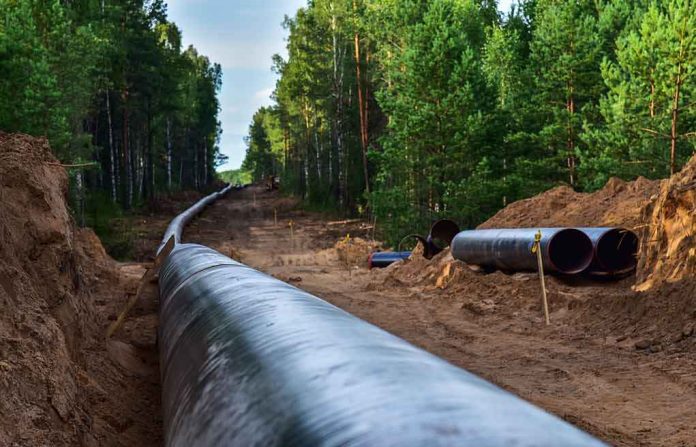
A pipeline fire that throws flame a hundred feet into the night sky looks, to anyone watching it from a county road, like catastrophe. What actually determines whether it becomes one is almost entirely invisible: the integrity of a buried steel seam, the speed of an automated shutdown, and decades of inspection records that either caught a flaw in time or didn’t.
Key Points
- A Southern Natural Gas transmission pipeline released gas and ignited near Ward in Sumter County, Alabama, at approximately 11:27 p.m. Central Time on November 21, producing flames reportedly visible tens of miles away.
- The operator shut down and depressurized the affected segment; no injuries or structural damage were reported by the company or by Sumter County Commission Chairman Marcus Campbell.
- The fire triggered an unscheduled outage on the South Main Loop Line east of the York compressor station, with Southern Natural Gas saying customer deliveries were not impacted at the time.
- The precise technical cause — corrosion, excavation damage, equipment or weld failure — had not been determined as of the operator’s statement.
- The incident fits a well-documented national pattern: onshore gas transmission pipelines average roughly 61 significant incidents a year, split chiefly among equipment failure, corrosion, and excavation damage.
What Happened Near Ward, Alabama
Southern Natural Gas, the interstate transmission operator, reported a natural-gas release and fire at approximately 11:27 p.m. Central Time on November 21, on a pipeline segment in rural southern Sumter County near County Road 9 between the communities of Bellamy and Ward. The explosion sent a column of flame upward that local reporting and eyewitness accounts described as visible for miles across the Alabama-Mississippi line, lighting the night sky over two states. Company personnel reached the site, secured it, and shut down and depressurized the impacted line segment — the standard first response to any transmission-line release, designed to starve the fire of fuel once ignition has already occurred.
The blast ignited a secondary brush fire in the surrounding woodland, drawing a multi-department response; the Pleasant Hill Volunteer Fire Department confirmed its crews and other volunteer departments responded to the pipeline fire and the resulting vegetation fire. Despite the visible violence of the event, Southern Natural Gas confirmed no injuries were associated with the incident, a finding corroborated independently by Sumter County Commission Chairman Marcus Campbell, who told WBRC that no one was hurt and no structures were damaged. That alignment between the operator’s own account and a named local official is the strongest form of corroboration this kind of incident typically produces in its first hours.
How a Transmission Line Fails and Why Shutdown Matters
Interstate transmission pipelines like the one operated by Southern Natural Gas carry gas at far higher pressure than the distribution lines that run to homes, which is why a rupture produces a sustained jet fire rather than a brief flash. Once ignited, the flame persists until the operator closes remote or manual valves isolating the breached segment and the line depressurizes — a process that, in comparable incidents, has taken anywhere from under an hour to several hours depending on valve spacing and detection speed. Here, the operator reported the segment shut down and depressurized, and separate reporting identified the affected asset specifically as the South Main Loop Line east of the York compressor station, with a resulting reduction in that line’s carrying capacity. Southern Natural Gas’s statement that customer deliveries were not impacted at the time is a narrower claim than saying the system suffered no consequence at all; a partial capacity reduction on one loop line is not the same as an interruption reaching end users, and both things can be true simultaneously.
Why the Cause Takes Time to Establish — and Why That’s Normal
Southern Natural Gas said the cause of the release remained under investigation, which leaves open the full range of standard hypotheses: corrosion, third-party excavation damage, a material or weld defect, or an operational anomaly. That is not an evasive answer; it reflects how pipeline failure investigations actually proceed. Determining cause requires recovering and metallurgically examining the failed pipe section, cross-referencing the operator’s integrity-management and inspection history for that segment, and checking excavation permits and one-call notifications in the area — work that federal investigators and the operator typically complete over weeks or months, not hours. The Pipeline and Hazardous Materials Safety Administration, the federal agency with jurisdiction over interstate transmission lines, is the body that would ultimately issue findings and, if warranted, a corrective-action order.
The Broader Pattern: Pipeline Failure Is Rare, Uneven, and Measurable
Incidents like this one are not statistical anomalies in the sense of being unprecedented, even though they are individually rare for any given mile of pipe. A Government Accountability Office analysis of PHMSA data found that significant onshore gas transmission incidents averaged 61 per year nationally from 2010 through 2022, with equipment or material failure accounting for roughly 43 percent of those events and corrosion for about 16 percent; excavation damage, while a smaller overall share, figures more prominently in high-consequence areas. National Transportation Safety Board investigations of individual ruptures have traced causes as varied as a scrap crew cutting into a service line mistakenly documented as abandoned, tape-wrap-induced stress corrosion cracking at a seam weld, and degraded 1982-era polyethylene fittings that let gas migrate underground before ignition. The point of citing that range is not to predict which applies in Sumter County — it is to show that “under investigation” routinely resolves into one of a handful of well-understood failure modes, each with its own fingerprint in the metal.
BREAKING MASSIVE NATURAL GAS PIPELINE EXPLODES INTO THE AIR IN WARD ALABAMA!
Fire on a natural gas pipeline lit up the sky in Alabama on Saturday evening. Orange flames prompted the operator to shut down part of the line, but caused no injuries. The cause of the explosion and… pic.twitter.com/VVTWtEvjbF
— SANTINO (@TheRealSantino) November 23, 2026
What Residents and Regulators Will Watch Next
For Sumter County, the immediate questions are practical: whether the operator’s force-majeure notice on the South Main Loop Line translates into any lasting capacity constraint, and whether PHMSA’s eventual findings point to an isolated failure or to a condition — aging pipe, a corrosion pattern, a documentation gap — that could recur elsewhere on the same system. Southern Natural Gas’s prompt, on-record statement and the county chairman’s independent confirmation of no injuries gave the public an unusually clear picture in the first 24 hours, which is not always the case in rural pipeline incidents. What remains is the slower, less photogenic part of the story: the metallurgical and regulatory work that turns a fireball visible from two states into a documented cause, and eventually, if warranted, into a corrective-action order that changes how that stretch of pipe is inspected going forward.
Sources:
thegatewaypundit.com, yahoo.com, queencitynewsfeed.com, al.com, wsfa.com, wtok.com, waka.com, energywar.net, gao.gov, ntsb.gov, phmsa.dot.gov