

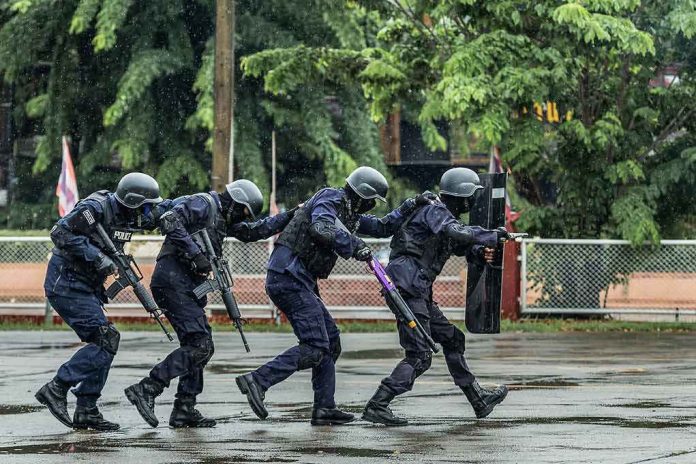
When a county controls the keys to its own facilities, it controls more than real estate; it controls the terms of its relationship with federal power. San Diego’s decision to end range-access agreements for immigration agencies is best understood as a case study in local authority asserting itself in a polarized policy space where the law permits discretion and politics sets direction.
The Short Version
- San Diego County’s Board of Supervisors voted 3–2 to terminate license agreements that let ICE and CBP train at county firearms ranges, exercising clear control over county facilities.
- The access being terminated was real and active, not symbolic: federal immigration agencies logged thousands of hours and paid six figures to use the ranges in recent years.
- The move aligns with a broader county posture to limit cooperation with immigration enforcement where the law makes local participation discretionary.
- CBP leaders warn of operational costs and longer border wait times if officers must leave the region for mandatory qualifications; the sheriff has signaled some CBP access may continue through her authority, blunting the immediate effect.
What the Board Actually Did: Terminating Real, Documented Agreements
The Board of Supervisors did not pass a resolution of sentiment; it took an operational step. In a 3–2 vote, the board directed termination of specific license agreements that gave U.S. Immigration and Customs Enforcement (ICE) and U.S. Customs and Border Protection (CBP) access to county firearms facilities. Contemporary local reporting identified the agreements with specificity: a 2017 license for CBP at the San Diego Regional Firearms Training Center in Otay Mesa, a 2021 license for ICE at the same facility, and a 2022 license for ICE at the Miramar Training Facility, which the county leases and administers. Those are the kinds of instrumented, signatory arrangements that matter because they bind access, scheduling, reimbursement, and liability in writing, not in handshake custom.
Local leaders framed the action squarely within their remit. Sponsors argued the county has jurisdiction over its facilities and may direct its Chief Administrative Officer to end discretionary licenses that no longer reflect county policy. That is routine governance: license agreements are privileges to use public assets for a time and purpose, revocable on stated terms—often for convenience with notice—when elected stewards choose a different course. Press accounts also confirm the item appeared on the posted agenda for the Aug. 18, 2026 meeting, matching the recorded vote date and process sequence one would expect for a significant facilities decision.
Why This Wasn’t Symbolic: Usage, Money, and Policy Trajectory
Sometimes a government withdraws a permission few used and calls it reform. Not here. ICE and CBP had become regular customers of county ranges. Since 2024 they logged roughly 3,350 hours and spent about $235,000 for access, with additional tallies through April 2026 reflecting ongoing use by both agencies. That level of utilization makes the termination concrete: it alters real training calendars, instructor allocations, and reimbursements, rather than simply closing a rarely used back door.
The vote also fits a larger policy arc. Since early 2025, the board under its current leadership has advanced measures to protect immigrants’ access to county services and to limit forms of cooperation with federal immigration enforcement deemed corrosive to trust between communities and local law enforcement. Within that frame, ending the use of county firearms facilities by immigration agencies is not an isolated gesture; it is a consistent application of a local public-safety and community-trust theory to a new domain—facilities governance.
The Legal Architecture: Discretion, Not Duty
Federal law sets immigration policy, but it does not conscript localities into supporting roles across the board. Outside narrow information-sharing mandates and specific statutory programs, cooperation remains discretionary. The 287(g) framework—under which local officers can be deputized to perform certain federal immigration functions—has, for two decades, functioned as a bellwether of this discretion. Jurisdictions opt in and out based on local politics, risk appetite, and resource calculus; crucially, no federal statute requires state or local governments to enter such agreements or to provide facilities or services to immigration authorities absent a contract both sides sign.
That history matters here. A county allowing ICE or CBP to rent a range is not complying with a mandate; it is choosing to extend a facility privilege through a license. Revoking that license—per its terms—is a textbook exercise of local autonomy. Whether the Miramar site is county-owned, county-leased, or a hybrid arrangement, the same principle holds: use flows from the county’s control bundle and can be withdrawn when elected supervisors change policy direction, subject to notice and other contract conditions. In short, the legal posture supports the board’s authority to act as it did.
The Operational Countercase: Readiness, Staffing, and Wait Times
CBP leaders pushed back with operational claims, some of which have intuitive force. Commissioner Rodney Scott warned that losing access to the Otay Mesa range—the site he described as the only facility used by local CBP officers for mandatory firearms qualifications—would trigger an immediate reduction in deployable staffing as officers leave the region to complete required training. He linked that to longer wait times at land ports of entry and at San Diego International Airport, a tangible consequence for travelers and commerce if training must migrate to distant facilities.
Those assertions draw a straight line from loss of proximate range time to diminished throughput at the border. They also reflect a broader institutional argument: that routine firearms qualifications are inseparable from officer safety and mission readiness and, by extension, public safety. As a matter of logistics, they are plausible; if 1,700 CBP officers in the region must qualify at fewer or more distant ranges on the same cycle, the scheduling burden rises and some posts will run thin on particular days or weeks.
Where the Move Lands in Practice: The Sheriff’s Gatekeeping Role
County boards set policy; sheriffs run law enforcement operations and, often, the facilities that support them. Immediately after the vote, Sheriff Kelly Martinez signaled that she would continue to allow CBP to use the San Diego Regional Firearms Training Center, citing economic considerations. That stance complicates the neatness of the board’s termination by preserving at least some CBP access in practice, depending on the scope of the sheriff’s control over scheduling and admission. It also underscores how divided authorities inside one county government can shape what a policy shift means on the ground day to day.
This intra-county divergence does not erase the board’s action, which terminated the identified license agreements and closed important channels of access for ICE and, potentially, for CBP at certain facilities. It does, however, temper predictions of an immediate, total cutoff. In real operations, change tends to be incremental: agreements sunset or are wound down with notice; agency users rebook or reallocate; and line officers experience disruption unevenly across units and qualification cycles.
Mechanism and Consequence: How Facility Access Moves Policy
Firearms ranges are not just shooting bays; they are calendars, safety officers, certifying instructors, maintenance crews, and insured premises configured to exact standards. A license agreement externalizes that infrastructure to a tenant-agency on scheduled blocks, often with cost recovery. Ending the license does two things at once. First, it reclaims those blocks for the county’s own public-safety users—sheriff’s deputies, probation officers, or allied local agencies—with fewer conflicts and more flexibility. Second, it imposes search, travel, and contracting costs on the displaced users, who must secure alternatives with equivalent safety envelopes, backstops, and credentialed trainers.
In the immigration-enforcement context, that reallocation is policy by other means. Supervisors who view federal enforcement as at odds with local trust goals reduce local fingerprints on that enforcement not by litigating immigration law but by declining to host its training lifecycle. Supporters read that as aligning public assets with local values. Opponents read it as degradation of a federal security mission. Both readings are coherent; the disagreement is over whose mission a county facility should serve when the law leaves room to choose.
How to Judge the Competing Claims
The board’s case rests on uncontested authority and documented agreements; the vote occurred, the licenses existed, and their termination lies within local discretion. The countercase is not a refutation of those facts; it is a forecast of operational impact made by named CBP officials on the record, tying range access to staffing and wait times. Taken together, the evidence supports two clear conclusions. First, the county acted within the bounds of ordinary facilities governance. Second, the effect on CBP and ICE training will be real, although partially offset by the sheriff’s gatekeeping and by the agencies’ capacity to shift training elsewhere over time.
What remains unknowable absent contract text are the precise wind-down timelines, notice and convenience-termination clauses, and any indemnity or reimbursement obligations—details that would determine the tempo of change and exposure to claims. But none of those uncertainties disturb the central dynamic: in the absence of a federal mandate to cooperate, supervision of public facilities is a lever local governments can and do pull to express—and enforce—policy choices.
After today’s San Diego County Board of Supervisors’ vote, @sdsheriff Kelly Martinez announced that she has notified Immigration and Customs Enforcement (ICE) officials that they will no longer have access to or be allowed to use Sheriff's facilities for purposes of training and… pic.twitter.com/olr0Kh4E6A
— San Diego Sheriff (@SDSheriff) August 18, 2026
What to Watch Next
Three developments will reveal how consequential this decision ultimately is. First, the publication or release of the board’s letter, legal memo, and agreement terms; those will tell us how fast the changes bite and whether litigation risk exists. Second, the sheriff’s implementation stance across both the Otay Mesa and Miramar facilities; subtle scheduling policies can either keep CBP’s access meaningful or marginal. Third, CBP and ICE adaptation—new contracts with non-county ranges, staggered qualification cycles, or mobile qualifications—will determine whether early disruptions translate into the chronic delays forecast by CBP leadership or settle into a new normal of higher training overhead and tighter staffing margins.
Sources:
kpbs.org, sandiegouniontribune.com, inewsource.org, youtube.com, highergov.com