

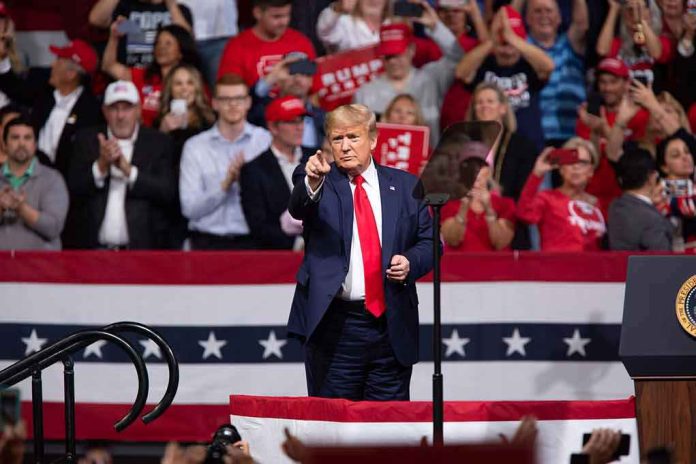
Removing a disruptive attendee from a presidential rally is one of the most practiced rituals in American campaign politics — security moves fast, the candidate reacts in real time, and the moment becomes instant footage long before anyone outside the room learns what was actually said or done. That ritual played out again on October 17, 2026, at Northern Kentucky University’s Truist Arena, when a man was removed from President Trump’s midterm rally after disrupting the speech.
Key Points
- Security removed a protester from Trump’s rally at Truist Arena in Highland Heights, Kentucky, on October 17, 2026, after he caused a disturbance early in the speech.
- Multiple local and national outlets independently described the man as shouting or screaming before he was taken out of the venue.
- Trump paused his remarks, joked about sending the man “back home to mom,” and publicly suggested the crowd not pursue charges against him.
- The episode echoes a 2016 Louisville rally controversy that produced years of litigation over Trump’s “get ’em out of here” remarks — a case the Sixth Circuit ultimately resolved in his favor.
- Exact details — the protester’s identity, his precise words, and whether any citation was issued — were not part of the public record in the immediate aftermath.
What Happened Inside Truist Arena
The disruption came early. According to LINK nky’s on-the-ground account, “an individual was removed from the arena by security forces after causing a commotion in the audience” shortly after Trump began speaking. Video circulated from inside the venue showing the man being escorted out while Trump’s remarks continued around the interruption. Mediaite’s coverage characterized him as a “screaming protester,” while a separate report described him as shouting before security intervened. The accounts differ slightly in emphasis — some use the more clinical “escorted,” others the more charged “removed amid a commotion” — but every version agrees on the core sequence: a disturbance, a security response, and a rally that resumed once the man was gone.
That kind of variance in verb choice is normal, not evidence of confusion. Reporters working from the same few seconds of chaotic video routinely land on different words for the same physical act, and nothing in the available coverage suggests the outlets were describing different events. Truist Arena, a 10,000-seat venue on NKU’s campus in Highland Heights, has hosted large-scale political and sporting events before; nothing about the setting was unusual, and nothing in the record suggests the rally’s broader proceedings were affected beyond the brief pause.
Trump’s On-Stage Response Became Its Own Story
As is often the case at his rallies, the president’s reaction to the interruption generated as much coverage as the interruption itself. Trump told the crowd, “Back home to mom,” and then posed a question that drew laughter: he asked whether they should “ruin his life and press charges,” before answering himself — “Just let him go”. Separate reporting noted Trump added a quip about the man’s mother being from Kentucky and likely to “slap the hell out of him”. These lines are classic Trump rally improvisation: a disruption gets folded into the performance, turned into a bit, and used to reinforce the contrast between the candidate and his critics in front of a friendly crowd.
Trump also repeated a broader claim he has made at other rallies — that protesters who interrupt his events are sometimes paid to do so, a figure he has previously put at $250 per disruption. No payment record, organizer, or named recipient has been produced to substantiate that specific claim in connection with this incident, and it should be read as a rhetorical assertion rather than a documented fact. What is documented is the sequence of events on stage: the pause, the joke, and the on-the-record statement that he did not want charges pursued.
What the Record Does Not Yet Establish
Several details that would normally round out a story like this were not part of the public reporting in its immediate aftermath: the protester’s name, his exact words before security moved in, and whether he was cited, briefly detained, or released without any law-enforcement action. Trump’s remark about not wanting charges pressed suggests the matter may have ended informally, but no police or venue statement confirmed an outcome. That is a routine gap in same-day rally coverage, not a sign of anything amiss — campaign security incidents of this scale rarely generate an official report unless an arrest or injury occurs.
A Familiar Pattern With a Decade of Legal History
Kentucky has been the backdrop for this exact kind of controversy before, and the earlier episode is worth knowing because it shows how far these moments can travel legally. At a March 2016 Louisville rally, then-candidate Trump told a crowd to “get ’em out of here” after protesters interrupted him; several of those protesters later said they were shoved and struck by other attendees as they left, and three of them sued Trump, alleging his words had incited the crowd. The case wound through federal court for years. In 2019, the Sixth Circuit ultimately ruled in Trump’s favor, finding that his instruction to remove the protesters did not amount to incitement and was protected speech, a decision that closed out the litigation. That precedent is now the controlling legal backdrop for virtually any dispute over a candidate’s on-stage reaction to a rally disruption, including the far more muted exchange in Highland Heights, where Trump explicitly discouraged rather than encouraged any punitive response.
The comparison matters less for its legal mechanics than for what it reveals about pattern recognition. Rally removals are common enough, and visually dramatic enough, that any new incident risks being read through the lens of the most famous prior one — even when the facts diverge sharply. In 2016, witnesses described physical shoving by other attendees; in 2026, the available accounts describe only a security escort and a president who told the crowd to let the man go. Treating the two as equivalent would be a mistake the evidence does not support.
Why These Moments Keep Recurring
Disruptions at high-attendance political rallies are not statistically rare, even if no reliable national tally tracks how often they happen or distinguishes a silent protester from a shouting one. Academic research on protest coverage has found that media attention to a given demonstration spikes mainly when it intersects with an issue already gaining traction in the news cycle, rather than scaling simply with the size or intensity of the protest itself. That helps explain why a single individual removed from one arena in Kentucky becomes national news, while dozens of similarly brief disruptions at other campaign stops pass with little notice: timing and narrative context, not the underlying conduct, often determine which incidents travel.
For a sitting president running a packed midterm travel schedule, that dynamic is simply part of the operating environment. Rallies will draw disruptions; security will remove people; and the candidate’s ad-libbed response — whether a joke, a rebuke, or, as in Highland Heights, a call for leniency — will typically outlast the original disruption in the public memory.
Sources:
youtube.com, cincinnati.com, linknky.com, yahoo.com, peachtreetv.com, courier-journal.com, news.meaww.com