

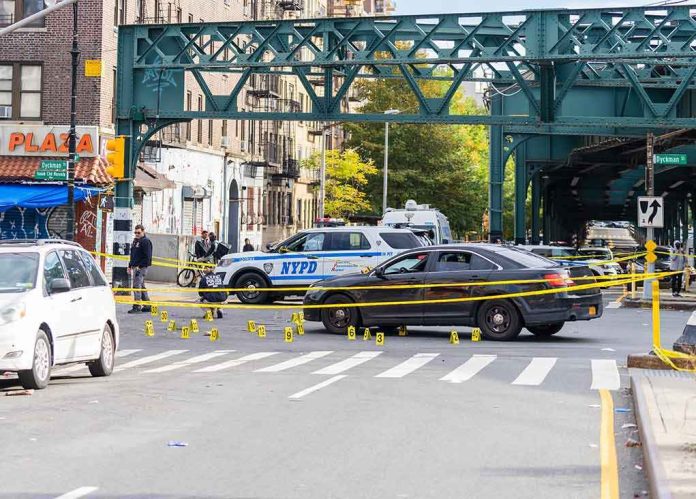
Juvenile gun violence in New York City has risen sharply since the state shifted most 16- and 17-year-olds out of adult courts—a change critics argue has coincided with, and plausibly facilitated, more teenagers carrying and using guns.
At a Glance
- NYPD leadership reports a dramatic rise in juvenile shooters since 2018, alongside a 25-year high in arrests of minors for gun offenses.
- Gun arrests of minors are up roughly 136% from pre–Raise the Age (RTA) baselines, while youth shooting suspects and victims have both climbed.
- RTA moved most 16- and 17-year-olds into juvenile processes with a dedicated Youth Part for serious cases; critics say its guardrails are too porous.
- City analysis shows youth remain a small share of overall felony arrests, but firearm-involved harms have grown within that slice.
What changed with Raise the Age—and why it matters for guns
New York’s Raise the Age law, passed in 2017 and fully implemented by 2019, shifted the age of criminal responsibility for most offenses from 16 to 18. In practice, that means most 16- and 17-year-olds are handled in Family Court; only defined serious felonies route into a specialized Youth Part within the adult court system, with strict criteria for when a case can remain there or must be removed to Family Court. The reform’s aim was developmental: align legal consequences with adolescent culpability science, reduce the harms of adult incarceration on teens, and improve long‑term public safety.
Guns complicate that calculus. A small cohort of teens now drives a disproportionate share of the most injurious violence. As the youth system absorbed older adolescents, New York police leaders say they observed more teenagers carrying firearms and more using them. According to public remarks summarized by the Manhattan Institute, NYPD Commissioner Jessica Tisch described a near-200% increase in juvenile shooters between 2018 and 2024—a period that brackets RTA’s rollout and the pandemic-era spike in gun violence.
What the data show: arrests, shooters, and victims
Three markers tell the same story. First, arrests of minors for gun possession have surged since RTA—roughly 136% above 2018 levels, according to NYPD figures reported by local outlets. Second, the number of juvenile shooting suspects has climbed markedly over the same period, tracking Commissioner Tisch’s account of a steep rise. Third, the number of youth shooting victims is also up since 2018, suggesting not just heightened offending but heightened exposure among teens to gunfire citywide. In parallel, the NYPD announced that in 2025, 14% of shooting victims and 18% of suspected shooters were under 18—underscoring the growing footprint of minors within gun violence even as overall shootings fell from their 2020–2021 highs.
Critics of RTA connect these trends to the statute’s procedural architecture: many cases involving gun possession by older teens begin outside the Youth Part or are presumptively removed therefrom absent proof of aggravators; the resulting timelines and sanctions can be lighter and less certain than adult dispositions, which may weaken deterrence among the subset carrying guns. Proponents counter that overall youth arrest shares remain similar to pre-RTA levels and that a small fraction of youth felony arrests are for the most serious violent offenses—evidence, they say, that the problem is narrower than its headlines. Both points can be true: the fraction remains small, and within it, gun harms have intensified.
Mechanism: how policy design meets street incentives
Policy does not cause behavior in a vacuum; it alters incentives on the margin for a small group already near the line. RTA created a bifurcated path. For adolescent offenders charged with serious felonies, the Youth Part can retain jurisdiction, but removal to Family Court is common unless statutory aggravators are proven; for gun possession cases without additional factors, the odds tilt further toward juvenile processing with its distinct detention, confidentiality, and disposition regime. Among crews and gangs—entities that NYPD says historically account for a large share of shootings—word travels quickly about who faces what consequences. If the perceived risk of a serious adult conviction for a gun case declines for 16- and 17-year-olds, crews will rationally assign risk to the youngest members, a long‑observed adaptation in cities with sharp age thresholds.
That adaptation interacts with two exogenous forces: the national pandemic-era gun surge and social-media-fueled conflicts that make retaliation swifter and more conspicuous. The result is not a broad wave of youth crime—most youth arrests have fallen over the last decade—but a concentrated rise in firearm carrying and use among a smaller, more violent subset of teens.
Context, not contradiction: the broader juvenile landscape
Nationally, juvenile offending has generally declined in property and many violent categories over the past decade, even as youth-involved homicides and gun assaults rose in the late 2010s and early 2020s. The Council on Criminal Justice reports juvenile-perpetrated homicides rose 65% from 2016 to 2022, contrasting with steep drops in burglary and larceny—an asymmetry mirrored in New York’s pattern of lower overall youth arrest shares but higher rates of youth involvement with firearms. Advocacy groups emphasize that youth arrests in New York City are down dramatically over 10 years, and they argue RTA made communities safer overall by preventing the well-documented harms of adult incarceration for adolescents.
City analysts likewise note that the youth share of citywide felony and violent felony arrests in 2024 matched 2018 levels, and that only about 5% of youth felony arrests involve the most serious violent felonies. Yet within that small band, the city has seen more guns and more shootings, a specific crisis demanding specific tools, not a wholesale repudiation of developmental justice.
What an evidence-aligned fix looks like
Two realities must be reconciled: adolescents are different from adults in ways that matter for sentencing and rehabilitation, and a small cadre of armed teens is imposing grave harms, often at the direction of older actors. Reform that acknowledges both realities will do five things.
First, tighten the statutory handling of adolescent firearm possession. Clarify and expand the aggravators that allow the Youth Part to retain gun cases, particularly repeat illegal possession, possession in connection with a shooting incident or credible social-media threats, and possession of high-risk configurations (e.g., auto‑sears, ghost guns). The objective is not to sweep every case into adult court but to ensure swift, certain, and proportional consequences for the repeat, gun‑involved subset.
Second, compress timelines. Adolescents are highly present‑oriented; dispositions that arrive months later lose salience. Prioritize fast-track adjudication for gun possession, pairing sanctions with mandated services—cognitive behavioral therapy, credible messenger mentorship, and school re‑engagement—delivered immediately.
Third, scale street‑proven gun‑violence reduction. Focused deterrence and Group Violence Intervention models, properly implemented, reduce shootings by combining targeted enforcement for those who persist with real, near‑term alternatives for those who desist. Given NYPD’s estimate that a large share of shootings are crew‑related, precision is the lever that moves outcomes.
Fourth, lock in consequences for adults who weaponize the age line—those who arm, direct, or transport minors for violent acts. Make straw-purchasing and gun distribution to minors a top-tier priority for joint local–federal prosecution; teens are the visible tip, but adult facilitators are the supply chain.
Fifth, keep perspective. The city recorded its fewest shooting incidents in years even as the proportion involving minors rose—a signal to target the youth gun problem without discarding reforms that reduced unnecessary incarceration for thousands of teens who never touch a gun. The right measure of success is fewer armed adolescents on the street and fewer families burying children, achieved with developmental accountability rather than nostalgia for 1990s sentencing.
Bottom line
New York’s experience is not a referendum on whether adolescents deserve a distinct justice system; they do. It is a referendum on whether that system can handle a concentrated gun problem with speed, certainty, and precision. The data from the NYPD and city reports tell a coherent story: while youth remain a small slice of overall crime, gun carrying and shootings among teens rose sharply after RTA’s rollout, and the current rules have not kept the highest‑risk youth from arming up. Fix the firearm pathway—tighten eligibility for Youth Part retention in repeat and aggravated cases, accelerate adjudication, and pair targeted enforcement with credible exits—and New York can protect both developmental justice and public safety.
Sources:
thegatewaypundit.com, nypost.com, citymeetings.nyc, criminaljustice.cityofnewyork.us, monroecountysheriff-ny.gov, sentencingproject.org, facebook.com, pmc.ncbi.nlm.nih.gov, kff.org