

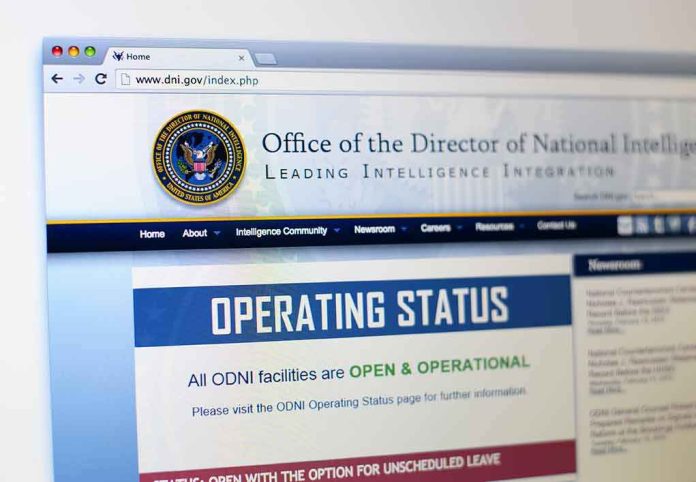
Markets do not punish salacious headlines; they punish uncertainty around national security, export controls, and leadership continuity. The Jensen Huang reinstatement saga sits precisely at that intersection, which is why the stock market’s air pocket was less about scandal and more about unresolved risk signals that investors cannot easily model.
At a Glance
- The core investor risk is not personal misconduct; it is counterintelligence exposure and export-control overhang that could affect access to technology, markets, and leadership continuity.
- U.S. officials signaled concern about foreign influence and security-clearance implications, even as Nvidia’s board relied on senior government input to reinstate Huang.
- Conflicting cues — intelligence-linked allegations versus presidential and Justice Department assurances — create precisely the ambiguity public markets discount.
- Clearances, counterintelligence, and export enforcement operate on different standards, so “no crime” does not equal “no risk.”
Why markets reacted: uncertainty priced, not morality judged
Professional investors distinguish between narrative noise and impairment risk. The alleged relationship between Jensen Huang and a woman reported to have maintained contact with a Chinese Ministry of State Security official is not, on its face, a valuation input; the potential consequences are. If a chief executive’s access to classified briefings or sensitive interagency consultations is curtailed, if the firm’s export posture is re-scrutinized, or if board and government judgments diverge, investors face path-dependent outcomes they cannot confidently bound. That is what widens bid-ask spreads and punishes multiples — not headlines alone.
Here, the market absorbed two incompatible signals. On one side, reporting tied the alleged relationship to ongoing MSS contacts, a frame that squarely implicates “foreign influence” concerns long embedded in clearance adjudications. On the other, the administration and Nvidia’s board communicated that Huang’s reinstatement posed no identified national-security risk, and that the Justice Department had not found unlawful conduct. Prices fell because both statements can be “true” in their own domains — and still leave material, unquantified downside.
How the three risk systems work — and why they confuse investors
Three government systems shape a company’s geopolitical risk profile, each with distinct thresholds and timelines. First, security-clearance adjudication is preventive: it weighs vulnerabilities — foreign contacts, coercion risk, financial pressure — rather than proving crimes. The Defense Counterintelligence and Security Agency processes hundreds of thousands of determinations annually and runs continuous vetting; its lodestar is future-risk mitigation, not prosecution burdens. Under well-established guidance, close and continuing contact with foreign-government–linked figures can constitute a “foreign influence” concern, even when lawful, though context can mitigate the risk. “Still holds a clearance” conveys a snapshot, not a guarantee; revocation can be discussed and never executed, or mitigations can be applied that investors never see.
Second, counterintelligence risk management inside agencies is iterative. Intelligence reporting can prompt defensive briefings, monitoring, or access restrictions without any criminal predicate. Those measures are largely invisible to markets; investors infer them from indirect cues — who attends interagency meetings, who is briefed, how boards phrase risk statements. Third, export-control and national-security enforcement is punitive and public, but only at the end of a lengthy pipeline. The National Security Division has redoubled export-control cases in recent years; declinations and resolutions turn on cooperation and intent, separate from clearance judgments. A company can face stepped-up scrutiny or remedial obligations absent executive culpability. None of this is contradiction; it is design.
The evidence investors actually have — and how to read it
On the allegation side, the most specific reporting describes a time-bounded pattern of contact between the woman at issue and an MSS official during her secret relationship with Huang — the sort of fact pattern that, if accurate, predictably triggers a foreign-influence review. Nvidia’s board disclosed that it was investigating whether Huang had been the target of a foreign-intelligence effort, language consistent with a counterintelligence lens rather than a criminal one. These are classic clearance-screen triggers: access, inducement risk, and undisclosed relationships.
On the exculpatory side, Nvidia’s board cited input from senior U.S. officials and unanimously reinstated Huang, while President Trump publicly stated the government had no reason to believe his return posed a national-security risk; a Justice Department official told NBC News the department had no evidence of wrongdoing by Huang or Nvidia. Multiple reports added that Huang still held a security clearance, although revocation had been discussed — a detail that underscores the provisional nature of clearance risk management. For markets, this set of facts means legal liability appears remote, but policy and access risks remain nonzero.
Where the real disagreement lies — standards, not facts
At bottom, the dispute is less about what happened than about which standard should govern a CEO at the fulcrum of U.S. AI leadership. National-security professionals ask whether any nontrivial chance of foreign leverage exists and, if so, how to reduce it. Corporate directors ask whether the company can operate effectively with appropriate safeguards and whether removal would create greater enterprise risk. Political leaders weigh strategic industrial capacity against intelligence-community caution. Each can answer “proceed” or “pause” credibly within their remit — and still leave public markets stuck between them.
Investors should resist the false binary of “cleared or compromised.” Clearance status is not a certificate of permanent safety; it is an adjudication in time, subject to continuous vetting and mitigation. Likewise, a DOJ statement that no evidence of unlawful conduct was found addresses criminal exposure, not the entirety of export-control compliance risk. The National Security Division’s own emphasis on corporate cooperation and controls illustrates how firms can face heightened expectations even without charges — expectations that can impose cost, delay, or constrained customer sets.
Nvidia's Jensen Huang still has security clearance, sources say https://t.co/J0Sk4bz8SO
— CBS News (@CBSNews) November 25, 2026
What it means going forward — how this risk prices into AI incumbents
For Nvidia and its peers, three valuation levers are now more sensitive to geopolitics than to quarterly beats: leadership durability, export addressability, and policy tail risk. Leadership durability depends on whether board assurances and government input harden into a steady state or give way to renewed scrutiny after congressional interviews or additional intelligence reporting. Export addressability hinges on whether enforcement focus tightens around gray-market flows into restricted jurisdictions; even absent corporate wrongdoing, the government can narrow channels, elongating revenue recognition and elevating compliance cost. Policy tail risk includes ad hoc decisions — waivers, carve-outs, or tightened thresholds — that can swing backlog value.
In practical portfolio terms, this argues for scenario-weighting, not binary calls. Assign modest probability to incremental export frictions increasing working capital needs; a smaller probability to leadership disruption; and a persistent background probability to policy shocks that cap upside in China-adjacent demand. Offset these with the still-dominant fundamentals: secular AI demand, supply-chain learning curves, and software-stack lock-in. The market’s initial selloff reflected a repricing toward this fatter left tail — not a collapse of the right.
How the uncertainty resolves — signals to watch
Investors should track four objective markers. First, clearance posture: any change in status, imposition of additional mitigations, or formal defensive briefings disclosed to Congress would clarify the counterintelligence vector. Second, export-control actions: additions to entity lists, new end-use rules, or public DOJ/Commerce actions related to AI accelerators will define the compliance runway. Third, board governance moves: added directors with export-control or national-security expertise, or formal board-level risk committees, would indicate durable adaptations. Fourth, revenue-mix disclosures: more granular geography and channel transparency will help the buy side distinguish enforcement noise from demand destruction. Until those arrive, spreads will stay wide — which is exactly how efficient markets behave under policy risk.
Sources:
nbcnews.com, cnn.com, 41nbc.com, nytimes.com, smh.com.au, ccsglobaltech.com, justice.gov, dcsa.mil