

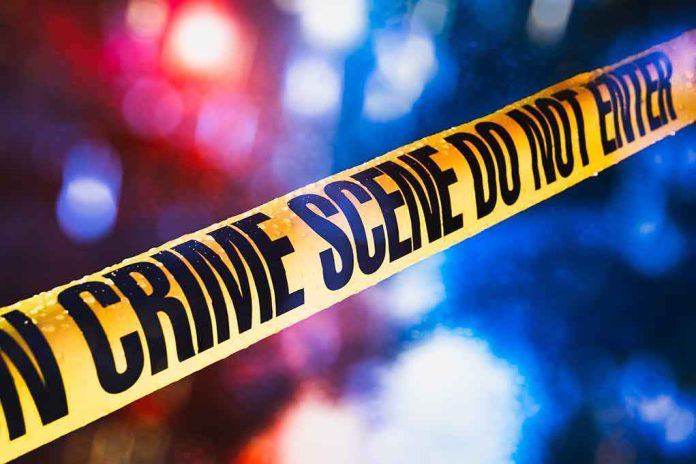
One man’s killing on a crowded Midtown platform was swift and singular; the operational shock to the city’s busiest transit system was immediate. That contrast—an isolated act that ripples across millions of rides—explains both the urgency of the police response and why such incidents, though rare, command outsized public attention.
At a Glance
- A man was shot once in the chest around 12:21 p.m. on the northbound E platform at Seventh Avenue–53rd Street and later died at Bellevue Hospital.
- Police initiated a large investigation on scene; no arrests were announced in initial reporting.
- Service on multiple subway lines was temporarily disrupted during the response.
- The incident fits a pattern where rare subway shootings are highly salient against a backdrop of citywide declines in gun violence.
What Happened on the Platform
Shortly after noon, at approximately 12:21 p.m., an adult male was shot on the northbound E train platform at the Seventh Avenue–West 53rd Street station in Midtown Manhattan. Initial accounts attributed to the NYPD and transit officials converged on the core facts: a single gunshot wound to the chest, rapid on-scene triage, and transport to Bellevue Hospital, where the victim was later pronounced dead; NBC News reported the pronouncement time as 1:06 p.m.. The shooting unfolded in one of the network’s highest-traffic nodes, a transfer complex serving the B/D/E lines within walking distance of Broadway houses and Carnegie Hall, which intensified both the commuter impact and the policing footprint.
Within minutes, the scene took on the features of a major incident response—cordoned station entrances, a platform secured for evidence collection, and multiple commands coordinating the investigation and crowd movement. As is standard in a fatal shooting, homicide detectives, transit bureau officers, and evidence collection teams moved in sequence: stabilize, secure, canvas. That sequencing explains visible delays to service even after the immediate medical emergency ended; the platform had become a crime scene.
Service Disruptions and the Mechanics of a Transit Crime Scene
When a shooting occurs in-system, the MTA’s first imperative is safety, the second is forensic preservation. Both collide with timetables. Trains that would normally dwell and dispatch through the affected station are rerouted or run through on bypass under direction from the Rail Control Center. CBS News and Patch reported that C, D, and E trains skipped Seventh Avenue and that riders experienced added delays across connected segments—an operational cost paid to keep investigators’ chain-of-custody clean and customers away from an active scene.
Passengers experience this as confusion—sudden platform announcements, a change in stopping pattern, trains that slow but do not open doors. To investigators, those precious minutes matter: fresh shell-casing placement, blood-spatter directionality, and witness vantage points can degrade quickly in a live station. Surveillance retrieval, another critical step, begins immediately; modern stations carry camera coverage on approaches, mezzanines, and fare control, which can trace a suspect’s egress even when a platform view is partially occluded by a train or column line.
The Known Facts—and Why They Converge Across Outlets
When multiple reputable outlets publish near-identical location, timing, and wound details, it typically reflects a single authoritative source with standardized language—an NYPD spokesperson reading from incident notes or a written advisory, augmented by FDNY transport confirmation. That is exactly what we see here. NBC News, CBS News, CNN/AP, and Reuters each cited police and officials in reporting a chest wound on the northbound E platform, transport to Bellevue, and the midday timing. Reuters, in particular, tends to strip to verifiable core facts and timestamp them, a style that anchors the timeline for other editors.
Two gaps persisted in the early window: the victim’s identity and the suspect’s. Both are common constraints. The medical examiner must confirm identity and notify next of kin before public release; police, absent an arrest or an imminent public-safety threat that warrants a wanted poster, will often withhold a suspect description while they review footage, test physical evidence, and reconcile witness statements. Early broadcast hits, including FOX 5 and ABC7, accordingly framed uncertainty about the precise platform-versus-train locus and number of shots—details that later converged on a single chest wound on the platform as more official confirmation solidified.
How Rare Events Distort Perception
A fatal subway shooting is stark and memorable. It is also statistically unusual. Citywide shooting incidents have fallen dramatically from pandemic-era peaks; NYPD reported 688 shooting incidents in 2025—down 24% from 2024—and the first nine months of 2026 reached the fewest recorded in the department’s modern series. Independent analyses, including a Brennan Center review, echo that trajectory, citing a 54% drop in shooting incidents from 2021 to 2025. Inside the transit system, shootings are rarer still, with just a handful recorded annually in recent years. That backdrop does not diminish the gravity of a single homicide; it does clarify that the underground is not the locus of the city’s gun violence burden, even when a single case commands citywide attention.
Two dynamics explain the attention gap. First, the subway concentrates strangers in confined spaces—when violence intrudes, the loss of perceived control is visceral. Second, a single in-station incident can disrupt tens of thousands of trips within an hour, magnifying visibility well beyond the immediate victim circle. Understanding those mechanics helps reconcile the paradox: falling rates in aggregate, but undiminished salience when a rare event occurs.
❗️NYC Subway Shooting ❗️
A shooting occurred before 12:30 PM today at the subway station in midtown Manhattan at Seventh Avenue and 53rd Street.
The male victim was said to be in his 30s.
He was taken to Bellevue Hospital where he was pronounced dead.
His name has not been… pic.twitter.com/WL8pmrYnUK— Marishay (@marishayone) October 17, 2026
Investigative Priorities After a Platform Shooting
Homicide work in a transit environment follows a concentrated checklist. Detectives will: pull and synchronize video from platform, mezzanine, and street egress; map the suspect’s path using fare array and street-corner cameras; recover ballistic evidence and submit casings for NIBIN comparison to link the round to any prior shootings; and canvass for witnesses with unobstructed sightlines. If an argument preceded the shooting, as some initial accounts suggested, sworn statements from independent witnesses and clear audio/video will be critical to separating rumor from admissible fact. Bellevue and the Office of Chief Medical Examiner provide the clinical record that anchors the forensic narrative—wound track, caliber inference, and time of death.
From there, arrests in subway shootings often break one of two ways: a rapid identification and apprehension based on crisp video and prior encounters, or a longer arc driven by ballistics hits, informant tips, or technology such as cellphone geolocation tied to fare-swipe patterns. Either path depends on disciplined evidence preservation at the outset, which is why the early disruption can feel disproportionate to onlookers. It isn’t; it’s the cost of a prosecutable case.
Why This Matters Beyond One Station
The city’s social contract with riders is simple: a predictable trip and a safe platform. That contract is upheld not by promising zero incidents—a promise no metropolis can make—but by ensuring that when something this serious happens, the response is fast, the investigation competent, and the system resilient enough to absorb the shock without cascading failure. The Seventh Avenue–53rd Street shooting triggered exactly that playbook: medical response, investigative lockdown, service adjustments, and public communication through media and announcements.
The broader policy frame remains where it has been trending: sustained focus on illegal firearms citywide, visible transit deployments calibrated to risk rather than fear, and transparency about outcomes. On the numbers, New York has driven gun violence down to historic lows; the goal in the transit system is to keep rare events rare, and when they occur, to clear them quickly and credibly.
Sources:
facebook.com, nbcnews.com, newsday.com, patch.com, nypost.com, cbsnews.com, cnn.com, rmb.reuters.com, nytimes.com, click2houston.com