

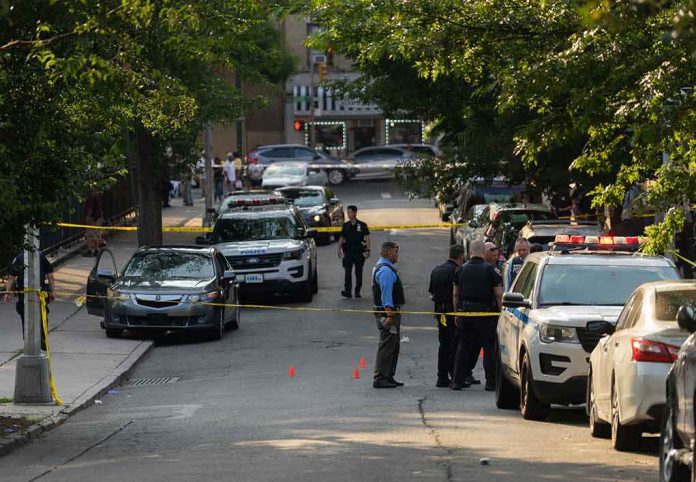
Holiday shootings like the deadly July 4 incident in downtown Pensacola are not random explosions of chaos so much as collisions of two trends: predictable spikes in youth-filled public spaces, and disputes that escalate into targeted gunfire inside those crowds.
At a Glance
- The Pensacola shooting was described by police as a targeted attack on a 19-year-old man, with six additional bystanders wounded.
- Hundreds of largely unaccompanied teens and younger youth had packed downtown for July 4 festivities, with disruptive behavior and fireworks reported before the gunfire.
- Media and social platforms framed the event as a “mass shooting” during celebrations, reinforcing a public sense of randomness despite police emphasis on intent.
- Shell casings and a wide crime scene suggest multiple shots and possibly multiple shooters, but no suspects or clear motive have yet been publicly identified.
- The incident fits a broader national pattern in which July 4–5 consistently produce the highest number of mass shootings in the U.S.
What Happened in Downtown Pensacola
In the early hours following July 4 celebrations, downtown Pensacola shifted abruptly from a noisy, crowded holiday scene to a homicide investigation. Police reported that a 19-year-old man was shot and killed and six other people were hit by gunfire, meeting common statistical definitions of a mass shooting—four or more victims injured or killed, excluding any shooter. The gunfire erupted near Intendencia and Palafox Streets, a popular stretch of bars and public space where crowds gather for fireworks and nightlife.
According to Pensacola police, the night was already strained before the shooting. They had deployed roughly 50 additional officers to manage “hundreds” of young people, many of them unaccompanied minors, who were congregating downtown and engaging in disruptive behavior including throwing mortar-style fireworks in the crowd. At least five arrests occurred prior to the shooting, including a teenager armed with a handgun who was throwing fireworks, underscoring how quickly a festive environment had tipped into a volatile one.
A Targeted Attack Inside a Crowded Holiday Scene
Police Chief Eric Winstrom has been unambiguous on one key point: he considers the shooting a targeted attack, not a random spray of bullets into the crowd. That assessment, he said, rests on preliminary eyewitness accounts and surveillance video showing the deceased 19-year-old as the apparent focus of the shooter or shooters’ attention. The working narrative inside the investigation is that the young man was the intended target and that the six other victims were struck because handguns were being fired at a moving person across a distance, in the middle of dense foot traffic.
That framing matters. If the evidence holds, the Pensacola incident sits closer to a street-style retaliatory or interpersonal shooting that happened to unfold in a crowded public place than to the archetypal indiscriminate rampage. Yet from the standpoint of harm to bystanders, the distinction is cold comfort. Many of the injured were likely doing nothing more than celebrating the holiday in what they thought was a public, policed, and therefore relatively safe space.
At this stage, however, much of the proof behind the “targeted” label remains inside police files. No suspects have been publicly identified or arrested, no ballistic report has been released, and the specific surveillance footage underpinning the chief’s conclusions has not been shared with the public. The motive—why this 19-year-old—remains entirely opaque. The targeted narrative is thus best understood as a preliminary working theory rather than a fully adjudicated fact.
Shell Casings, Crime Scene Size, and the Question of Multiple Shooters
Investigators recovered numerous shell casings scattered along a large stretch of Intendencia Street, consistent with a volley of somewhere between ten and twenty shots. The spread of evidence forced police to treat a wide corridor as the crime scene; that alone signals more than a single close-range shot. The chief has publicly floated the possibility of multiple shooters, based on the number and apparent distribution of casings, but he stopped short of declaring it definitively.
Determining whether more than one gun was used will ultimately depend on ballistic analysis—matching casings to distinct firearms—and, ideally, to recovered weapons or known offenders. Those reports have not yet been made public. Until they are, multiple scenarios fit the observed evidence: several shooters firing at one target, one shooter moving along the street as he fired, or even an exchange of gunfire between opposed groups. What is clear is that a significant number of rounds were discharged in a dense, youth-heavy crowd, dramatically elevating the risk of unintended injury and death.
Media Framing: “Mass Shooting” vs. “Targeted” Violence
News outlets and social media users quickly labeled the Pensacola incident a “mass shooting,” emphasizing the tally of one dead and six wounded during July 4 celebrations. That language aligns with the Gun Violence Archive’s widely used numerical definition—four or more victims injured or killed in a single event—but it carries rhetorical weight beyond statistics. For many people, “mass shooting” evokes a random, indiscriminate attack, an unpredictable terror that could strike anywhere.
Police, by contrast, have emphasized intent and specificity: a particular 19-year-old was targeted, in a context of preexisting disorder among unaccompanied youth. The friction between those framings is familiar in modern coverage of public-place shootings. Research on media treatment of high-profile attacks, such as Parkland, shows how narratives can rapidly coalesce around certain tropes—chaotic carnage, failed institutions, or lone evil actors—depending on which details are emphasized and which are left out.
Importantly, in Pensacola there is no genuine “Side B” offering a well-evidenced alternative interpretation of what happened. No outlet or activist group has produced forensic data or sworn witness statements contradicting the police view that the victim was singled out. Skepticism exists mostly in the abstract: doubts about official motives, discomfort with the idea that a mass casualty event might be classified as anything other than chaotic murder, and confusion fed by early misstatements about dates and street names.
Youth Crowds, Fireworks, and the Thin Line Between Disorder and Violence
One of the most striking details in the Pensacola account is the age profile of the crowd. Police described “hundreds” of young people, some as young as middle school, congregating in downtown streets late at night with minimal adult supervision. Fireworks—legal in some contexts, illegal in others—were being thrown into the crowd, used as both entertainment and provocation. At least one teen was arrested while simultaneously possessing a handgun and handling fireworks.
This mix of adolescent bravado, pyrotechnics, and firearms is not unique to Pensacola. Cities across the United States have reported similar holiday street scenes in recent years, where groups of youths converge in commercial districts and public spaces with little structure and quickly generate calls for service—noise complaints, fights, property damage, and suspected shots fired. Social media amplifies the draw: videos of “teen takeovers” circulate, and loosely organized meet-ups morph into large, hard-to-manage crowds.
From a policing standpoint, these environments are challenging. They require both crowd management and investigative capabilities, and they exist against a backdrop of broader debates about youth criminalization, curfews, and zero-tolerance responses. Yet the Pensacola case shows the stakes when tensions and weapons enter the mix: a single targeted dispute inside such a crowd can become, in outcome if not in motive, a mass casualty event.
Reactions vary among folks in downtown Pensacola after a shooting early this morning.https://t.co/6OFUMpTUX0
— Brendan Kirby (@BrendanKKirby) July 5, 2026
Holiday Gun Violence: Pensacola in National Context
The Pensacola shooting is part of a larger statistical pattern rather than an outlier. Analyses of gun violence across major U.S. cities show that shootings cluster at night, on weekends, in summer months, and around holidays. Among all calendar days, July 4 and 5 stand out: they consistently record the highest number of mass shootings nationally each year.
Over the recent July 4 weekend studied in national coverage, the Gun Violence Archive logged at least ten mass shootings on July 4–5 alone, and twenty-two across the broader holiday period, leading to roughly 20 deaths and 126 injuries. Incidents ranged from a seemingly indiscriminate rampage in Philadelphia to targeted attacks at parties and neighborhood gatherings in cities like Lansing and Washington, D.C. In Chicago, more than 90 people were shot during one holiday stretch, including children.
Against that backdrop, Pensacola’s numbers—one killed, six wounded—are tragically ordinary. The event illustrates how national trends play out in mid-sized cities: a holiday gathering, a youth-heavy crowd, the presence of firearms, and a dispute that crosses the line into gunfire. The question for policymakers and communities is not whether this pattern exists—it clearly does—but what mix of supervision, enforcement, and environmental design could reduce the probability that any given holiday crowd becomes another datapoint.
Unanswered Questions and Long-Term Stakes
Despite the detail in police briefings, several critical facts remain unresolved. No suspect has yet been publicly named, no charges have been announced, and no motive has been disclosed. The ballistic profile—how many guns, what types, which casings correspond to which locations—remains internal to the investigation. Surveillance footage and audio recordings that could clarify shooter movements and intent have not been released, in part because doing so could compromise future prosecutions.
Those gaps matter less for understanding the basic shape of the event—targeted shooting in a crowded July 4 scene—than for deciding what should follow. If the shooter and any accomplices are identified and linked to prior incidents, questions will arise about missed intervention points. If they are youths themselves, local debates about curfews, parental responsibility, and youth programming will intensify. If, as in many comparable cases, they turn out to be legally armed adults, attention may shift back to state gun policy.
For Pensacola residents, the more immediate concern is the psychological toll. Downtown streets that function as civic living rooms were filled with children and teenagers fleeing gunfire, some injured by bullets unleashed in what police believe was a focused attack. That reality—one targeted young man, six wounded by proximity—captures the dual nature of contemporary American gun violence. Most shootings are rooted in specific relationships, conflicts, or criminal activity; yet when they occur in crowded public spaces, the consequences are collective, and the fear they generate is as diffuse and enduring as any random massacre.
Sources:
independent.co.uk, weartv.com, youtube.com, en.wikipedia.org, facebook.com, news.wttw.com