

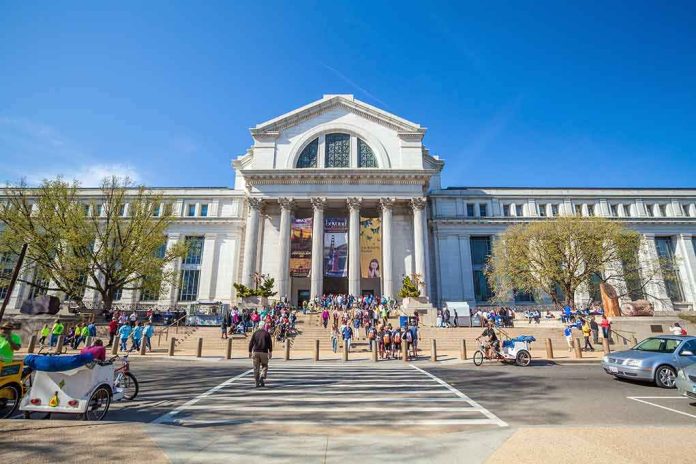
The National Museum of American History removed the phrase “American history” from its mission statement as part of a deliberate shift away from an explicitly “America First” framing toward a broader, more critical, and more inclusive account of the past—one that its director openly describes as a tool for fostering a “more just and compassionate future.”
Key Points
- The museum’s mission was rewritten to replace “explore the infinite richness and complexity of American history” with language about “empowering people” through “the complexity of our past.”
- Director Anthea Hartig has said this change was intended to “get out of the ‘America First’ mentality” in how history is told.
- Critics in the White House and Congress argue the shift turns a patriotic history museum into an instrument of social-justice activism.
- Hartig and allied historians contend the new framing simply adds previously omitted voices and “hard history” while remaining grounded in scholarship and nonpartisan standards.
What Changed in the Mission Statement, and Why It Matters
For most of its modern life, the National Museum of American History defined its mission in classically civic terms: “Through incomparable collections, rigorous research, and dynamic public outreach, we explore the infinite richness and complexity of American history. We help people understand the past in order to make sense of the present and shape a more humane future.” That wording does two things at once. It affirms that what the museum presents is American history, and it presents that history as “infinitely rich”—a phrase that signals abundance, variety, and, implicitly, national achievement. Understanding the past is framed as an intellectual task that supports civic comprehension, with “a more humane future” as a downstream benefit rather than the mission’s organizing purpose.
Under Director Anthea Hartig, the museum adopted a very different formulation: “Empowering people to create a more just and compassionate future by exploring, preserving, and sharing the complexity of our past.” “American history” disappears, replaced by “our past.” The stress on “infinite richness” is gone; what remains is “complexity.” The verb “help people understand” is replaced by “empowering people to create” a particular kind of future. In the world of museum governance, these are not cosmetic edits. They signal a reorientation from a primarily descriptive mission—helping visitors understand what happened—to a more normative one: encouraging visitors to see history as a resource for social and ethical transformation.
Hartig has been explicit about the intention behind this move. In the Domestic Policy Council’s report on the museum, she is quoted as explaining that the change was designed to “get out of the ‘America First’ mentality” when telling history. In congressional testimony and media interviews, she has framed the museum’s work as “reframing the traditional celebratory narrative of U.S. history,” using history as “a prime tool of social justice,” and connecting “research and scholarship to activism and advocacy.” The phrase “American history” was not removed by accident; it was part of an attempt to decenter a celebratory, nation-first lens and foreground the complexity of past injustice and struggle across many communities.
The Museum’s Stated Rationale: Inclusion and Complexity
When pressed by lawmakers who viewed the mission change as a political act, Hartig defended the shift as an effort to broaden the story rather than to discard it. In a widely watched hearing, she told Congress that “the museum does not take sides in America’s political debates. We preserve and document the evidence of American life in all its breadth, so that the public can encounter the past and draw their own conclusions.” She stressed that when historians talk about “reframing” traditional narratives, they “do not mean erasing” existing stories; they mean “adding the evidence, voices and objects that earlier tellings left out, so that more Americans can see themselves in the national story.”
This explanation aligns with a broader trend in public history. For several decades, historians and curators have tried to incorporate slavery, Indigenous dispossession, immigration, gender, and sexuality into accounts that were once overwhelmingly focused on Presidents, Founders, and wars. The emphasis on “complexity” in the new mission statement is a condensed way of saying that the past contains both heroism and brutality, expansion and exploitation, and that the museum will not restrict itself to the uplifting parts. Hartig’s suggestion that it is “hard to get out of the ‘America First’ mentality” describes the museum’s effort to shift away from a narrative in which national greatness is the default frame and toward one in which multiple communities’ experiences—including conflict with state power—are foregrounded.
Supporters of this approach, including prominent academic historians, argue that such reorientation is not activism but a necessary correction to earlier omissions. They point out that the museum still preserves and displays iconic artifacts of the traditional national story—George Washington’s belongings, Jefferson’s drafting desk, Lincoln’s top hat—and that expanding the lens to include, say, enslaved people’s lives or LGBTQ activism does not inherently deny the importance of the Founders. From this vantage point, dropping “American history” from the mission is less about rejecting the nation and more about acknowledging that the museum’s interpretive work touches transnational, subnational, and marginalized experiences that have never fit neatly within older patriotic slogans.
The White House and Conservative Critics: From History to Activism
President Trump’s White House read the same changes very differently. On July 4, it released a lengthy report, Saving America’s Story, prepared by the Domestic Policy Council. The report argued that the National Museum of American History had been “ideologically captured,” abandoned its founding mission to foster patriotism, and embraced a “radical view of American history” that treats the past as “a prime tool” for social justice and societal transformation. One of its centerpiece claims is that rewriting the mission statement to remove “American history” and emphasize “empowering people” is evidence of a shift “from history to activism.”
According to the report and allied commentary, the new mission language, combined with internal interpretive plans, instructs staff to tie exhibitions to seven “core issues of our time”: race and identity, gender and sexuality, environmental change (often summarized as climate change), immigration and migration, economic inequality, technological change, and nationalism versus globalism. Conservative lawmakers and media voices argue that this framework recasts the museum as a platform for contemporary political themes rather than a neutral presenter of the American story. They also charge that key exhibits overemphasize racism, colonialism, and systemic injustice, while downplaying the Founders, the Revolution, and the development of constitutional liberty.
In hearings, Republicans framed the mission change as emblematic of a broader “woke rewrite” of history, accusing the museum of using taxpayer funds to “divide, dispirit, and discourage” Americans by focusing on oppression. They highlighted staff programs that discuss “white privilege” and “heteropatriarchy,” educational materials that avoid terms like “illegal immigrant,” and displays touching on sexuality and gender that they claimed were inappropriate for children. For these critics, removing “American history” from the museum’s core self-description is not a semantic nuance; it is a symbolic renunciation of patriotic obligation and an embrace of ideological advocacy.
Where the Evidence Is Clear and Where Interpretation Diverges
On the narrow factual question—did the museum deliberately remove the phrase “American history” from its mission statement and replace it with empowerment language—the evidence is straightforward. The museum’s prior and current mission texts are public, and the Domestic Policy Council report quotes them at length. Hartig has acknowledged both the change and her aim of moving away from an “America First” mindset in how history is narrated. There is no real dispute that the museum’s leadership chose to alter the mission in this way or that they did so with an articulated intention to reframe the institution’s role.
What is contested is how to characterize that intention. The White House and conservative commentators describe the shift as a repudiation of patriotic history and an embrace of activist ideology, pointing to Hartig’s own references to social justice and advocacy as confirmation. Hartig and many historians counter that interpreting previously neglected histories of race, gender, and inequality is part of any honest effort to tell “the fullness of America’s story,” and that facing “harder chapters” is not hostility to the nation but fidelity to truth.
For a reader trying to understand “why” the phrase disappeared from the mission, the most reliable guide is Hartig’s own explanation: she wanted the museum’s self-conception to move beyond an “America First” mentality and toward an exploration of “our past” as a complex, multifaceted inheritance that can inform work for a “more just and compassionate future.” Everything else—the accusation that this is activism, the defense that it is inclusion—follows from how different political and intellectual camps interpret that choice.
The Larger Pattern: Museums, Memory, and National Identity
This particular fight sits within a familiar cycle in American cultural politics. Whenever major public-history institutions—national museums, battlefield parks, presidential libraries—attempt to broaden their narratives beyond triumphalist accounts, they trigger disputes over “whose” history is being told and “for what purpose.” In one phase, curators expand exhibits to include enslaved people, Native nations, immigrants, women, and queer communities; in the next, political actors accuse them of bias, “denigrating” heritage, or indoctrinating children. Oversight reviews, hearings, and executive directives follow.
In the Smithsonian case, President Trump ordered formal reviews of multiple museums, accompanied by directives to celebrate American exceptionalism and to avoid what the administration called divisive, race-centered ideology. Historians’ organizations responded by defending the Smithsonian’s independence and warning against political interference in scholarly interpretation. The mission-statement controversy at the National Museum of American History is thus both specific—a debate over a short paragraph of institutional self-description—and emblematic of a broader struggle over whether national history should primarily inspire pride or invite critical reflection.
For visitors and citizens, the practical implication is straightforward. When you walk into the National Museum of American History today, the institution no longer greets you with a promise to explore “the infinite richness and complexity of American history.” It invites you instead to join an examination of “the complexity of our past” with an eye toward a “more just and compassionate future.” That wording embodies the leadership’s conviction that history is not only something to understand but something to use—carefully and, they insist, rigorously—in thinking about the society we are still building. Whether that feels like responsible stewardship or unwelcome activism will depend less on the words themselves than on the broader expectations each visitor brings about what a national museum is for.
Sources:
facebook.com, abcnews.com, usatoday.com, nytimes.com, thehilltoponline.com, deadline.com, youtube.com