

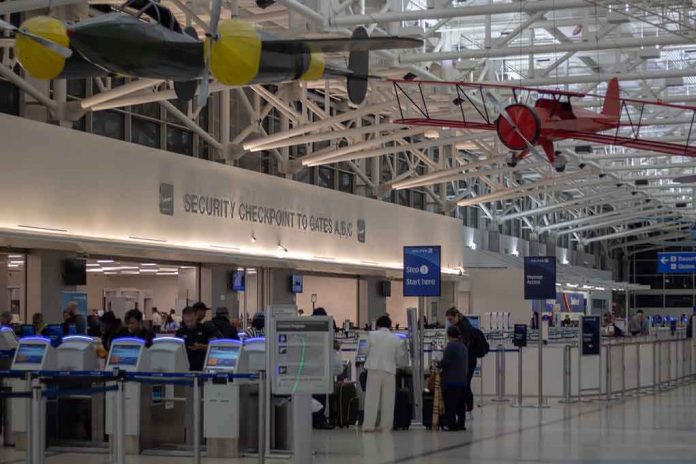
Airport arrests are where immigration enforcement, privacy law, and constitutional limits collide in full public view: once ICE turns a terminal into a target-rich environment, the legal question is no longer whether the agency has broad arrest power, but whether the way it uses that power stays inside the Fourth Amendment.
Intro Header
- ICE has sharply expanded arrests tied to U.S. airports, with reporting describing detentions at check-in counters, gates, jetways, and other terminal spaces.
- Airlines are not objecting to immigration enforcement in the abstract; they are objecting to the operational and legal risks of arrests unfolding inside secure passenger areas.
- The constitutional dispute turns on ordinary Fourth Amendment rules, not airport symbolism: warrantless immigration arrests still require a lawful basis, and reasonableness still matters.
- The broader pattern is a quota-driven enforcement system that treats airports as efficient choke points for finding people whose status has lapsed or is under review.
Why Airports Became a New Enforcement Choke Point
The recent airport crackdown is not a random shift in venue; it is a tactical choice that fits a larger enforcement strategy. Multiple reports describe ICE arrests inside terminals increasing under President Trump’s second term, with arrests tied to more than a dozen airports and a marked rise in airport-linked enforcement data compared with the period before his second inauguration. CBS reporting says arrests at airports became part of a broader summer surge in ICE custody numbers, driven by White House pressure to hit a daily arrest target. Once that incentive exists, airports become attractive because travel manifests, boarding information, and checkpoint encounters make people easier to locate than in neighborhoods or workplaces.
That is also why the cases feel so startling to travelers. The people being stopped are often not being intercepted after a long investigation; they are being identified because they are already in transit, sometimes after TSA and ICE data sharing has flagged them as noncitizens or as people whose immigration status has lapsed. In that sense, the airport is not merely a place of arrest. It is an enforcement funnel. What makes the setting legally and politically volatile is that a place designed for security screening is now being used for civil immigration seizures, which carries different constitutional assumptions and much higher visibility.
The Fourth Amendment Does Not Pause at the Terminal Door
The core legal issue is straightforward even if the facts of each arrest are not: the Fourth Amendment still applies to immigration-related arrests and detentions. Congressional Research Service materials say there are constitutional limits on ICE’s arrest authority and that the Amendment’s protections against unreasonable searches and seizures generally govern immigration enforcement. Legal guidance cited in the research also states that warrantless immigration arrests require, at minimum, a reason to believe the person is unlawfully present and likely to escape before a warrant can be obtained. That is the constitutional frame airlines and civil liberties groups are invoking when they object to arrest operations inside terminals.
Airport setting does not erase those limits. Border-search doctrine gives the government greater latitude at the international border, but that doctrine does not automatically convert a domestic airport into a constitutional free zone. The legal posture is therefore more exacting than the public rhetoric often suggests. ICE may have statutory arrest authority, and federal law does give immigration agents power to arrest and detain people believed to have violated immigration law, but that power remains bounded by ordinary rules against unreasonable seizure. Put plainly: the fact that a person is in an airport does not, by itself, substitute for probable cause, reasonable suspicion, or a lawful arrest basis.
Why Airlines Are Pushing Back
Airlines are not trying to litigate the entire immigration system; they are trying to keep federal arrests from spilling into the machinery of air travel. Reporting describes carriers and industry officials warning that detentions in gate areas, jet bridges, and boarding lines create safety risks for employees and passengers and disrupt operations in spaces where crowd control matters. That concern is practical before it is ideological. A terminal arrest can trigger confusion, delays, recording restrictions, and the presence of bystanders who are suddenly pressed into the middle of an enforcement action. Airlines have reportedly asked DHS to move enforcement earlier in the travel process so that arrests do not occur in the most sensitive passenger areas.
The industry’s objection also reflects an institutional instinct: airlines depend on predictable procedures. Immigration arrests carried out in civilian clothes, near boarding doors, can look indistinguishable to passengers from a private confrontation until badges appear and the person is removed. That ambiguity is precisely what produces the constitutional anxiety. When enforcement becomes a name-match exercise, fueled by shared data and conducted in public view, the risk of overreach rises; when that happens in an airport, the harm is not limited to the person arrested. It extends to the people around them, including airline workers who are expected to keep the operation moving while federal agents execute a seizure.
What the Airport Cases Reveal About Modern Immigration Enforcement
The airport arrests described in the reporting also show how modern immigration enforcement has changed in method. Instead of relying only on traffic stops, workplace sweeps, or home encounters, ICE appears to be using travel records and interagency data to identify people whose legal status has expired or whose applications are pending. That means the government can arrest someone at the point of departure without first staging a more traditional field investigation. The efficiency is obvious. So is the controversy. The same efficiency that makes airport arrests attractive to the agency is what makes them look, to critics, like a bureaucratic shortcut around the harder constitutional questions that arise when officers seize people in public.
There is a reason these cases generate such strong reactions from passengers and advocates. Some of the people swept up in the enforcement have been described as having pending asylum claims, pending renewals, or valid work authorization even as DHS says their underlying status had expired. That does not make every arrest unlawful. It does mean airport enforcement is often aimed at categories of people whose immigration posture is procedurally messy, not self-evidently criminal. The law can permit removal proceedings or detention in those circumstances; the difficult question is whether the particular stop, seizure, or transfer satisfied the constitutional standard at the moment it happened.
Airlines Are Interfering With ICE Arrests at Airports | Catherine Salgado, PJ Media
More than one major airline’s employees have illegally interfered with federal immigration officers as they were attempting to arrest foreign criminals.
The National Pulse reported on Tuesday… pic.twitter.com/raxcwNIuMQ
— Owen Gregorian (@OwenGregorian) August 12, 2026
The Real Dispute Is About Boundaries, Not Authority in the Abstract
The strongest reading of the evidence is that ICE’s airport operations are legally real, operationally effective, and constitutionally fraught at the same time. ICE has authority to arrest people suspected of immigration violations, and airport-linked enforcement has clearly expanded. But that authority is not unconfined. CRS and other legal materials in the record make the same basic point: civil immigration enforcement still sits inside the Fourth Amendment’s prohibition on unreasonable seizures. If an arrest is based on a lawful immigration ground and carried out with the necessary factual predicate, it may survive scrutiny. If it is little more than a rapid terminal apprehension based on thin information, the constitutional objection becomes serious.
That is why the airlines’ complaint matters beyond the immediate travel disruption. They are signaling that the government has chosen a setting where the stakes are high, the optics are harsh, and the legal standards remain unchanged. Airports are not exempt from the Constitution; they are just crowded places where constitutional mistakes become visible quickly. The practical result is a enforcement model that may be efficient for the agency, alarming for travelers, and hard for airlines to absorb without becoming unwilling participants in an immigration dragnet.
Sources:
reason.com, yahoo.com, aclu.org, americanimmigrationcouncil.org, ilrc.org, brennancenter.org, law.stanford.edu, lawblogs.uc.edu, cdn.vanderbilt.edu