

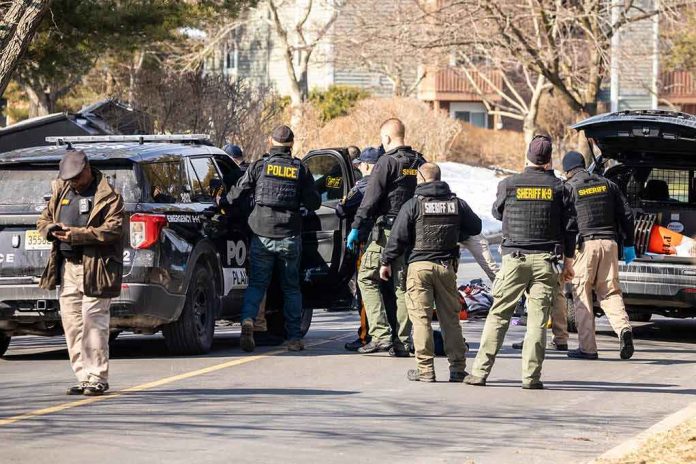
The core protection of the First Amendment is not polite speech; it is criticism that ruffles power. When police answer that criticism with handcuffs and a predawn raid, the legal system takes a hard look at motive—and, in this Tennessee case, an appellate court has already stripped away the key speech-based charge.
The Short Version
- A Kingsport, Tennessee resident who routinely films local police was arrested in a predawn home raid after posting videos critical of officers.
- His federal civil-rights lawsuit alleges the raid was retaliation for protected speech, including a video of an officer allegedly speeding and another showing an officer making an obscene gesture.
- Tennessee’s Court of Criminal Appeals later overturned his disorderly conduct conviction, finding no evidence his criticism impeded any lawful activity.
- The suit argues that filming and verbally criticizing police are protected; the appellate ruling undercuts the speech-based justification for the arrest.
What Happened and Why It Matters
The lawsuit Gibbons v. Phipps et al., filed in federal court, alleges that after Joshua Gibbons posted videos critical of Kingsport officers—including footage of a police SUV allegedly speeding without lights or siren and a separate clip of an officer flipping him off—department leadership approved a predawn raid on his home to arrest him. The complaint ties the enforcement action to the timing of Gibbons’s speech: the raid closely followed the late-night filming and public posting of the speeding video, the moment his channel drew public attention and complaint traffic about the officer’s conduct.
Gibbons was charged with disorderly conduct, speeding, and using a cellphone while driving. The speech-based count is the one that matters for First Amendment analysis, because courts scrutinize arrests that appear to rest on verbal criticism or public recording of officers. In June 2023, the Tennessee Court of Criminal Appeals unanimously vacated the disorderly conduct conviction, concluding there was no evidence Gibbons’s criticism prevented anyone from carrying out lawful activity—a central element of the offense. The appellate court’s language echoes longstanding doctrine: even vulgar or insulting criticism of police does not, by itself, convert protected speech into a crime.
How Retaliation Claims Work: Speech, Motive, and Pretext
First Amendment retaliation claims follow a clear framework. A plaintiff must show he engaged in protected speech, suffered an adverse action that would deter a person of ordinary firmness, and that the speech was a substantial or motivating factor in that action. Recording police in public is protected in every federal circuit to have reached the question; so is direct, even caustic, criticism of officers performing public duties. A predawn, multi-officer home entry culminating in arrest plainly qualifies as an adverse action. The contested question is motive: did speech animate enforcement, or did independent probable cause drive it?
Gibbons’s complaint argues motive through specificity and timing. It singles out the two videos—one showing the obscene gesture, another allegedly capturing departmental rule-breaking—and asserts that senior leadership “blessed” a home raid in direct response to the embarrassment those videos caused the department. Temporal proximity is not proof by itself, but it is probative; when a raid follows on the heels of public criticism and the speech-based charge later collapses on appeal, the inference of retaliatory purpose strengthens. The complaint seeks damages for this alleged retaliation and for the raid’s execution at an hour and scale designed to intimidate a critic.
The Criminal Case Outcome and Its Legal Weight
The appellate reversal does not, by itself, adjudicate retaliation; civil liability turns on motive and qualified immunity standards, not merely the correctness of the criminal conviction. But the reversal does important work. It removes the central legal justification that made this a speech case at all—the idea that Gibbons’s words transformed into criminal disorder. The appeals court said there was “no evidence” his criticism impeded lawful activity, which is functionally a finding that the speech, however sharp, remained constitutionally protected. That posture materially undercuts the city’s future reliance on disorderly conduct as a neutral, content-agnostic basis for the arrest.
Broader doctrine points in the same direction. The Supreme Court has long held that a city may not criminalize verbal abuse of police merely because it is offensive; the First Amendment “protects a significant amount of verbal criticism and challenge directed at police officers.” That principle—articulated in cases evaluating “contempt of cop” enforcement—reflects a recognition that officers are trained to absorb verbal provocation without resorting to punitive arrest. The Tennessee appellate panel’s reasoning tracks that lineage.
Mechanics of the Raid: Process, Discretion, and Optics
According to the complaint and contemporaneous reporting, the arrest warrant issued swiftly after Gibbons posted the speeding video, with a clerk—rather than a judge—signing the warrant packet, and the department deployed multiple armed officers for an early-morning entry at Gibbons’s home. While clerk-issued warrants can be lawful under state procedure, the optics of a predawn operation over misdemeanor-level allegations, centered on speech later deemed protected, will face exacting scrutiny in civil discovery. A raid communicates institutional seriousness; using that tool against a vocal critic invites the inference that the process punished the message, not the conduct.
This is where discovery will matter. Internal emails, body-camera footage, incident reports, and decision logs can either corroborate the lawsuit’s narrative or provide a content-neutral explanation of enforcement sequencing. But in evaluating what we already know, the legal weight of the appellate reversal and the tight timing between criticism and raid organize the facts into a coherent First Amendment retaliation theory.
How This Case Fits a National Pattern
Gibbons’s story sits inside a well-documented policing pattern: arrests that track perceived disrespect rather than public safety imperatives. These cases often begin with a citizen’s camera or a blunt verbal exchange and end with a contempt-of-cop charge that later evaporates in court. Civil liberties litigators have cataloged this arc for years, and appellate decisions across circuits have repeatedly vindicated the right to record and to criticize uniformed officers in public spaces. The underlying constitutional logic is simple and durable: government cannot penalize citizens for speech because it is embarrassing or inconvenient to those in power.
That logic has concrete implications for police practice. Departments reduce litigation risk when they train officers to distinguish between obstruction and insult, to de-escalate verbal provocation without resorting to custodial arrest, and to address alleged driving infractions or cellphone use with proportionate, ordinary process rather than tactical raids. The line between punishment for speech and enforcement for conduct is not merely theoretical; it is visible in charging choices, warrant affidavits, and deployment decisions.
They filmed a sergeant speeding with no lights. The department responded with eight guns at 5 a.m. and a warrant built on a one-minute drive-thru argument. That is the case. The criminal file is already dead. The civil file is where the city pays for teaching a family that… https://t.co/2J6ftrGGmy
— Durwin Lloyd, ND (ret) (@LloydDurwin) September 24, 2026
What Comes Next
The civil case will likely turn on documents and testimony that clarify who initiated the warrant process, how the raid was authorized, and whether Gibbons’s videos influenced those steps. The appellate reversal on disorderly conduct gives the plaintiff a strong platform to argue that speech animated the most punitive parts of the response. If discovery shows the department mined his channel or discussed reputational harm as a driver of enforcement, the retaliation claim strengthens; if the city produces content-neutral justifications with contemporaneous corroboration, its defense improves.
Either way, the constitutional baseline is settled. Citizens may film police in public. They may criticize officers—loudly, even crudely—without risking a criminal record for the words alone. When agencies reach for extraordinary tactics against vocal critics, they step onto terrain the First Amendment has already fenced off. This lawsuit asks whether Kingsport crossed that line; the appellate court’s decision suggests the criminal theory that bridged the gap from criticism to cuffs will not hold.
Sources:
foxnews.com, yahoo.com, townhall.com, supertalk929.com, wcyb.com