

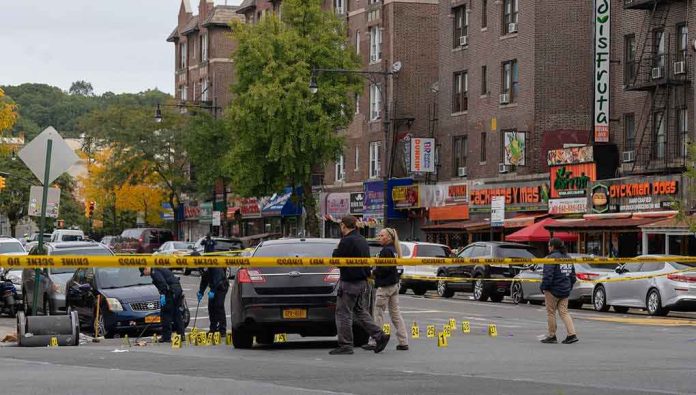
A family street festival built to celebrate Latin music and culture turned into a chaotic crime scene, raising fresh questions about public safety and trust in official messaging.
Story Snapshot
- Gunfire at Toronto’s Salsa on St. Clair festival left two men dead and at least four others wounded in a packed crowd of about 13,000 people.
- Police say this was an exchange of gunfire between individuals, not a lone active shooter, but the suspects are still at large.
- Officers recovered two guns and marked three crime scenes along the street, yet key details about who fired and why remain unclear.
- Confusing early “active shooter” alerts, shifting injury counts, and political reactions are feeding a wider sense that authorities and elites are failing to keep public spaces safe.
Deadly gunfire shatters a crowded Latin street festival
On Saturday evening in Toronto, gunfire erupted in the middle of the Salsa on St. Clair festival, a popular Latin street event that drew about 13,000 people to a busy stretch of St. Clair Avenue West. Toronto Police say two men were pronounced dead at the scene, and at least four other people were taken to hospital with serious gunshot wounds. The shooting turned a family-friendly celebration of music and food into panic and chaos as crowds fled for safety.
Deputy Chief Frank Barredo told reporters that investigators believe the incident was an exchange of gunfire between individuals, not a lone gunman randomly attacking the crowd. Police recovered two firearms and set up three separate crime scenes along the festival route to collect shell casings and other evidence. Officers stressed there was no ongoing threat to residents once the area was secured, saying they did not believe a shooter was hiding nearby or stalking festival-goers.
Confusing alerts, shifting numbers, and suspects still on the run
In the first minutes after the shots, police warned the public to avoid the area and treated the situation as a possible active shooter event, matching the language people in both Canada and the United States now know all too well. Later briefings walked that back, explaining that it appeared to be targeted gunfire between people who knew or were connected to each other, not a random attack on festival crowds. That shift in messaging, while based on new evidence, added to public confusion and fear about how clearly officials understand fast-moving events.
Basic facts also changed as the night went on, deepening doubts. Some outlets and officials reported five victims, while others later confirmed six people with gunshot wounds. Toronto police have not yet said whether the two men who died were among the shooters or bystanders caught in the crossfire, leaving families and neighbors unsure who was targeted and who was simply unlucky. No arrests had been announced at the time of the main police briefing, and officers said suspects were still believed to be at large, triggering a wider manhunt across the city.
Community shock and political noise after a rare Canadian festival shooting
For many Canadians, gunfire at a packed street festival feels especially shocking because such public mass casualty events are rare compared with the United States. An earlier analysis of Canadian gun culture noted that people there largely expect public spaces to be safe and see shootings in open, symbolic places as almost unthinkable. That sense of safety is shaken when families have to sprint down alleys, as seen in doorbell camera footage, just to escape bullets at a neighborhood celebration.
Local workers and attendees described deep sadness and anger that a beloved cultural event ended in bloodshed and cancellation, with organizers scrapping the festival’s final day out of respect for victims and to allow police to investigate. At the same time, political voices quickly used the shooting to push broader arguments about crime and guns. Commentators like Mark J. Carney posted that Toronto and Canada have “a real big problem with crime and guns on the street,” urging national leaders to make this a priority and feeding a narrative that everyday people are paying the price while elites talk.
Video evidence, unanswered questions, and growing distrust
Investigators now face a complex puzzle that reaches beyond normal police work. With thousands of people at the festival, officials are asking witnesses to share cellphone and security videos that may show who fired, where they moved, and how the exchange of gunfire began and ended. Police forensic teams are studying the recovered guns for ballistic matches to other crimes and possible links to gang activity, trying to see if this was a one-time clash or part of a larger pattern.
BREAKING | Two Killed, Four Injured in Shooting at Toronto Street Festival
Two people were killed and four others injured after an exchange of gunfire at the Salsa on St. Clair Festival in Toronto Saturday night.
Police say two individuals exchanged gunfire in a crowd of… pic.twitter.com/YTBvwNZOUX
— Citizen (@CitizenApp) July 12, 2026
Autopsy reports, witness interviews, and camera footage may eventually clarify whether the dead men were shooters or victims and how many people fired shots, yet those answers will take time. In the meantime, many on both the left and the right see the same troubling picture: crowded public spaces feel less safe, basic facts about major incidents are muddy, and powerful figures respond with talking points more than solutions. For a growing number of citizens, in Canada and the United States alike, episodes like the Salsa on St. Clair shooting reinforce a belief that the people in charge are not doing enough to protect ordinary families from senseless violence.
Sources:
thegatewaypundit.com, 6abc.com, youtube.com, instagram.com, facebook.com, nytimes.com, nbcdfw.com, nanaimonewsnow.com, cbc.ca, english.news.cn