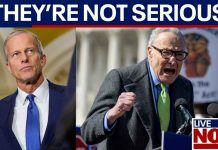
Joy Behar’s latest defense of Don Lemon didn’t just excuse a church disruption—it invoked Dachau, turning a political stunt into a shocking insult to faith and history.
Quick Take
- Joy Behar defended Don Lemon’s role in a Minnesota church disruption and compared his “journalism” to Eisenhower documenting Nazi camps like Dachau.
- The incident stems from a January 18 disruption at Cities Church in St. Paul, where activists confronted a pastor believed to be tied to ICE while Lemon filmed and praised the action.
- Lemon later faced federal charges under the FACE Act, a law used to penalize interference at protected locations, including religious sites.
- Conservative critics argue Behar’s comparison trivializes the Holocaust and normalizes intimidation of worshippers under the banner of activism.
Behar’s Dachau Comparison Sparks a New Flashpoint
Joy Behar used a segment on ABC’s The View to argue that Don Lemon was acting as a journalist during a church disruption in Minnesota, then escalated the defense by praising Lemon in the same breath as Dwight D. Eisenhower. Reports describe Behar likening Lemon’s actions to Eisenhower’s documentation of Nazi concentration camps such as Dachau. The remark triggered backlash because it treated a domestic political protest at a Christian church as morally comparable to exposing industrial mass murder.
Behar’s defense also leaned on a familiar media narrative: that the Trump administration is targeting journalists to suppress “truth-telling.” The available reporting does not show that Lemon was charged for publishing reporting or questioning officials. Instead, coverage centers on his behavior during the disruption and whether that crossed legal lines. The result is a political argument about press freedom being stapled to an incident that many Americans saw as harassment of worshippers.
What Happened at Cities Church in St. Paul
The dispute traces back to January 18, when activists entered Cities Church during a service in St. Paul, Minnesota, protesting claims that a pastor held a role connected to ICE enforcement. Accounts say the group halted proceedings and confronted congregants, with footage described as showing children fleeing and a man yelling at worshippers. Lemon, a former CNN host now operating independently, filmed the scene and publicly praised the activists, with commentators portraying him as a “hype-man” rather than an observer.
On January 19, Lemon publicly thanked the protesters, and clips continued to spread online. Later in January, he faced federal charges under the FACE Act. The research provided describes the statute as applying to religious sites as well as clinics, and the case has been framed by critics as a test of whether public figures can help drive disruptive confrontations at protected venues and then claim a press label afterward. Publicly available details in the provided sources are limited to summaries and commentary rather than full charging documents.
The Legal and Constitutional Question: Speech vs. Disruption
The central issue is not whether the left or right can criticize ICE or protest government policies; Americans retain broad First Amendment rights. The issue is whether physically disrupting a worship service and encouraging the crowd crosses into illegal interference—especially when a federal law like the FACE Act is involved. The reporting summarized here indicates Lemon’s defenders argue “journalism is not a crime,” while critics respond that recording an incident is different from helping energize it.
From a conservative constitutional perspective, the distinction matters. Free speech protects commentary and reporting, but it does not automatically immunize conduct that blocks, intimidates, or interferes with people peaceably exercising their own rights—here, the free exercise of religion. The available research does not resolve how a court will interpret Lemon’s precise role, but it shows why the incident resonates: many families see it as political activism exported into the one place Americans expect to be left alone.
Media Defenses, Selective Outrage, and a Credibility Problem
After Lemon’s legal trouble became public, the research notes that CNN figures defended him and warned about a chilling effect on journalism. Conservative outlets, meanwhile, focused on the footage and the tone of Lemon’s commentary, arguing it looked like participation rather than documentation. The competing claims highlight a broader credibility fight: Americans who watched legacy media excuse street-level intimidation in recent years are skeptical when those same voices suddenly present themselves as guardians of civil liberties.
Behar’s Dachau reference intensified that skepticism because it did not merely defend Lemon’s rights; it sought moral elevation by tying him to a moment of world-historic evil. The reporting also points to past media controversies involving Holocaust analogies and consequences that appeared inconsistent. Whether ABC takes any action is unclear based on the provided research, but the political impact is already evident: the story hardened perceptions that elite media circles apply one standard to their allies and another to everyone else.
For the Trump-era policy landscape, the immediate takeaway is practical. If prosecutors proceed under statutes meant to keep protected venues accessible, future activists may think twice before targeting churches for political theater. If media figures continue to blur the line between reporting and participation, the public will keep questioning whether “press freedom” arguments are being used to launder conduct most Americans would never tolerate at their own place of worship.
Sources:
Joy Behar roasted for ‘idiotic’ and ‘dishonest’ comparison for Don Lemon joining mob in a MN church
Top 10 Worst Media Reactions: Don Lemon’s Arrest