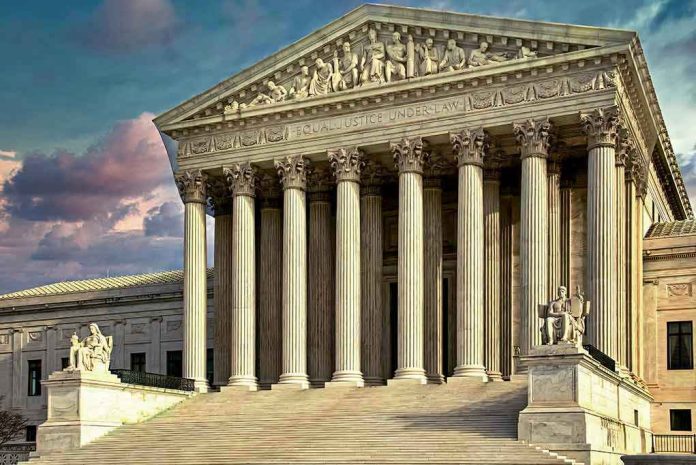
The Supreme Court’s quiet refusal to back Trump officials on immigration judges’ speech rules exposed just how far the legal establishment will go to protect its grip on the system—even when voters demanded change.
Story Snapshot
- The Supreme Court declined a Trump administration request on immigration judges’ speech restrictions, ending a long emergency-docket win streak.
- The dispute highlights how deeply entrenched the immigration bureaucracy remains, even under presidents promising tougher enforcement.
- The emergency docket, once reliably favorable to Trump-era policies, now shows limits when internal government speech rules are involved.
- Conservatives see the case as a warning about unelected officials and legal elites still steering immigration policy from the shadows.
Supreme Court Halts Trump’s Emergency-Docket Momentum
The Supreme Court refused to intervene in a fight over restrictions on what immigration judges can say publicly, breaking a months-long streak in which Trump administration requests had repeatedly prevailed on the Court’s emergency docket. Until this case, Trump’s team had used emergency applications to keep key enforcement policies alive while lower courts battled over them. The justices’ refusal signaled that even a Court often seen as more conservative will draw a line when internal speech rules, not direct border actions, are at issue.
Immigration judges had challenged government-imposed limits on their public speech, including rules on giving talks, writing articles, or commenting on immigration policy outside the courtroom. The Trump administration defended those restrictions as standard workplace controls on officials speaking in their official capacity. Critics, however, argued that the rules chilled judges who wanted to expose systemic failures, lenient practices, and backlogs that frustrate enforcement. When the Supreme Court declined to step in, it effectively left lower-court skepticism of those restrictions in place, at least temporarily.
Immigration Bureaucracy and the Battle Over Who Sets the Narrative
The dispute over immigration judges’ speech goes beyond workplace policy and cuts to who controls the narrative on America’s broken border system. Immigration judges sit inside the executive branch, not the independent judiciary, and historically operate under tight supervision from the Department of Justice. Trump officials argued that because these judges are executive employees, the administration must be able to limit outside commentary that could undercut active cases or official messaging. Opponents countered that without open criticism, the public cannot see how deeply the system undermines serious enforcement.
For conservatives who watched years of catch-and-release, sanctuary policies, and courtroom activism, the case underscored how immigration enforcement is still shaped behind closed doors. Even when voters elect a president promising strong borders, career officials and legal advocacy groups continue to push back from the inside. The fight over judges’ speech restrictions became another proxy war over whether the federal bureaucracy answers to the president and the people, or to its own internal culture and outside pressure from progressive legal networks determined to keep the system lenient.
The Emergency Docket’s Limits and What It Means for Future Fights
The emergency docket, sometimes called the Court’s “shadow docket,” had become one of the Trump administration’s most important tools for keeping policies alive while litigation dragged on. From immigration enforcement to regulatory rollbacks, quick Supreme Court orders often allowed Trump rules to remain in effect after lower courts tried to shut them down. The immigration-judge speech case showed that this fast-track path is not automatic, even when the administration previously enjoyed a long winning streak, and even with justices appointed by Republican presidents.
For constitutional conservatives, that outcome is a double-edged signal. On one hand, it shows the Court will not rubber-stamp every executive branch request, preserving a check on government power that the Framers intended. On the other hand, it reminds Trump supporters that legal victories are never guaranteed, even on a Court with several justices picked by Republican presidents. The refusal to intervene signals that future border and immigration fights must be built on the strongest possible factual records and legal arguments, leaving less room for internal agency rules that can be portrayed as silencing dissent.
What This Means for Trump’s Second Term and Conservative Priorities
As Trump’s new administration works to dismantle Biden-era open-border policies, this earlier setback on immigration judges’ speech is a cautionary tale. Efforts to secure the border now focus on clearly constitutional levers: shutting down mass parole, tightening asylum standards, building physical barriers, and cutting off incentives that draw illegal crossings. Those moves directly serve voters’ demands for sovereignty and law and order. Internal rules about who can speak will still matter, but they are no substitute for concrete policy that survives serious court scrutiny.
For readers frustrated by years of unchecked illegal immigration, this episode confirms that the real battle is not just at the ballot box or the border fence, but inside the legal system itself. A single Supreme Court order cannot fix decades of activist rulings, bloated bureaucracy, and entrenched resistance to enforcement. Trump’s constitutionalist supporters will need to keep pressing for judges, lawmakers, and agency leaders who respect the rule of law, protect American communities, and refuse to let backroom procedures weaken the nation’s borders again.