

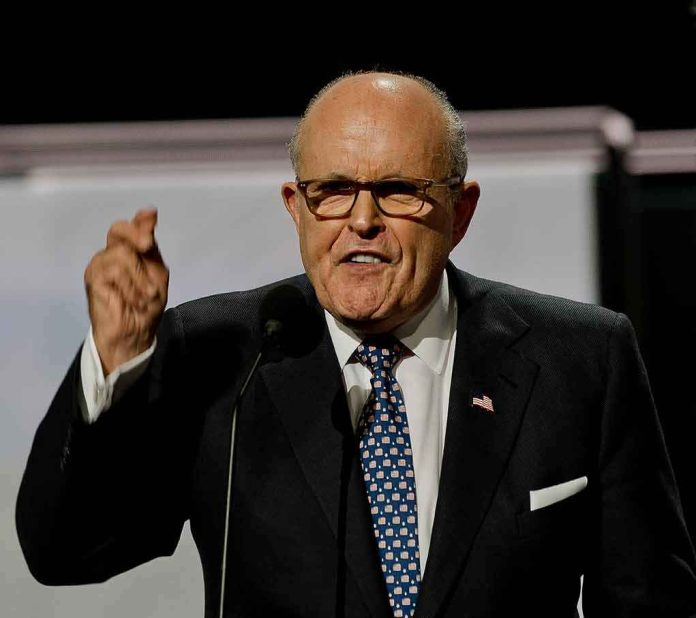
President Trump’s decision to award Rudy Giuliani the Presidential Medal of Freedom forces a question the honor itself was never designed to settle: can a single ribbon and medallion hold both the man who steadied a grieving city in September 2001 and the lawyer whose post-2020 conduct ended in disbarment and a nine-figure defamation judgment. The ceremony happened. The praise and the backlash both happened. Neither cancels the other out.
Key Points
- President Trump awarded Giuliani the Presidential Medal of Freedom in a closed-door Oval Office ceremony, citing his leadership as New York City mayor, particularly after the September 11 attacks
- The White House statement and Trump’s own announcement emphasized Giuliani’s crime-reduction record and crisis leadership, not his later legal career
- Giuliani was disbarred in New York and Washington, D.C., and ordered to pay $148 million in a defamation judgment to two Georgia election workers over false 2020 fraud claims
- The award fits a documented historical pattern: presidents routinely use the Medal of Freedom to honor political allies and shape their own legacies, not only to recognize apolitical achievement
- Reaction split almost entirely along the same lines that have defined Giuliani’s public life for the past five years — admiration for the mayor, condemnation for the post-election lawyer
What Was Announced, and What the White House Said
The award was not a surprise sprung on the public. President Trump first floated it in a White House statement calling Giuliani “the greatest Mayor in the history of NYC, and an equally great American Patriot” who would receive “our Country’s highest civilian honor”. More than a year later, the ceremony itself took place in the Oval Office, with Giuliani telling Steve Bannon’s War Room audience beforehand that he was “very, very humbled” by the honor. A White House spokesperson, Olivia Wales, described him as a “dedicated public servant whose decisive leadership has left a lasting impact”, language that echoed a later statement calling him “America’s Mayor”.
The citation the administration offered rests almost entirely on two chapters of Giuliani’s career: the sharp decline in violent crime in New York City during his mayoralty, and his visible, steadying presence in the city in the days after the September 11 attacks. Both are real and well-documented. What the citation did not mention, and what nearly every independent news account paired alongside it, was the quarter-century-later coda to that career — his role as President Trump’s personal attorney during the effort to contest the 2020 election result.
https://www.youtube.com/watch?v=gk7coJlEt-E
The Mayoralty: A Record Historians Still Argue Over, But Rarely Dismiss
Giuliani’s claim to the honor begins with numbers that are, by any measure, extraordinary. New York City’s murder count exceeded 2,000 a year in the early 1990s; within several years of his taking office it had fallen below 1,000, and it continued falling after he left City Hall. His son, speaking publicly after the ceremony, cited the same trajectory — below 700, then below 300 within a few years of Giuliani’s departure — crediting his father’s policies for turning “the self-proclaimed rotting apple” into what later became the safest large city in the country. National Bureau of Economic Research analysis of the period found that aggressive policing strategies, including the “broken windows” approach to low-level offenses, explained a meaningful share of that decline, with violent crime falling by more than half and property crime by nearly two-thirds across the 1990s. Scholars still dispute how much of that drop belongs to Giuliani’s specific policies versus a national crime decline underway in nearly every large American city during the same decade. But no serious account disputes that New York’s turnaround was real, or that Giuliani was its most visible architect and its loudest advocate. That record, and his composed public leadership in the days after September 11, 2001, is the foundation the White House built its citation on — and it is a foundation that would, on its own, have made him an uncontroversial choice for the honor decades ago.
The Complication the White House Citation Left Out
The trouble is that Giuliani’s public identity did not freeze in 2001. In the years after the 2020 election, he became the most visible legal face of President Trump’s effort to overturn the result, advancing fraud claims that courts across multiple states rejected. That campaign produced consequences that followed him for the rest of the decade: disbarment in both New York and Washington, D.C., an indictment in Arizona connected to a fake-elector scheme, status as an unindicted co-conspirator in the special counsel’s investigation into 2020 election efforts, and — most costly of all — a $148 million defamation judgment won by Georgia election workers Ruby Freeman and Shay Moss, whom Giuliani had falsely accused of ballot fraud. Critics of the Medal of Freedom decision, including legal analysts and former Trump administration officials who spoke out after the ceremony, argued that honoring Giuliani now effectively absolves or minimizes that record. One pointed comparison circulating among critics invoked Aaron Burr — a Revolutionary War officer whose later conduct against the young republic ensured he was never honored despite his earlier service, the implicit argument being that medals are supposed to weigh a life in full, not just its most flattering chapter.
Is This Unusual? What the History of the Medal Actually Shows
Here the evidence cuts against the idea that this award represents some unprecedented politicization of the honor. A comprehensive academic analysis of every Presidential Medal of Freedom awarded between 1963 and 2013 found that presidents consistently favor recipients from their own party and that political and public service was, in fact, the single most common category of achievement among recipients — roughly 27 percent of all medals awarded, ahead of the arts, academia, and science combined. The same research found that presidents frequently use the ceremony for legacy-shaping and to reward political loyalty, though the public approval bump that might justify the political cost rarely materializes. Giuliani’s medal, in other words, fits an established pattern rather than breaking from one — it is a more pointed example of a practice every modern president has engaged in, not a departure from the norm.
U.S. President Donald Trump has conferred the nation’s highest civilian honour, the Presidential Medal of Freedom, on his longtime ally Rudy Giuliani.https://t.co/I8DYBuujVA
— News Central TV (@NewsCentralTV) November 25, 2026
What the Award Signals Going Forward
The split reaction to Giuliani’s medal is unlikely to resolve, because it isn’t really a dispute about facts — both sides agree on what happened in 1990s New York and what happened in the courts after 2020. It is a dispute about which chapter of a public life should carry more weight when a president confers the nation’s highest civilian honor. Supporters treat the medal as recognition of concrete, measurable achievement: a city made safer, a crisis led through with visible composure. Critics treat it as a signal that loyalty to a president’s political battles can outweigh professional disgrace in the calculus of official honor. Both readings are defensible from the same set of facts, which is precisely why this award will likely be remembered less for what it says about Giuliani than for what it confirms about how the Medal of Freedom itself now functions — as a tool of presidential legacy-building as much as a neutral verdict on a life’s work.
Sources:
onairwithryan.iheart.com, usatoday.com, hawaiinewsnow.com, x.com, ny1.com, ms.now, nber.org